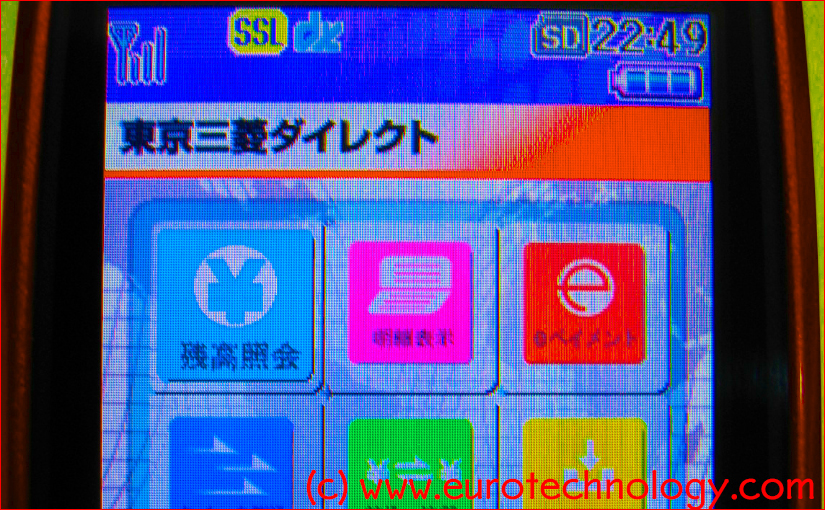
DoCoMo has upgraded radio networks to 3.6 Mbps in the Tokyo region, and NEC’s N902iX handsets will be released very shortly.
DoCoMo has upgraded 3G networks in the Tokyo region to 3.6 Mbps (data download) in the Tokyo region using HSDPA technology (HSDPA = High-Speed Downlink Packet Access), and will soon sell NEC’s N902iX handsets. HSDPA upgrades will come to the Kansai (Osaka/Kyoto/Kobe) region from autumn 2006.
DoCoMo announced that during 2007 the data uplink (sending data from mobile phones) will be upgraded to 1 to 2 Mbps, which is a substantial improvement to FOMA’s present 64 kbps upload speed.
DoCoMo/FOMA download speed: 3.6 Mbps (summer 2006 in the Tokyo region, Osaka/Kansai and other regions to follow)
DoCoMo/FOMA upload speed: 1 … 2 Mbps (from 2007)
NEC mobile phone handset N902iX for NTT docomo’s HSDPA network
Vodafone quits business in Japan having sold all operations to SoftBank
Photographs below show the world famous Vodafone board on Tokyo-Shibuya’s Hachiko-square being replaced by the SoftBank advertisement from June 14, 2006.
SoftBank acquired Vodafone-Japan and rebranded to SoftBank mobile on June 14, 2006
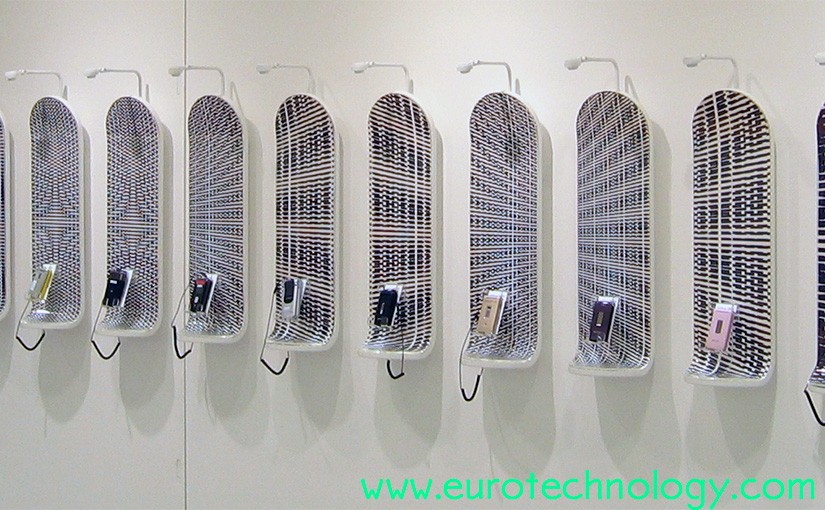
Cheese phones anyone?… Vodafone “cheese phone” and “car tire phone” posters replaced by SoftBank posters on Tokyo’s Yamanote Line
Vodafone had difficulties to manage the relationships with Japanese mobile phone manufacturers, and as a consequence Vodafone’s pipeline of new mobile phone models dried up, while competitors KDDI and Docomo of course continued to introduce seasonal spring, summer, autumn and winter collections of attractive 3G phones which many special functions such as location services, GPS, color screens, autofocus cameras – functions which at that time were only available in Japan and nowhere else globally.
Since Vodafone had few attractive phones, Vodafone switched to covering old models with cheese, mint ice cream and car tire plastic covers to give them a new outside make-up. Of course this course contributed to the exodus of subscribers from Vodafone to competing customers, which eventually led to the sale of Vodafone-Japan to SoftBank, which turned around the former Vodafone-Japan company within a few months.
Swiss Emmentaler cheese covered phone for Japan???
Rebranding advertisement boards along Tokyo’s Yamanote ring line. Noteworthy are the cheese, cow, car tire and ice cream bar shaped mobile phone covers, which Vodafone offered because it was short of new phone models, and which did not help to improve Vodafone’s brand in Japan – cheese phones anyone?
Understand Softbank: our report: “SoftBank today and 300 year vision”
NTT Docomo CEO: Japanese leadership in the Wall Street Journal
Wall Street Journal, in the section “Leadership Question of the Week”, on Monday June 12, 2006 on page 31, published an article I wrote about a very extraordinary experience I had several years ago at the German Embassy here in Tokyo, with Dr. Keiji Tachikawa (立川敬二) – then CEO of NTT-DoCoMo (Dr. Keiji Tachikawa has since then moved on to become the head of Japan’s Space Agency JAXA).
Please find the unedited manuscript here (the actual published version was shortened a bit).
Leading in Asia:
What was the best business advice you received and who gave it to you?
The best business advice I received in Japan was from the former NTT Docomo CEO, Dr. Tachikawa – he taught me that when two parties do business, both parties have to profit/benefit – not just one party. He also taught me to go straight to the point, not waste time with irrelevant things.
Here the story in more details:
I had met Dr. Tachikawa at a reception at the German Embassy – purpose of the reception was to bring together German and Japanese leaders in telecommunications and mobile phones.
I noticed that Dr. Tachikawa, then NTT Docomo CEO, was standing for quite some time at the window, looking out into the beautiful garden of the Embassy with no one to talk to.
Why was Dr Tachikawa standing alone with no-one to talk to? My explanation was that the Japanese CEOs at this reception were mainly from DoCoMo’s suppliers, and therefore probably too shy to talk to Dr Tachikawa since Japanese business customs places these suppliers on a lower social ranking than their major customer DoCoMo. On the other hand, the German CEOs who had come from Germany, probably did not know who it was who was standing lonely at the window.
So I approached Dr Tachikawa and we talked quite a while – all in Japanese.
His first question after the initial introduction was very surprising – Dr Tachikawa asked me, how our company makes money, where our income comes from.
Having been CEO of our Tokyo based company for the last 10 years, I am very often asked where our company’s offices are located, how big our office is, how many people we employ and other irrelevant conversational detail., Dr. Tachikawa did not ask any of these irrelevant things – he went straight to the point: how do we make money. In my almost 10 years as CEO in 1000s of conversations, Dr Tachikawa was almost the only manager (Western and Japanese) who went straight to the point not losing time over irrelevant details.
A few days later I received an email from Dr Tachikawa inviting me to his office at DoCoMo’s headquarters to discuss possibilities of cooperation between NTT-DoCoMo and our very small company Eurotechnology Japan KK which I had founded about 10 years ago here in Tokyo.
I was amazed by Dr Tachikawa’s kindness. A few days later I spent about one hour in his office at the top floor of Sanno-Tower at DoCoMo’s headquarters, right next to the Prime Minister’s Office.
I had prepared four proposals and towards the end of our conversation I showed these four proposals to Dr. Tachikawa. He rejected three of them, and decided that DoCoMo was interested in one of my proposal.
I learn a lot from his way of action – he immediately took three decisions about the one proposal he was interested in:
he said that we must now find a way that both our company profit from this plan
he decided who within DoCoMo would be responsible to carry this project out with our company, and
he decided where the source of the budget for this project should be
I have been working 20 years with Japan now – and Dr. Keiji Tachikawa is certainly the Japanese manager I learnt most from, in the meetings I was lucky enough to have with him.
Speed of the essence: SoftBank loses no time to turn around Vodafone-Japan
Vodafone’s withdrawal also shows, that the values of cross-cultural management skills are often underestimated
by Gerhard Fasol
SoftBank rebrands Vodafone Japan: Saturday June 10, 2006 was the first time we saw SoftBank replacing the Vodafone brand in Japan – bringing a formal end to Europe’s largest ever investment in Japan.
Vodafone’s withdrawal from Japan is a turning point in more ways than one and has wider implications for Europe (read below).
Rebranding from Vodafone to SoftBank after SoftBank acquired Vodafone Japan
Upper image shows the world-famous Vodafone board on Shibuya’s hachiko square, which has appeared in many movies and TV shows. It will soon be replaced.
Lower image shows one of the first SoftBank advertisements in Tokyo’s busiest commuter railstation Shinjuku showing Sharp’s mobile-TV handset.
Implications for Europe of Vodafone’s withdrawal from Japan
As a European myself, I am looking at the wider implications for Europe of Vodafone’s withdrawal from Japan – and our company was recently awarded a contract by the European Union Government on exactly these issues – as well as others.
Vodafone’s investment was by far the largest European investment in Japan. What is maybe less well known is that Vodafone was dispatching a relatively large stream of managers between several continents (Europe, Australia etc) and Japan. Several times when visiting the KDDI Designing Center for example I could meet young German Vodafone managers who had just arrived for a management position at Vodafone-Japan, and who were studying the mobile phone handsets in KDDI’s showroom. These expatriates all left within a few weeks of SoftBank taking control of the company.
As a result of these interactions, Vodafone could bring J-Phone’s J-Sky mobile internet service to Europe, which was adapted for European conditions and rebranded “Vodafone Live!”. There would be no “Vodafone Live!” in Europe without Vodafone’s acquisition of J-Phone (including JSky). Vodafone also brought SHARP and Toshiba mobile handsets to Europe.
Apart from the immediate impact on Vodafone as a Corporation, we expect also a more general longterm impact from the strong reduction of Europe-Japan technology exchanges due to Vodafone’s withdrawal from Japan.
Vodafone’s withdrawal from Japan also shows how difficult it is for European telecom firms to succeed in Japan – and for Japanese firms in the telecom sector to succeed in Europe. Our company knows this first-hand from our work for NTT-Communications, and some other Japanese companies. – Read our presentation to Japanese industry associations here (in Japanese language).
Underestimating the importance of cross-cultural management skills and the associated perils
While large US corporations, including INTEL, General Motors, and Motorola have been forced by confrontation with Japan’s competition to completely reshape themselves, this has not yet happened to any large European corporation because of the larger perceived separation between EU and Japan.
DoCoMo plans to sell BlackBerry to corporates in Japan
With the RiM/NTP patent infringement lawsuit settled with a US$612.5 million payment, DoCoMo and Research in Motion (RiM) announced on June 8, 2006 that DoCoMo plans to start selling BlackBerry in Japan from autumn 2006 to corporate customers. Will RiM invest US$ 612.5 million to build business in Japan? Less? or more?
Over the last years I was asked 100s of times by foreign CEOs and expatriate managers why BlackBerry does not work and does not exist in Japan. Several large global corporations also asked us for work arounds to get solutions in place for Japan which fulfill the job of BlackBerry. Finally, also several venture companies came to us which supply secure corporate email solutions and corporate scheduling applications similar to BlackBerry’s offerings.
Which BlackBerry device will DoCoMo offer
Although we have not seen an official announcement of the precise BlackBerry device DoCoMo will offer, we assume that it will be based on the Blackberry 8707 device.
We have also heard the following details:
The planned BlackBerry for Japan will work on DoCoMo’s FOMA (wCDMA) network in Japan, and will also have in-built connectivity for GSM and GPRS (2G legacy networks which are and will be in use for a long time to come in most countries outside Japan)
The initial BlackBerry device will have no Japanese input, which restricts the device to foreign expatriates in Japan, and guarantees to keep BlackBerry initially out of the mainstream Japanese market. This means that the initial market will be mainly managers in foreign subsidiaries in Japan. Those managers who are integrated into Japan’s business world and private world, will need a separate local Japanese mobile phone to communicate and exchange email messages with their Japanese colleagues
Why was there no BlackBerry in Japan?
For a number of reasons:
RiM did not invest in Japan
RiM reached no agreement with Japan’s mobile operators
BlackBerry until recently did not work with 3G (wCDMA/UMTS) which dominates in Japan
Also, BlackBerry’s QWERTY keyboard gives no advantage for Japanese language input
and finally, Japanese mobile phones with added software already provide most functions of a BlackBerry (and a lot more functions which BlackBerries cannot do)
What are BlackBerry’s prospects in Japan? Will BlackBerry be successful in Japan?
The key issue will be whether RiM invests sufficiently to succeed in Japan. Foreign telecom firms – including some of the most famous – have a record of underinvesting in Japan, and as a consequence to fail, or to remain trapped with a 0.5% market share. Will BlackBerry remain focused on the niche foreign executive market, or will BlackBerry expand into the much bigger mainstream in Japan?
The success of Willcom’s W-ZERO is an indicator that BlackBerry might be successful beyond the expatriate market.
What will make success difficult for BlackBerry in Japan?
Success is not at all guaranteed for BlackBerry in Japan. We see as key issues:
according to our information BlackBerry will not allow Japanese language input
apparently BlackBerry will not support i-mode. Lack of i-Mode automatically cuts BlackBerry out of Japan’s mainstream
RiM will need to fulfill DoCoMo’s quality requirements, which tend to be higher then those in other markets
RiM’s art will be to balance necessary investments and profitability requirements
On June 8, 2006, DoCoMo and Research in Motion (RiM) announced that DoCoMo will start marketing RiM’s BlackBerry to corporate customers from autumn 2006.
DoCoMo will offer a version of BlackBerry which will use wCDMA (FOMA) 3G network connection in Japan, and will also be able to operate on legacy GSM/GPRS networks which are still in common use in other parts of the world (there is no and there has never been any GSM network in Japan).
SoftBank acquires Vodafone’s Japan operations, announces turnaround strategy
SoftBank turnaround for Vodafone-Japan: Focus on customer service and increased investments
by Gerhard Fasol
SoftBank has acquired Vodafone-Japan (Vodafone KK) and will change the name to SoftBank Mobile.
SoftBank‘s alliance with APPLE to develop iPod-mobile phones is the latest in a string of actions to take the former J-Phone back onto the growth track before Vodafone acquired it. One day after announcing the acquisition, SoftBank announced a target of 26 million subscribers (compared to today’s 15 million).
SoftBank turnaround: five point strategy to turn around Vodafone-Japan
A few days after acquiring Vodafone-Japan, SoftBank announced a five point SoftBank turnaround program for Vodafone Japan, which is now well on-track:
1. Continued use of mail addresses:
SoftBank has learnt from Vodafone that it does not pay to force 15 million subscribers and all their friends and acquaintances to change email addresses …
2. Strengthen the shops and customer service:
SoftBank is reversing Vodafone’s store strategy – SoftBank has started to recruit full-time regular employees for it’s stores, and plans to sell APPLE products and iPod phones in the stores.
3. Rebranding – Change to an easy-to-understand and familiar company name:
The brand “Vodafone” will be replaced by SoftBank Mobile.
4. Stepping up capital investment:
On Friday April 21, 2006, SoftBank announced the decision to increase the investments to YEN 250 billion to increase the number of 3G base stations from 20,000 to 30,000. This is a reversal of Vodafone’s initial strategy to dramatically cut investments in Japan during it’s ownership of J-Phone/Vodafone KK (for graphics of investment data by Japan’s operators see our blog)
5. Synergies with SoftBank BB, Japan Telecom and YAHOO:
Softbank now reunites the former Japan Telecom – which Softbank has acquired in two steps from Vodafone. First Vodafone acquired the fixed line operations via Ripplewood and now the former mobile subsidiary of Japan Telecom from Vodafone. Synergies between YAHOO-Japan and SoftBank’s new mobile operations are particularly interesting and promising – think mobile auctions… now SoftBank is moving further into eBay’s territory in Japan, or what is eBay’s territory anywhere else in the world, except in Japan.
According the headline report in Nihon Keizai Shinbun (the world’s largest business daily) on Saturday May 13th, Apple’s CEO Steve Jobs and SoftBank’s Chairman Masayoshi Son met recently, and are developing a joint mobile phone with iPod and iTunes functions.
On March 17 SoftBank announced the full acquisition of Vodafone’s Japan subsidiary – the former J-Phone. Thus SoftBank has acquired a 20% piece of the global Vodafone-Group, propelling SoftBank into the global top-league of telecom players. Within a few days SoftBank announced a string of actions to bring the former J-Phone back onto it’s former growth track. Read below – and read a detailed analysis of the APPLE/SoftBank cooperation in today’s May 15 version of our Mobile Music report.
Is it pure coincidence that DoCoMo and Microsoft announced a music cooperation just one or two days before the APPLE/SoftBank iPod cooperation made headlines?
Apple/SoftBank iPod mobile phones have the potential to:
revolutionize Japan’s mobile phone market
accelerate the shift of the music industry’s business model from CDROM sales to mobile music for mobile phones
make APPLE a global mobile phone handset brand in the NOKIA league
put pressure on DoCoMo which has been falling behind in the mobile music sector
enable Vodafone to offer Softbank/APPLE/Vodafone/iPod phones globally via Vodafone’s recently announced Softbank joint venture for handset development
Implications of an Apple/SoftBank iPod mobile phone
Revolutionize Japan’s music business landscape: about 20% of Japan’s music sales are to mobile phones, while internet music downloads are almost neglibile in comparison. Therefore iTunes cannot have much impact in Japan if limited to internet downloads. iTunes downloads to mobile phones will change the business models of Japan’s music industry.
SoftBank could leapfrog DoCoMo which is already about 1-2 years behind KDDI/AU in the mobile music arena.
iTunes pricing is far below established mobile phone music prices in Japan
Pressure on DoCoMo and KDDI/AU: Success of an iTunes/SoftBank mobile phone will put strong pressure on DoCoMo and KDDI/AU: a “must have” iPod mobile phone can be a huge advantage for SoftBank when number portability arrives this autumn.
Global impact: Success of an APPLE/SoftBank phone could put APPLE on track towards a global mobile phone brand competing with the NOKIA’s of this world
Impact on Apple: APPLE could leverage it’s design power, it’s user interface principles, and brand power into BOTH the mobile phone space (globally), and the mobile music distribution space
Impact on global mobile phone business landscape: APPLE could become the challenger in the global mobile phone handset landscape
As a consequence of our CEO’s briefing entitled “Why Japan is several years ahead of Europe in telecommunications and what Europe can do to catch up” on March 23, 2006 for the Technology Attaches of the Embassies of the 25 European Union countries here in Tokyo our company has been awarded a project contract by the Government of the European Union to examine EU vs Japan benchmarking issues in telecommunications and related key technology areas.
In Japan the nickname for digital mobile TV is written in Katakana: ワンセグ (pronounced wansegu). Japanese people love to abbreviate – oneseg is short for OneSegment. Why?
The reason is technical: digital TV is broadcast in certain radio frequency channels. Each TV station (e.g. NHK, Fuji-TV, TBS etc) uses one particular 6 MHz wide frequency channel for digital TV broadcasts. Each channel is divided into 14 segments, and one segment is used for digital TV to mobile phones, while the other remaining 12 segments are used for high-definition digital TV, while the 14th segment is used as a buffer between adjacent channels to avoid interference.
Digital mobile TV started officially in Japan on April 1, 2006 after several months of testing. Japan’s media industry is large – Japan’s broadcasting industry alone is about US$ 40 billion sales/year, so mobile-TV will probably develop into a multibillion-$ industry over the next few years. At the moment there is a chicken-and-egg situation: content providers need a market with lots of subscribers, but subscribers will only buy handsets if there is enough good content. So investment and a longterm view is necessary to jumpstart this new market.
Apparently about 500,000 mobile phones with digital TV have been sold already – KDDI started selling mobile phones for digital terrestrial TV (1-SEG) from autumn 2005, while DoCoMo introduced the first digital TV handset only a few weeks ago.
According to major phone retailers, buyers are mainly men in the 25-35 age group. So there are some more steps to do until mobile TV goes mainstream, for example, making mobile-TV enabled phones smaller and more attractive for female customers.
Viewers can watch TV and they can purchase & download the music, join fan clubs and much more
First simple estimations by our team based on analysis of Japan’s TV industry and on the development of i-mode in Japan show that the mobile TV industry segment in Japan may well reach a volume of US$ 4 billion or more within a few years for m-commerce, advertising and other business combined.
Briefing at the European Union Embassy following Vodafone’s failure in Japan
and what Europe can do to catch up?
by Gerhard Fasol
Today (March 23, 2006) I was invited to brief the Technology Attaches of the Embassies of the 25 European Union countries here in Tokyo about the topic “Why Japan is several years ahead of Europe in telecoms and broadband?”, about Japan’s telecommunications sector (both fixed net and wireless) in a one hour presentation + discussion, following Vodafone’s failure in Japan, and sale of Vodafone-Japan to SoftBank.
I had offered several alternative topics and the conference of EU Technology Attaches selected the most provocative title I had offered:
Why Japan is several years ahead of Europe in telecommunications and what Europe can do to catch up
Vodafone KK’s Chairman and former NTT-DoCoMo Vice-President Tsuda, who had worked 34 years at NTT and DoCoMo (and who resigned from his Vodafone-Japan CEO position a few weeks after being head-hunted), said in a recent interview with Bloomberg that “Japan is way ahead in 3G”. – therefore, although this title is clearly provocative, it’s clearly worthwhile examining this question. With the sale of Vodafone KK to SoftBank last week, the timing of this briefing was particularly interesting. My presentation discussed the following questions:
Softbank acquires Vodafone Japan in an approx. US$ 15 billion deal – worth an estimated US$ 83 billion ten years later
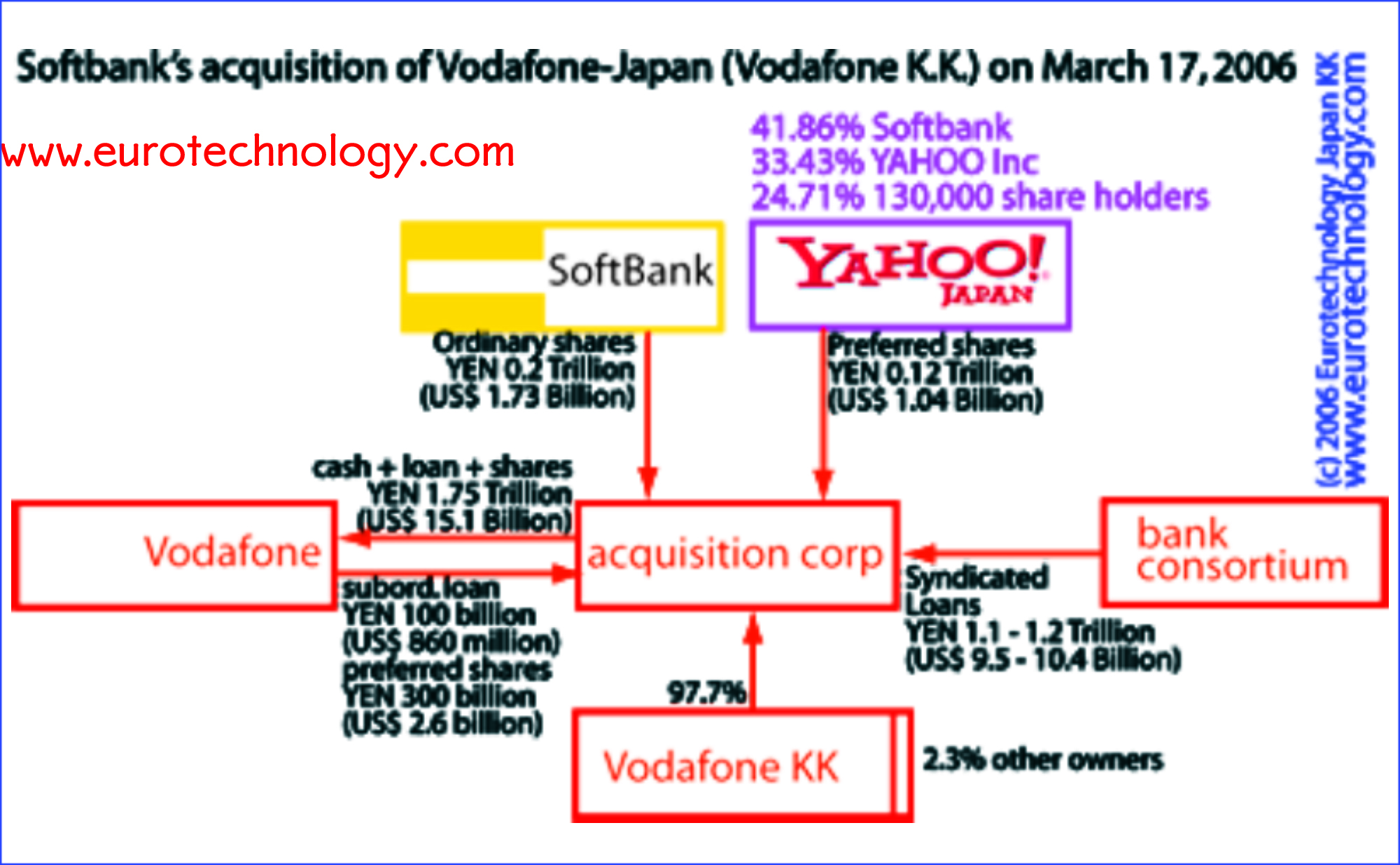
SoftBank and Yahoo-Japan acquired 97.7% of outstanding shares of Vodafone Japan (Vodafone KK) in Japan’s largest M&A transaction (the remaining 2.3% are owned by other investors). In a Leveraged Buy-Out (LBO) a consortium of banks extended US$ 9.5 to 10.4 Billion in loans.
Citibank was the lead in this transaction on SoftBank side, but because of the size of this transaction, essentially all major players in Japan’s financial industry were involved – including our company, which advised one of the loan risk assurance companies on aspects of the risks of this transaction.
SoftBank acquires Vodafone KK (= Vodafone Japan) – outline of the transaction
Ten Years later (2016) we estimate that Vodafone-Japan would have been worth approx. US$ 83 billion
We estimate that ten years later, had Vodafone-Japan been successful, would have been worth an estimated US$ 83 billion, a value lost to Vodafone as opportunity cost, and the reward to SoftBank fur the successful turnaround.
For details of our analysis of the value of this company ten years later read:
SoftBank’s aim: grow to 26 million mobile subscribers and become No. 2 in Japan
SoftBank announced the plan to return to J-Phone’s growth curve and to aim for 26 million subscribers, which would place the resulting mobile operator on place 2 in Japan.
After acquisition of J-Phone by Vodafone, growth stopped.
Japan’s new telecom landscape
Three major players emerge after a sequence of consolidation and restructuring: NTT, KDDI and Softbank/YAHOO. The following figure outlines Japan’s telecom sector in 2006:
Outline of Japan’s telecom sector in 2006 and M&A transactions source: https://www.eurotechnology.com/store/jcomm/
When Vodafone acquired Japan Telecom in a series of transactions, Japan Telecom was a full service fixed and mobile (= J-phone) telecom operator servicing private and corporate customers, competing neck-to-neck with KDDI Corporation (TYO:9433) for the second place in Japan’s telecom sector.
KDDI Corporation (TYO:9433) today (10 August 2016) has a market cap of YEN 8450 billion (= US$ 83 billion), and at the time when Vodafone acquired Japan Telecom, was very similar to KDDI.
It can therefore easily be argued that if Japan Telecom had been managed equally well as KDDI, then there is no reason to believe that Japan Telecom today would not have a market cap of at least US$ 83 billion as well.
And according to the BBC, Vodafone announced in February/March 2006, that Vodafone would write off (write down the value of Vodafone assets) £28bn (= approx. US$ 50 billion).
Vodafone Japan fail: Learn from Vodafone’s experience in Japan for your own business
Vodafone Japan failed not for one single reason but for hundreds of reasons, which can be grouped into soft factors (mainly lack of understanding Japan and Japan’s telecom markets and it’s true size) and hard factors (mainly far too low investment) – read more details in our SoftBank-report:
Soft factors:
Japan knowledge at HQ, and knowledge at HQ about the specifics of Japan’s telecom sector (or lack thereof).
choice of management structure (there were attempts to correct the management structure, however too little and too late).
attitude displayed both privately e.g. within the Japanese industry sector and publicly via marketing messages and advertising
choice of executives and lower ranking managers and their knowledge and experience in Japan’s telecom sector (or lack thereof)
lack of sufficient know-how and experience to manage a large Japanese company, and particular the chain of retail stores
lack of management and execution know-how in Japan: tried three (3!!) times to introduce / roll-out 3G services in Japan, and failed every time to attract sufficient subscribers. As a result Vodafone Japan was far behind in 3G introduction. Only after sale to SoftBank, did SoftBank succeed in implementing the transition to 3G
far too low budgets for infrastructure investment resulting in much lower coverage and network quality compared to competitors NTT-DoCoMo and KDDI/au and TuKa, Willcom and others. As a consequence of far too low investment budgets, Vodafone failed three times to introduce 3G services in Japan. (3G services were not successfully introduced until after the acquisition by Softbank, and after conversion of Vodafone KK to Softbank-Mobile).
mobile phone handsets were inferior to the handsets offered by competitors NTT-DoCoMo and KDDI, and TuKa
and many more
Vodafone Japan? Why did it fail and sell to SoftBank? – Detailed answer
Find a long answer in this blog post below, in our other blog posts, and in some detail including statistics and financial data in our Softbank Report.
On Friday March 17, 2006, Vodafone and Softbank announced that Vodafone sells Vodafone KK (the totality of all Vodafone operations in Japan) to Softbank.
It has been reported that on Monday March 20, 2006, Softbank started to move all Vodafone KK staff, furniture and equipment from Vodafone KK’s former headquarters in the top floors of the Atago-Greenhills-Mori-Tower to Softbank headquarters in Shiodome (near Shinbashi). Also Softbank arranged very quickly that essentially all foreign expatriate managers left Vodafone KK – some stayed in Japan working for other IT companies, some returned to European Vodafone divisions, and some pursued telecom careers in USA, India, Bangladesh, or elsewhere.
By total coincidence, I had dinner with a high-level manager of Vodafone KK, of European nationality, at the indian restaurant Moti’s in Tokyo-Roppongi on exactly the same day, the Friday March 17, 2006 a few hours after the sale of Vodafone KK to Softbank was announced.
I asked him: “Which of the following is true:”
Vodafone never did any market research in Japan?
Vodafone did market research in Japan, but the quality was low?
Vodafone did market research in Japan, but nobody read it?
This Vodafone KK (Vodafone Japan) manager’s answer at the indian dinner was (3): market research was done about Japan’s mobile phone market, but the market research was not sufficiently taken into account in the business and strategy planning.
Fact is, that Vodafone KK (Vodafone Japan) took many major strategy and market decisions in Japan, which were not related to the realities of Japan’s market. Here one example. When “rebranding” (=changing the company / product / services names) from J-Phone to Vodafone, this “rebranding” campaign was centered on global roaming, i.e. Vodafone enabled Japanese customers to use Japanese J-Phone/Vodafone mobile phones in a very large number of countries outside Japan as well as inside Japan. This was at a time, when Japan’s mainstream mobile 2G phone system which both DoCoMo and J-Phone used was PDC, while much of the rest of the world, especially Europe used GSM. However, what Vodafone overlooked was, that at that time DoCoMo had about 30,000 roaming customers, out of approx. 50 million subscribers, i.e. only about 0.1% of Japanese mobile phone users used international roaming at that time. Thus Vodafone KK in Japan focused their main nation-wide poster and TV and other media campaign on about 0.1% of the Japanese market (and about 0.02% of Vodafone KK’s accessible market, given Vodafone KK’s approx. 20% market share) – less than a niche. (The reason we know how many roaming customers DoCoMo had at that time, is because one of Vodafone KK’s competitors in Japan engaged our company Eurotechnology Japan KK to analyze Japan’s roaming market, and help our client to develop strategy to better compete with Vodafone KK’s roaming products, which were aggressively marketed, and the core of Vodafone KK’s marketing focus).
Another example was Vodafone KK’s strategic focus on Japan’s prepaid market (find detailed statistics and market shares and analysis of Japan’s prepaid market in our JCOMM report). In 2006 there were about 2.6 million prepaid mobile phone customers in Japan, i.e. about 2.7% of the market, while DoCoMo had about 45,200 prepaid subscribers, i.e. about 0.09% of DoCoMo’s subscribers were prepaid customers. Since the prepaid market in Europe (especially Italy where about 1/2 of the market is prepaid) is extremely important and highly profitable, Vodafone decided on the strategy to focus strongly on the development and growth of Japan’s prepaid market. Almost at the same time however, a national campaign started in Japan linking unregistered and illegally traded prepaid mobile phones to crime, and a law was proposed in Japan’s parliament to outlaw any type of prepaid mobile phones. Thus Vodafone KK found itself on the one hand promoting and investing to develop prepaid mobile phone services in Japan, developing, purchasing (as was the business model in Japan at that time) and bringing to market special prepaid handsets, and organizing national media campaigns promoting Vodafone prepaid mobile phones, while at the same time on the other hand facing the possibility that Japan’s parliament would outlaw these same prepaid mobile phones, and a broad press and TV national discussion on how prepaid mobile phones are linked to crime. The end result was, that instead of outlawing prepaid mobile phones, it was decided to introduce far stricter registration requirements and ID requirements for mobile phones and especially for prepaid mobile phones, and the unauthorized/unregistered sale or transfer of prepaid mobile phones in Japan was made a crime. The end effect for Vodafone of course was a commercial failure of Vodafone’s prepaid mobile phone campaign, in addition to a general decrease of ARPU (average revenue per user).
Instead of focusing on its core business in Japan, Vodafone KK focused management resources, and other resources to try to influence political decisions concerning 2.7% of the market: Japan’s minute and decreasing prepaid market.
Vodafone had many other management issues in Japan, which included recruitment and personality and retain issues of top executives, many kinds of HR issues, management issues at the retail stores, handset planning issues, branding and brand management issues, localization issues and much more.
As a consequence of these and other factors, Vodafone KK’s market share continuously decreased, subscribers moved from Vodafone KK to DoCoMo and KDDI/au, and the financial performance of Vodafone KK deteriorated, in the end convincing Vodafone that the best option was to sell Vodafone’s Japan operations and terminate business activities in Japan.
Vodafone-Japan’s leadership was also chaotic. While normally sending a stream of European Vodafone executives without knowledge of Japan or Japanese language on very expensive expatriate packages for limited periods to Japan, at some stage Vodafone decided to headhunt one of Japan’s top mobile industry veterans, who had just lost a battle for Docomo’s CEO position. This Japanese mobile phone industry veteran after a few weeks asked to be transferred from his executive CEO of Vodafone-Japan position to the non-executive Chairman position and soon after left Vodafone-Japan – clearly it took him only a few weeks to understand the hopelessness of the situation.
You can find further details and statistics, financial performance and market share data during this period in our reports:
i-Tunes Music Store (ITMS) kick-started internet music downloads in Japan
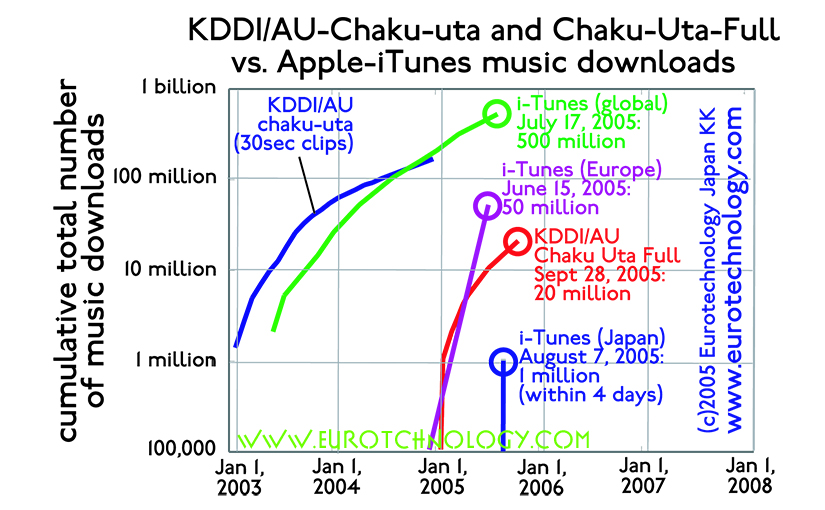
i-Tunes Music Store (ITMS) kick-started internet music downloads in Japan, which were falling just before ITMS arrived:
Mobile music going strong in Japan
i-Tunes & i-Pod themselves are under attack in Japan
i-Tunes & i-Pod themselves are under attack by KDDI‘s “au Listen Mobile Service” – LISMO!, which includes sophisticated viral marketing, music community and location based services.
“Vodafone K.K.’s Tsuda, 津田志郎, seeks growth in Japan, not sale”
However, sale to SoftBank may be the way forward
About one year ago, in an interview with Bloomberg (“Vodafone KK’s Tsuda seeks growth in Japan, not sale“), I mentioned that a sale of Vodafone’s Japan operations to Softbank might be the way Vodafone will go in Japan. This seems to be happening now and negotiations to this effect were confirmed by both Softbank and Vodafone over the weekend.
The potential deal
Although a deal has not been closed yet, it is widely reported that a sale of Vodafone’s Japan operations to Softbank is very likely to be closed within a few weeks. What could this deal look like?
As reported by Bloomberg Vodafone KK’s capitalization at the point of delisting from the Tokyo Stock Exchange was around YEN 1.4 Trillion (= about US$ 12 Billion). Bloomberg mentions estimations by London based analysts who value Vodafone KK in the range US$ 14 to 16 Billion. Of course, if a deal is actually concluded, it might be a complex deal with several components, not just a simple cash price, and any cash value will not be determined by analysts in London, but on the negotiating table between Softbank and Vodafone, and the final deal could be more complex than a simple sale against cash payment.
In any case, this deal – if it happens – promises to become one of the largest M&A transactions ever in Japan sofar in terms of cash value. Vodafone is reported to prefer a cash deal, and Softbank has been reported to consider a leveraged buy-out (LBO) where Softbank will take debt against the to-be-acquired company.
It has also been reported that Softbank seems to be planning to change the name of the resulting company, so the “Vodafone” brand is not likely to survive in Japan.
What is Softbank likely to do with Vodafone’s Japan operations
An acquisition of Vodafone’s Japan operations will be the completion of Softbank‘s march to build a full-scale telecommunications group on a par with NTT and KDDI through a series of acquisitions plus internal growth.
Softbank in this new shape will become a much more serious competitor for NTT and KDDI, which both have succeeded to transform themselves from former monopolies into some of the world’s most advanced telecom operators.
In a sense Softbank is already where DoCoMo and KDDI are working very hard to get to: DoCoMo and KDDI are working hard to build content and transaction businesses (such as shopping, financial services, auctions and music), because pure traffic revenue (ARPU) is driven down by relentless competition.
Softbank is strongly linked to YAHOO-Japan, and YAHOO-Japan demonstrated it’s strength by driving eBay out of Japan – so Softbank is already where DoCoMo and KDDI want to go. All Softbank still needed was a wireless network, and with a Vodafone acquisition, Softbank will have a wireless network much faster than expected.
A Vodafone/Softbank deal will not be a good development for eAccess/eMobile, and eAccess/eMobile is reported to have submitted documents to Japan’s regulatory authorities regarding Softbank’s wireless license. It will be interesting how the regulating government ministry will decide on the regulatory aspects of any Softbank/Vodafone deal. In the past few years Japan’s government has been singularly focused on creating the conditions to make Japan the most advanced IT market in the world, so I think we can be confident to expect a wise decision – wise for Japan, not necessarily beneficial for particular mobile operators.
What made Vodafone change it’s mind about Japan?
As reported by Bloomberg, one year ago Vodafone had the clear intention to remain in Japan for the next 10, 20, 30 years. What made Vodafone change it’s mind?
As widely reported, Vodafone was loosing market share in Japan’s mobile phone market over the last several years.
With number portability being introduced in Japan from autumn 2006, and with three new operators entering the market during 2006-2007, the competitive environment will become much more severe than it is now, decreasing pure network profitability, while at the same time massive network investments are necessary.
Analysis of Vodafone-Japan’s subscriber numbers shows that early warning signs appeared already in 2002 – 2002 would have been the time for Vodafone to take decisive action to turn the business around in Japan.
Was interviewed today about the announced JV between SANYO and Nokia for CDMA2000 phone handsets (I added some corrections here):
[Q1] How will SANYO benefit from this, since they are the ones who have the technology, what do they hope to gain from working with Nokia? Or is this merely a way to reduce costs for the company, since it’s struggling to remain profitable?
It is clear to me that NOKIA will benefit, since NOKIA needs 3G know-how from Japan because all markets where NOKIA is dominating are behind compared to Japan in 3G development, and also NOKIA needs a lot of other advanced technology from SANYO.
Of course who benefits depends both on the contract conditions and the relative strengths of the parties.
It’s clear that financially NOKIA is the much stronger of the two. NOKIA is financially very strong, while SANYO is in a very weak position, so it’s a very clever move for NOKIA.
[Q2] Is it already too late for Nokia to make such a move in the CDMA 2000 market, with strong players like Samsung, LG and Motorola already entrenched in the market?
I don’t think it’s too late – both Motorola and NOKIA demonstrated rebounds recently with new design initiatives such as Motorola’s RAZR and NOKIA did a successsful turn-round by introducing clam-shell phones a trend which NOKIA had missed by not being linked sufficiently into Japan before.
To succeed you need to make spectactular phones which match consumer needs, and you need the financial and manufacturing power as well as the brand. The combination of SANYO‘s technology with NOKIA’s financial strength and brand, as well as NOKIA’s efficient supply chain are a good basis.
[Q3] When would you expect to see the benefits of such a move to emerge?
I think one should not underestimate the cultural risks. NOKIA and SANYO have extremely different corporate cultures, and we have seen many cases where corporate cultures lead to great difficulties.
I think the key will be to manage the difference in corporate cultures of two very proud companies. Locating the JV in the USA might help.
SONY-Ericsson has demonstrated that such a JV can be successful. In the case of SONY-Ericsson it has taken several years for the JV to succeed. If one takes SONY-Ericsson as a measure, then it might take a couple of years (3-4 years) for this JV to succeed. If it’s faster than that it will be a positive surprise.
The European Institute of Japanese Studies (EIJS Academy in Tokyo) of the Stockholm School of Economics will hold a seminar in Tokyo-Marunochi on Thursday, February 16, 2006:
Topic: “Why are Mobile Phones (Keitai) so hot in Japan? – and How European companies in all sectors can profit from Keitai”
Speaker: Gerhard Fasol
Gerhard Fasol “Why are keitai so hot in Japan?” Embassy of Sweden
Agenda:
Japan created the most passionate and most advanced mobile communications (keitai) market in the world. Recently, almost all innovations in mobile communications have been developed or brought to market first in Japan. Fasol’s talk will explain why this is, and how European companies in all fields, from retail to publishing can profit by building keitais into their business models.
Date: Thursday, February 16, 2006
Time:
6.15 – 7.00 p.m. Drink and Snack (served before the lecture)
7.00 – 9.00 p.m. Lecture and Discussion
Place:
Marubiru Conference Square, Room 2 (Tel: 03-3217-7111) 8th floor of Marubiru, 2-4-1 Marunouchi, Chiyoda-ku, Tokyo One-minute walk from JR Tokyo Station, Marunouchi South Exit
Fee: JPY2,000 per person, payable at the door Free for students, please bring your student ID Free for those who are from sponsoring companies
Advance registration required: Please sign up (via email) or fax to (FAX 03-3212-1530) for the attention of Ms. Futagawa (EIJS Tokyo Office.)
Music player phone for KDDI LISMO mobile music service
LISMO! competing with iPod and iTunes
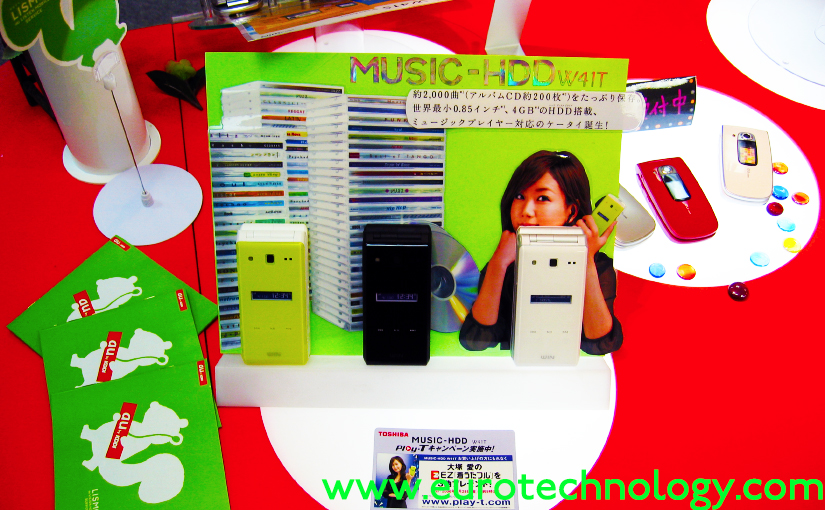
(Tokyo, Feb. 6, 2006 by Eurotechnology Japan KK) In the last few days KDDI/AU‘s “MUSIC-HDD” phone (W41T by Toshiba) went on sale nationwide in Japan. The W41T includes a 4 Gigabyte 0.85 inch (22.6mm) diameter Hard Disk Drive (HDD), and can store roughly 2000 full songs. This storage is the same as for a top range iPod-nano (however the storage in an iPod-nano is flash memory, not HDD). With the “MUSIC-HDD” phone and other “music player” phones, KDDI/AU launched the “LISMO!” service, an integrated online-store & mobile & PC music offering, which competes in the same arena as iPod/iTunes.
4 GigaByte Hard Disk music phone for KDDI AU LISMO! mobile music service
Overall Japanese mobile operators generate on the order of US$ 10 Billion/year in profits with a rising tendency.
US$ 10 Billion/year profits attract three new entrants to Japan’s mobile markets (eMobile, YAHOO-BB and IP-mobile), mobile virtual operators, and attracted Vodafone to acquire J-Phone some time ago.
DoCoMo’s domestic profits in particular have been continuously rising to reach the spectacular figure of US$ 8 billion/year recently. However, conspicuous is a US$ 10 billion hole (shown in bright red color in the figure below) in DoCoMo’s otherwise impeccable record. This US$ 10 billion losses are DoCoMo’s write-offs for investments in KPN-Mobile (Netherlands, Germany and Belgium), Three-Hudginson (UK) and AT&T-Wireless (US). DoCoMo has withdrawn from all three investments and has written off about US$ 10 billion. Most companies on planet earth will not survive a US$ 10 billion write-off – however, DoCoMo’s incredible domestic performance allowed DoCoMo to survive this US$ 10 billion write-off without much trouble.
Vodafone’s performance in Japan is rather mixed – the results show a zig-zag line with profits one year and losses the next and average profits around zero, if performance is averaged over several years.
Net income of Japan’s mobile operators showing NTT-DoCoMo’s losses on international investments in red
Japan’s cellphone market continues to grow by more than 4.5 million subscriptions/year
DoCoMo and KDDI are continuing their head-to-head race
Since June 2005 Vodafone is consistently gaining customers again (but losing market share)
Willcom’s turn-round is continuing, and Willcom is consistently gaining market share. Willcom is outperforming Vodafone as far as gaining new subscribers is concerned
Month-by-month gain/loss for 2005:
Annual subscriber growth for 2001-2005 shows DoCoMo’s and KDDI’s head-to-head race, Willcom’s turn-round and Vodafone’s difficulties to apply GSM-style management to Japan:
Month-by-month growth during 2005 shows that KDDI is moving TuKa customers to AU. (TuKa uses a legacy PDC network – a technology developed by KDDI’s competitor NTT, while AU uses Qualcomm’s CDMA2000):
The Mobile Data Association (MDA) announced in a press release on November 25th, 2005 under the headline “Text messaging soars during October” that SMS sent in the UK during October 2005 “have soared … to a staggering … 93.5 million SMS/day”. Read below to find out that Japan’s numbers are at least three times more staggering.
The Figures below show that Japan’s figures are about three times higher – implying that SMS in Europe is impressive, but still has a lot of room to grow further taking Japan as a measure:
SMS/user/day in Europe vs mobile email/user/day in Japan
Data sources:
Data for UK are official data published by the Mobile Data Association (MDA) on their www.text.it website, data for Germany are taken from the “Netsize Guide 2005 Edition – The Mobile is Open for Business” (ISBN 2-9523533-0-1), subscriber numbers for Japan are official data communicated by Japan’s mobile operators to the telecom industry association, and the number of email data for Japan are official data from Japan’s mobile operators. The data have been extrapolated using scientific/mathematical methods to render smooth curves. Solid data are obtained from official data, shaded curves are extrapolations by Eurotechnology Japan KK.
For more statistical and financial information about Japan’s telecom industry:
Japan’s mobile internet is a growth market with about 0.5 Million new subscriptions/month – Japan’s mobile internet grows by about one Finland per year, and even more in terms of ARPU!
Vodafone’s subscriber numbers on the other hand have been more or less stable around zero growth.
Growth of mobile internet subscriptions for DoCoMo’s i-Mode and KDDI’s EZweb combined stabilizes at 0.5 million/month, while Jsky stopped growing after acquisition by Vodafone and renaming to Vodafone-Live!
QR codes (QR = “quick response”) have a lot more capacity than conventional bar codes:
Capacity of typical QR code for mobile phone applications compared to traditional linear bar code
Marketing i-Pod-nano with QR-code: QR-code takes you directly to the mobile Apple store to buy your i-Pod-nano here and now on the road (read a detailed description of the Apple i-Pod QR-code campaign in our QR-Code report):
iPod-nano QR code campaign in Tokyo/Shibuya in November 2005
NorthWest Airlines QR code campaign in Tokyo Shinjuku station
Docomo acquires music retail know-how and a laboratory for mobile payments at the point-of-sale
NTT Docomo acquisitions: 32.34% of Tower Records a major share of Japan’s second largest Credit Card issuer
Nikkei reports several NTT Docomo acquisitions: DoCoMo will use a total investment of around YEN 10 Billion (approx US$ 100 million) to acquire 32.24% of Tower Records Japan’s shares from Nikko Principal Investments Japan Ltd, and additional shares in a third party allotment taking it’s stake to around 40%. Tower Records Japan plans an IPO, and DoCoMo apparently intends to keep a 33.4% controlling stake even after the IPO.
Tower Records Japan was founded by the US-company Tower Records in August 1979 in a pioneering entry by Tower Records into the Japanese market. At that time, almost all foreign companies entering Japan formed a joint venture with a Japanese company or licensed their brand to a Japanese company. Tower Records instead acquired an unrelated Japanese company with the same name (“Tower Records”) and built it’s business in Japan successfully alone without a Japanese joint venture partner.
In October 2002, Tower Records Japan became independent of the US mother company through a Management Buy-out by Japanese management.
NTT Docomo acquisitions strategy
Repordedly, DoCoMo aims to implement many synergies including:
use of mobile FeliCa wallet phones for customer relationship management (CRM), reward points, and customer data collection for marketing purposes
Napster Japan: Since about 1/2 of official content sales of i-mode is from mobile music, and since Tower Records Japan is about to launch Napster-Japan in a joint venture with Napster, we expect DoCoMo to become involved in online music distribution through Napster Japan.
NTT Docomo acquisitions: The bigger picture
Acquisition of a controlling stake in Tower Records is the latest step in a string of investments by DoCoMo, to expand revenue into new areas independent of ever shrinking voice and data traffic related charges. Recent investments include:
With more than 100 stores the Tower Records Japan investment will give DoCoMo an excellent experimentation ground to develop many new ways of using FeliCa wallet phones in a real-life retail environment.
The Communications and Information Network Association of Japan (CIAJ) and the CEATEC trade exhibition invited our CEO to brief Japanese executives on the differences between Europe’s and Japan’s mobile phone markets, opportunities for Japanese mobile phone companies in Europe and difficulties for Japanese companies to overcome in Europe
Presentation at CIAJ Headquarters on Friday, September 30, 2005 (in Japanese)
Presentation at CEATEC Trade Exhibition on Thursday, October 6, 2005 (in English with simultaneous Japanese translation)
From time to time our CEO is asked to brief top executives of major corporations – or even the President of Germany, or the Vice-Minister of Industry of France.
Japan’s broadcasting is a US$ 40 billion/year industry
There have been many attempts over the years for Japan media landscape restructuring
by Gerhard Fasol
Japan’s broadcasting markets (commercial TV + NHK + CATV + satellite + AM & FM radio) have annual combined revenues on the order of US$ 40 billion. The main players in this market are five large commercial TV groups and the semi-public NHK.
Media Group TBS attracts uninvited merger proposals
One of these five TV and media groups – TBS – has received an uninvited merger proposal by it’s largest shareholder – the internet portal Rakuten – and in parallel also attracted the Murakami-Fund as an investor.
TBS media group under pressure? and why?
Earlier this year Japan’s Murakami Fund acquired about 7% of the TBS Media Group, and declared that TBS was undervalued and should sell non-core assets, such as real estate and other non-TV / non-media related properties.
Recently, Rakuten acquired about over 20% of TBS shares, making Rakuten the largest shareholder of TBS. Rakuten announced a business plan for a merged Rakuten-TBS Group integrating Rakuten’s internet businesses with TBS’ TV and media operations. Since Rakuten’s stock market valuation is about 35% higher than TBS’ valuation (as of October 24, 2005), Rakuten’s management is expected to dominate a potentially merged group.
TBS’ management is not delighted with the prospect of losing control in this way. In response, three things happened:
TBS management announced cooperations with “stable shareholders” Dentsu, Mitsui Bussan, and Bic-Camera, and non-shareholder Amazon.co.jp, and other Japanese corporations.
The Murakami Fund proposed a management buy-out, which would lead to a delisting of TBS by the Tokyo Stock Exchange, taking TBS private. This possibility was voted down by TBS management.
Livedoor offered support as a (very unlikely) white knight. Given Livedoor’s record of a failed hostile take-over attempt of the Fuji-Sankei media group earlier this year (for details see our report on Japan’s Media industry), it seems to be more than unlikely for TBS to go for Livedoor as a white knight – however no one knows for sure.
At this time the acquisition battle for the TBS Group is in full swing and the final outcome is difficult to estimate. In parallel to the take-over battle, a public discusson by Japan’s industry leaders is examining the desirability of hostile take-overs in Japan.