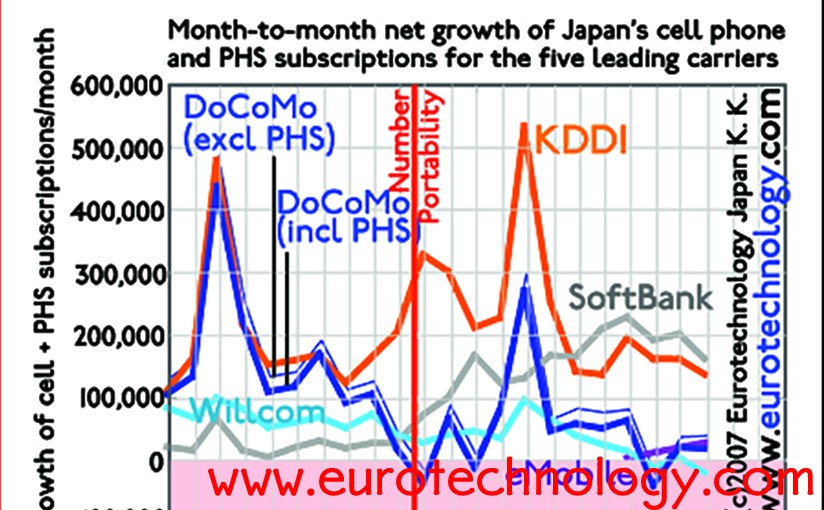
SoftBank from 4th to 1st position within less than 12 months… SoftBank‘s turn-round of x-Vodafone-Japan, went faster than many expected. Within less than 12 months SoftBank went from last place to first place in customer sign-ups, overtaking even KDDI‘s super-popular AU.
Willcom recently suffers from SoftBank‘s revival, as well as from eMobile‘s flat rate data services.
Month-to-month net subscription growth/decline for Japan’s mobile phone operators during the period when mobile number portability (MNP) was introduced
In the last few days NTT, NTT-DoCoMo, KDDI and SoftBank announced their first half financial results. SoftBank and KDDI are the winners both for market share and for profits, while DoCoMo‘s results and market shares are sinking, and pulling the NTT-Group down at this time. Extrapolation indicates that DoCoMo‘s net profits may fall into the red about one year from now, drastic action is taken soon.
Net after-tax income of Japan’s top three mobile operators NTT-docomo, KDDI and SoftBank. Currently docomo’s net profits follows a downward trend, and risks to drop into the red, unless docomo takes drastic measures.
The thin lines show linear interpolations of quarterly net profit data. Our extrapolation seems to indicate that DoCoMo‘s net profit might fall into the red towards then end of calender year 2008 unless drastic action is taken. If current trends continue, SoftBank‘s net profits might exceed DoCoMo‘s mid-2008. We expect DoCoMo to take dramatic action before this happens.
Net after-tax income of Japan’s top three mobile operators NTT-docomo, KDDI and SoftBank. Currently docomo’s net profits follows a downward trend, and risks to drop into the red, unless docomo takes drastic measures.
People who want to participate need to register and link their plastic SUICA card, or their mobile SUICA (wallet phone with installed SUICA application) with a registered mobile or PC email address.
Whenever a registered participants touches the SUICA reader/writer on the side of a poster, links to a campaign homepage, coupons, event announcements or other information is sent to the registered PC or mobile phone email address.
The SuiPo system puts interactivity into posters and allows the advertiser to build an opt-in data base of interested people and to interact with them.
SuiPo = SuicaPoster: linking mobile phones and smartphones to posters for interactive advertising
Seven-Eleven rolls out national electronic money and mobile payment system
Retail chain AEON follows with WAON e-cash and mobile money
This week two of Japan’s largest retail chains roll out electronic and mobile cash: Monday April 23rd, 2007 the Seven & I Holdings Group started “nanaco” and tomorrow, Friday April 27th, 2007, the AEON retail group will start “WAON”.
At first sight the massive roll-out of electronic cash and mobile payments systems during March and April this year here in Japan has been smooth and without problems (except for PASMO underestimating the success and running out of cards). However, when we look below the surface, clouds of a competitive storm are brewing. This storm might be followed by consolidation. Here are some examples:
PASMO cards were sold out within the first three weeks, and PASMO is now losing market share (and commission payments) to SUICA day-by-day – PASMO became a victim of it’s own success.
Seven-Eleven’s nanaco and AEON’s WAON use different business model variations
7-11’s “nanaco” offers twice as much discount as AEON Group’s “WAON”. Clearly “nanaco” is on a more aggressive course than “WAON”. We expect competition to heat up.
By the way- on Wednesday April 25th, 2007, two days after Seven-Eleven’s national roll-out of their e-money and mobile payment system, our company Eurotechnology Japan KK arranged a meeting between Seven-Eleven’s Chief e-Money architect and manager with the top-management of one of Europe’s most important mobile operators to enable the European operator to almost live experience an important global mile-stone in the development of e-money and mobile payments. To this day, to our knowledge, there is nothing like Seven-Eleven’s nanaco e-money and mobile payments system in Europe.
E-cash business model schematics
Schematic of Seven-Eleven’s nanaco e-money and mobile payment system
On March 31, 2007 eMobile will start high-speed (3.6 Mbps, HSDPA) mobile data services in Tokyo, Osaka and Nagoya, bringing disruption into the mobile data market in Japan.
While Willcom offers a flat data rate of YEN 9000 (US$ 77) per month for unlimited data transmission at 128kbps, eMobile will offer 30 times higher speed at about 1/2 the price:
3.6Mbps for PDAs, laptops and PCs for YEN 4980 (US$ 43, EURO 32) per month flat rate without any data limit (and n.b. no “fair use limit” as many European operators impose in the fine-print). …. and yes- you can probably also do wireless VOIP or Skype if you set this up yourself.
The established mobile operators (DoCoMo, KDDI/AU and SoftBank) do not offer any flat data rate to connecting PCs and laptops at this time.
(By the way- did you ever wonder why new entrants love flat rates? it’s because telecom billing systems are so expensive and complex. Flat rates are one of many competitive weapons new entrants have over incumbents…)
eMobile went to market with a splash in Japan – the first terminal was an HSDPA / wLAN and mobileTV equipped pre-smartphone smartphone
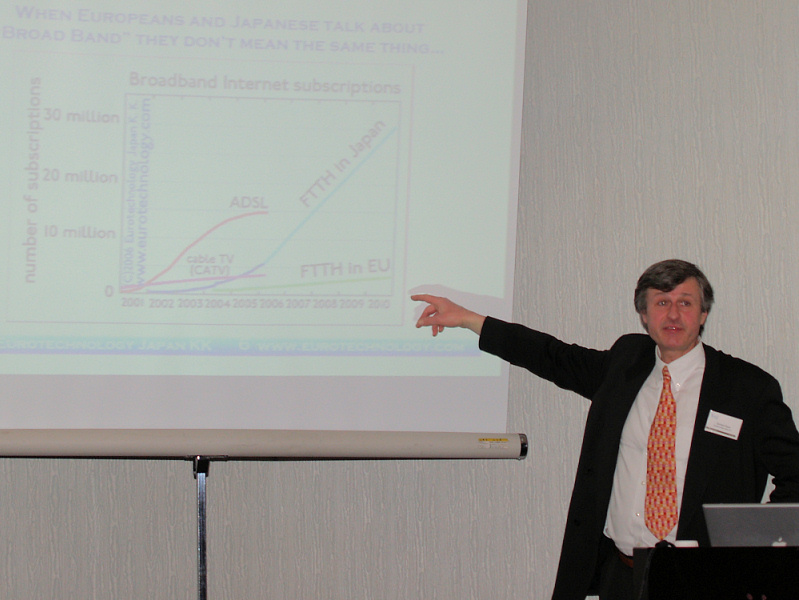
In his presentation, Dr. Fasol will explain the essentials of Japan’s mobile phone market, why and how it is so different to Europe’s. He will also talk about some of the reasons why it is so difficult for European companies to succeed and uncover opportunities and the keys to success for European companies in this important market.
Gerhard Fasol “Help – my mobile phone does not work!” – Why Japan’s mobile phone sector is so different from Europe’s, at the Finnish Chamber of Commerce in JapanGerhard Fasol “Help – my mobile phone does not work!” – Why Japan’s mobile phone sector is so different from Europe’s, at the Finnish Chamber of Commerce in JapanGerhard Fasol “Help – my mobile phone does not work!” – Why Japan’s mobile phone sector is so different from Europe’s, at the Finnish Chamber of Commerce in Japan
Japan’s mobile subscriber numbers grew by about 5 million in 2006. Because of the much higher ARPU, Japan’s mobile market again grew by a couple of Finlands during 2006. A growing number of people have more than one mobile phone, to take advantage of the best rates, eg for mail, voice and data. We expect growth to continue. Our analysis below shows that KDDI’s and AU’s gains are a lot larger than a superficial view of the statistics reveals – see our Figure below. Find a detailed review in the latest edition of our JCOMM-Report.
During 2006 Japan’s mobile subscription base grew by about 5 million – KDDI gained about 4.2 million new subscriptions and is the clear winner, despite shutting down its TuKa 2G service during this period
KDDI‘s subscriber gains during 2006 are much bigger than a superficial analysis reveals (see figure above):
KDDI’s AU mobile service gained about 4.2 million new subscribers during 2006 – more than twice as many than DoCoMo’s cellular service, which gained about 1.8 million new subscriptions.
Currently, KDDI is shutting down it’s TuKa 2G service, and DoCoMo is shutting down it’s PHS service. Both services together lost more than 2 million subscribers during 2006 – this is a much larger movement than due to number portability introduced on Oct 24, 2006.
KDDI offers both number portability and mobile email portability, and reports surprise that many former low-end TuKa users moved to top-end high-speed WIN (2.4 Mbps) data services.
For KDDI, enticing TuKa subscribers to move to high-end/high-speed AU services was an excellent preparation for number portability, and helped KDDI win in the first stage.
Today we released the 23rd edition of our JCOMM-Report – about 250 pages of overview and analysis of Japan’s telecom sector.
KDDI gains 524,000 subscribers in Oct & Nov 2006. DoCoMo for the first time ever since it was founded experienced a net loss of subscriptions.
Net gain/loss of Japan’s mobile operators at introduction of mobile number portability (MNP)
KDDI gains 600,000 new EZweb subscribers, Japanese operators earn much from mobile internet – subscription data show even better results for KDDI‘s EZweb.
gain/loss of subscriptions by Japanese mobile internet services during introduction of mobile number portability (MNP)
Both docomo’s i-Mode and KDDI’s EZweb top menu pages display Season Greetings and reflect Japan’s seasonal mood: autumn sports days in schools, skiing in winter, Halloween and New Year.
Here are this year’s New Year greetings for the Year of the boar on i-mode and EZweb which were displayed from January 1, 2007 for a few days during Japan’s New Year vacation:
New Year 2007 on docomo’s i-Mode and KDDI’s EZweb mobile internet home pages
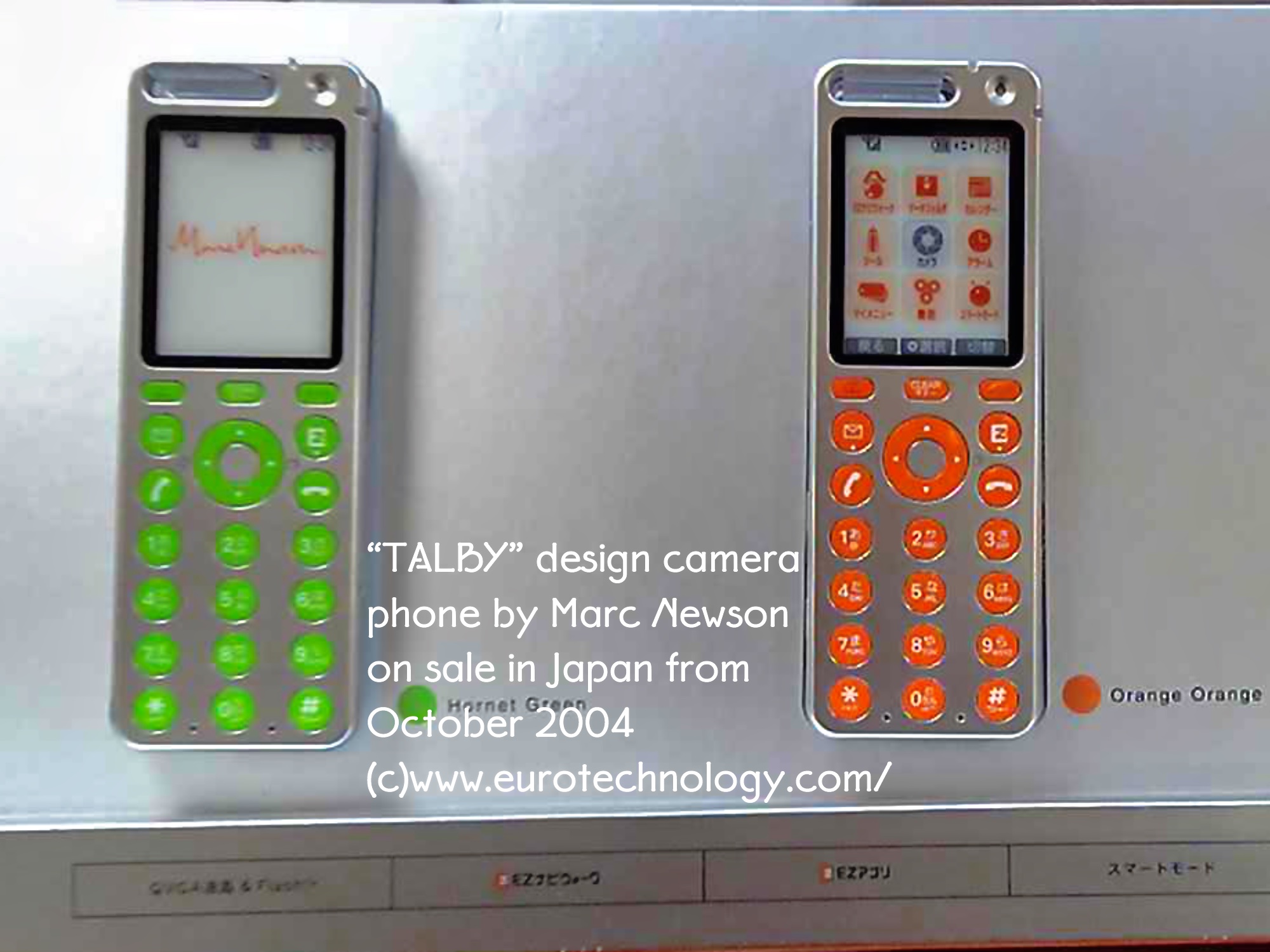
KDDI is unique among mobile operators in creating value from design for phones with the “au design project”. Creating value for which consumers are willing to pay premium prices is a key to success in the rapidly growing global US$ 150 Billion mobile phone business.
au design project 2006:
The KDDI Designing Center showed the exhibition “TRILOGY”, displaying some results of the “au design project 2006”. The three concept phones are (from left to right):
“kaos” by Naoki Sakai
“cypres” by Nao Tamura
“vols” by Ross McBride
KDDI / au design project 2006KDDI / au design project “kaos”KDDI / au design project “cypress”KDDI / au design project “vols”
KDDI is unique among mobile operators in creating value from design for phones with the “au design project”. Read more about KDDI in our KDDI report.
Creating value for which consumers are willing to pay premium prices is a key to success in the rapidly growing global US$ 150 Billion mobile phone business.
INFOBAR was a big success for KDDI. Industrial designer Fukawasa Naoto recently created INFOBAR-2, and introduced it at a show at the KDDI Designing Center in Tokyo:
“au design project”: INFOBAR-2 by Fukawasa Naoto“au design project”: INFOBAR-2 by Fukawasa Naoto
Eurotechnology’s CEO was invited to attend Ericsson’s Strategy & Technology Summit in Tokyo on November 15, 2006.
Ericsson’s CEO, Carl-Henric Svanberg, Ericsson CSO – Chief of Strategy, Japan-CEO Rory Buckley and other Ericsson top management presented Ericsson’s strategy and vision. About 100 investors and investment bank analysts were invited to attend.
I was given the opportunity to share the lunch table with CEO Carl-Henric Svanberg and had a fascinating discussion (some of his comments flowed into our company’s project report to the European Union on benchmarking Japan’s vs EU’s fixed and mobile telecommunications and broadband sectors).
With some of the largest and most advanced mobile investments, Japan’s mobile market is one of the most important markets globally for Ericsson. Recently Ericsson won major contracts from SoftBank and eMobile.
Ericsson CEO Carl-Henric Svanberg speaking at the Ericsson Technology Summit in Tokyo
Mobile operators expand into mobile payments and mobile credit
Mobile phones use qr codes for payments
Japan’s mobile operators DoCoMo, KDDI/AU and SoftBank are expanding their business into mobile payment and mobile credit, traditionally the realm of banks, credit card companies, financial institutions and cash. With the bubble/post-bubble bad loans problem largely resolved and the mega-mergers completed, Japan’s banks are now ready again to develop new business.
Customer’s camera phone reads the barcode or QR-code on an utility bill or mailorder invoice, and forwards secure payment instructions to the customer’s bank account.
What is the expected impact?
Expect positive impact on Mizuho’s earnings
Today such payments are typically made by walking to the nearest convenience store: expect negative impact on convenience stores which handle much of the barcode based bill payments today
Expect additional competitors with alternative methods to compete with Mizuho in the domain of mobile phone based bill payments
Mobile number portability was a major factor forcing Vodafone out of Japan
MNP is the first challenge for SoftBank Mobile – read how SoftBank approaches the MNP battle
Mobile number portability (MNP) was introduced in Japan on October 24, 2006. Mobile number portability means that Japanese cell-phone subscribers (excluding PHS subscribers) can move their subscriptions between DoCoMo, KDDI/AU and Softbank while keeping the same phone number. However, number portability does not mean email portability, or portability of purchased content which in Japan is normally subject to strict digital rights management and normally cannot be transfered from one subscription to another.
SoftBank went into the MNP battle with fireworks of campaigns
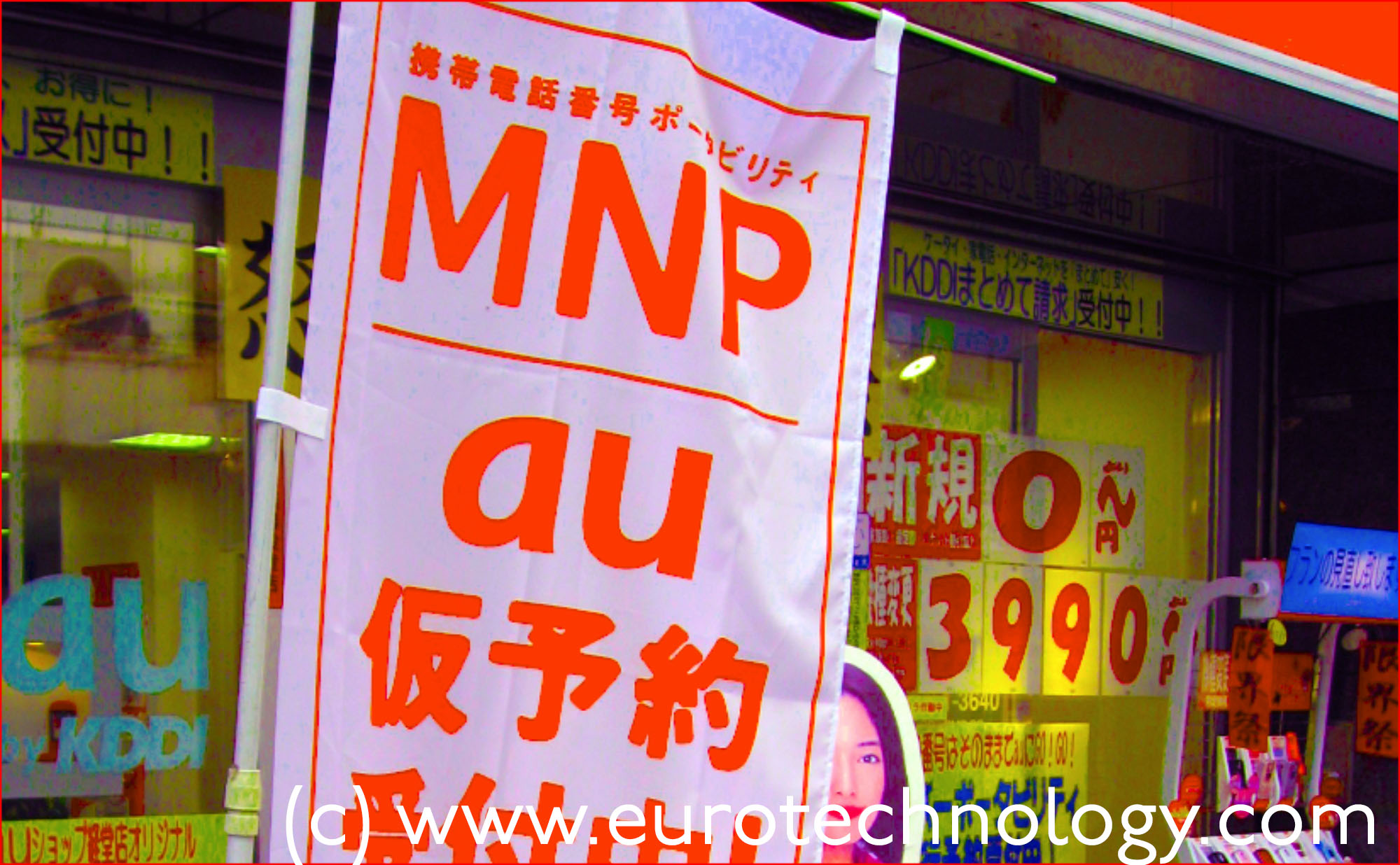
The “Zero YEN” campaign plays with the fire of a price war. As shown in the photograph below, from October 24, 2006, SoftBank stores prominently displayed “Zero Yen” prices for all handsets and many different services, creating the superficial impression that suddenly all SoftBank handsets and services are free of charge, which of course is not the case. This advertising trick led to an enquiry by Japan’s fair trade commission. The fair trade commission later admonished SoftBank saying that some aspects of the campaign were misleading – however the fair trade commission at the same time admonished all other cell phone operators and PHS operator WILLCOM for different types of misleading advertising. SoftBank came away quite lightly – however the photograph below shows, that the ZERO YEN signs were covered up (and are still visible below the hastily applied cover sheet of paper).
The “unexpected campaign”: Softbank introduced an “unexpected” Gold Plan, which offers essentially flat fee voice calls under certain conditions, but restricted in time and length, and also restricted to calls between SoftBank subscribers only. Since SoftBank only represents about 15% of Japan’s mobile phone market, it is much easier for SoftBank to offere flat on-network plans, than for DoCoMo, since for DoCoMo a much larger ratio of calls would fall under the on-network plan. DoCoMo and KDDI therefore did not respond with any flat voice on-network plans.
SoftBank’s computer systems were either overloaded, or broke down under the load of MNP, leading to irritated complaints by KDDI and DoCoMo, and some damage to the new SoftBank brand.
SoftBank Zero Yen campaign
This photograph shows SoftBank’s Zero Yen Campaign (left photograph). AFter a few days Japan’s Fair Trade Commission started to investigate SoftBank (and all other mobile operators) and admonished them for misleading advertising practices – as a consequences the original Zero Yen poster is covered up (right hand photograph):
Mobile number portability in Japan: SoftBank’s Zero YEN campaign
Preview – SoftBank today and 300 year vision report:
October 27, 2006 the Finland-Japan Ubiquitous Society Conference was held in Tokyo.
Tero Ojanpera, Exec VP and CTO of NOKIA, gave an overview of NOKIA’s vision of communications, other speakers and panelists included Juho Lipsanen, Finland CEO of TeliaSonera, KDDI Chairman Murakami.
The day before I briefed and had a long discussion with the top management team of TeliaSonera-Finland.
Nokia CTO Tero Ojanpera talking at the Finland Japan Ubiquitous Society Conference
Panel discussion with TeliaSonera CEO Juho Lipsanen and KDDI-Chairman Murakami.
Nokia CTO Tero Ojanpera talking at the Finland Japan Ubiquitous Society Conference
The day before the Finland-Japan Ubiquitous Society Conference in Tokyo, I briefed the top-management (CEO, CTO and other top managers) of TeliaSonera, on October 26, 2006.
The next day, October 27, 2006, the Finland-Japan Ubiquitous Society Conference was held. Tero Ojanpera, Exec VP and CTO of NOKIA, gave an overview of NOKIA’s vision of communications, other speakers and panelists included Juho Lipsanen, Finland CEO of TeliaSonera, KDDI Chairman Murakami.
Nokia CTO Tero Ojanpera talking at the Finland Japan Ubiquitous Society Conference
Panel discussion with TeliaSonera CEO Juho Lipsanen and KDDI-Chairman Murakami.
Nokia CTO Tero Ojanpera talking at the Finland Japan Ubiquitous Society Conference
SoftBank acquired Vodafone KK for about US$ 15 billion, essentially with a very large loan. Thus SoftBank is under enormous pressure to succeed in Japan’s very competitive mobile phone market, where Number Portability was introduced on October 24, 2006.
Recent subscriber number statistics and our observations indicate that SoftBank looks likely to succeed in turning round the mobile phone company they acquired from Vodafone and renamed Softbank Mobile.
During the week of October 24, 2006, when number portability was introduced, Masayoshi Son introduced a firework of new pricing plans – on the surface these pricing plans all advertise “Zero Yen”, ie nominally the price of buying mobile phones from SoftBank appears to be ZERO.
Of course, with a consortium of lenders anxious to be repaid, SoftBank has no possibility of giving away mobile phones for free. In actual fact, our analysis shows that SoftBank at the end of the day actually increased prices slightly. SoftBank introduced a series of pricing plans, where customers essentially purchase the mobile phone handsets under an installment plan running over variable periods, but typically 48 months, with zero down payment at the time of initial purchase. So in fact, the terminals are not sold for ZERO YEN at all – this issue led to an investigation by Japan’s Fair Trade Commission.
As is usual practice in Japan, the Fair Trade Commission did not single out Softbank, but critized each one of the major mobile operators for different unfair advertising practices, and encouraged each mobile operator to be more accurate in advertising discount plans.
SoftBank got away lightly – the image below shows on the left hand side the initial ZERO YEN announcement, which a few days later was hidden by a more careful explanation… (the Zero Yen poster can still be seen shining through the paper above…)
SoftBank’s “zero yen campaign” offering mobile phones at the price of zero yen. Japan’s Fair Trade Office prohibited this campaign – and on the right hand side therefore the “0 yen” signs are covered up
Contrary to SoftBank‘s “Zero YEN” campaign, which plays with the fire of a price war, KDDI centered AU’s number portability campaign on “customer satisfaction” emphasizing services. The “customer satisfaction campaign” uses a symbolic customer as the campaign theme:
SoftBank replaced Vodafone-Live! by Yahoo!-Keitai. SoftBank phones have a “Y!”-button which links to Yahoo!-keitai. Yahoo-Keitai! offers a list of official sites, new services (e.g. a new communicator service), and also access to free mobile internet sites through the YAHOO directory, as well as access to YAHOO services, such as YAHOO-auctions.
SoftBank replaces Vodafone-Life by Yahoo!-keitai as part of the acquisition of Vodafone-Japan
YAHOO!-keitai is a fresh start to revive the mobile internet service, previously known as Vodafone-Live!, and which had been losing market share to competitors i-Mode and EZweb for about 4 years. Previous to the Vodafone-Live! period, Jsky had been successful in gaining market share both from i-Mode and EZweb.
Market share in Japan’s mobile internet market: Vodafone-Life was continuously losing market share before it was acquired by SoftBank, while KDDI’s EZweb was winning market share over several years
Understand Softbank: our report: “SoftBank today and 300 year vision”
Toru Arakawa, CEO and Founder of ACCESS, gave a keynote speech at this years CEATEC show in Makuhari on October 6, 2006, outlining ACCESS strategies.
ACCESS is the maker of NetFront browsers and other software at the core of DoCoMo’s i-mode. ACCESS acquired PalmSource and is developing the Access Linux Platform (ALP) based on the PalmSource acquisition.
With ALP, ACCESS is planning to deliver a full software stack for mobile phones based on Linux. In his speach Toru Arakawa outlined company strategy also beyond mobile phones to multimedia home centers.
Looks to me like ACCESS is shaping itself to compete with APPLE and Microsoft both in the mobile phone and the home entertainment markets.
On September 29, 2006, a few days before the official name change from Vodafone KK to SoftBank Mobile, SoftBank opened the rebranded Shibuya flagship store:
Rebranding the flagship store in Shibuya from Vodafone to SoftBank after SoftBank acquired Vodafone KK and changed the name to SoftBank Mobile
Because of the crowded streets in Shibuya most of the building work was done during the night:
Rebranding the flagship store in Shibuya from Vodafone to SoftBank after SoftBank acquired Vodafone KK and changed the name to SoftBank Mobile
u-Japan follows i-Japan and e-Japan to take Japan to the forefront of global IT developments
Presentation at the EU-Japan Center for Industrial Cooperation, 12 October 2006
Title: “Japan’s Mobile Phone Industry and u-Japan”
Date and Time: Thursday, 12th October 2006, 17:00-19:00
Location (tentative, please check closer to the date for changes):
Main Conference Room 4F, EU-Japan Centre for Industrial Cooperation, Tokyo
Agenda: u-Japan and Japan as the mobile internet pioneer
Japan’s mobile phone and broad-band markets are about 3-6 years ahead of Europe: new services are typically invented or first brought to market in Japan, 3-6 years earlier than in Europe. Internet in Japan is generally much faster and much cheaper than in Europe. For this reason and because of it’s size, Japan’s telecom markets are full of opportunities for European companies with the right products and the right strategy, and for investors with the necessary knowledge.
Japan’s mobile phone industry is notoriously difficult to understand for Europeans because it’s market logic is very different from Europe’s, and because the pace of innovation and structural change is much faster, and because of the language barriers.
This talk will explain the driving forces behind recent dramatic changes in Japan’s mobile telecom sector, and will explain new changes that the “ubiquitous-Japan” (“u-Japan”) policy will bring in the near future.
Do you need to know what Europe’s mobile phone and internet markets will look like in 2010 or 2015? – Come to this talk and you will get a good look into Europe’s IT future about 5 years ahead, as well as Japan’s telecom markets today.
Background: Japan – the mobile internet pioneer, and Vodafone’s departure from Japan
The EU Technology Attaches were particularly interested in the impact on Europe by the termination of by far the biggest ever European investment in Japan. Clearly it is also important to determine, what other European companies can learn from Vodafone’s experience.
Eurotechnology Japan KK has been awarded a contract by the European Union to benchmark Japan’s telecom sector vs EU and make recommendations.
More about Japan’s telecom sector
Read our report on Japan’s telecommunications markets
Why did Vodafone quit Japan and sell Vodafone-Japan to Softbank?
Following Vodafone’s decision to end business in Japan and the announcement of the sale of Vodafone-Japan to SoftBank, this author has been asked to brief the Technology Attaches of the 25 EU Embassies in Tokyo on Japan’s mobile phone and telecom sector, mobile internet and broadband.
The EU Technology Attaches were particularly interested in the impact on Europe by the termination of by far the biggest ever European investment in Japan. Clearly it is also important to determine, what other European companies can learn from Vodafone’s experience.
European Union awards project contract to Eurotechnology Japan KK to compare EU and Japan in wireless and fix-net broadband, and to prepare recommendations for EU what can be learnt from Japan
Eurotechnology Japan KK has been awarded a contract by the European Union to benchmark Japan’s telecom sector vs EU, particularly in broadband and make recommendations to the EU how EU can learn from Japan in the telecommunications sector.
Mobile Number Portability (MNP) started in Japan on October 24, 2006
Mobile Number Portability increased competition between mobile operators and forced Vodafone to give up in Japan and sell to SoftBank
On October 24, 2006 Japan’s government regulators order the mobile phone operators to introduce number portability (MNP).
KDDI/AU seems to be the winner in the MNP race
The consensus has emerged in our community that KDDI/AU will probably be the winner when MNP is introduced.
We believe that KDDI/AU is certainly the most successful company globally in the 3G (=UMTS) sector.
Interestingly, KDDI/AU uses the CDMA2000 3G/UMTS standard, which has been excluded from Europe. European telecom manufacturers have mostly abandoned the CDMA2000 standard for 3G/UMTS, as our company has recently studied and analyzed in detail in a project contract for the Government of the European Union, and outlined to the 25 EU Technology Attaches in Japan.
Mobile Number Portability (MNP) in detail
From Oct 24, 2006 Japanese mobile phone operators are required to enable their customers to change mobile phone operator while keeping the same mobile phone number.
Number portability – not email address portability
While GSM countries use SMS for messaging, subscribers in Japan use almost exclusively mobile email and not SMS. (As we have recently explained to the 25 EU technology attaches, mobile email is much more advanced, much more convenient, much cheaper, has much more functionality and is much more open than SMS, which is generally used outside Japan). However, mobile email addresses in Japan are of the format [user selected artificial name]@[name of mobile operator].ne.jp, and therefore specific to the operator. Government does not require mobile email portability.
Mobile digital rights management (mobile-DRM)
for content in Japan is relatively strict and in general music, JAVA applications and other digital content, and many other services are not portable between mobile operators.
The process of changing from one operator to another has been made very smooth for consumers. The termination fee is generally YEN 2000 (about US$ 17) and is refunded by the operator welcoming a moving subscriber, at least during temporary MNP campaigns.
Impact of MNP sector by sector:
Mobile operators
The consensus is that KDDI/AU will be the winner in attracting subscribers both from DoCoMo and SoftBank – and correspondingly KDDI’s share price has increased recently substantially, while DoCoMo’s share price has fallen over the last two years, as shown in our JCOMM report.
Masayoshi Son has of course won many battles in his life, and we expect Son’s SoftBank-Mobile to be a “wild card” in the MNP game. One of Son’s strategies recently is to partner with famous brands including SHARP/AQUO, and iPod. For example SoftBank has announced an iPod phone in cooperation with Apple Computer, and recently offered a discounted mobile phone/iPod package when a subscriber purchases a 2 year subscription.
Handset makers
In Japan mobile phone handsets are locked to the mobile operator. It is not possible in Japan to use the mobile phone of one operator on a different network. Increased churn due to MNP therefore is good news for handset manufacturers, and we expect handset sales to increase.
Mobile content
Our recent Mobile Payment and Keitai Credit report also covers mobile content and mobile commerce, and shows that mobile commerce has recently exceeded mobile content. Generally, we expect a negative impact of MNP on mobile content (not mobile commerce). The reason is that many mobile content subscriptions are “dormant”. For example, mobile music in Japan is sold in monthly subscriptions. Our mobile music report estimates in detail the ratio of mobile music consumers in Japan pay for, and the (substantially smaller) amount of mobile music actually downloaded. We have deduced this ratio by detailed analysis of Japanese mobile music industry data. When a subscriber changes from one mobile operator to another, the content subscription does not move along to the new operator, but the subscriber has to actively subscribe fresh again. We expect that subscribers will at this point take the opportunity not to freshly subscribe to those content programs where they were “dormant” subscribers, i.e. those where they paid US$ 3 or US$ 5 per month without actually downloading any content. This negative effect may be balanced by a smaller amount of additional purchases of music and content, which has expired due to digital content management conditions, which do not allow purchased content to be moved to a different handset (although the mobile phone number is the same).
Vodafone Japan turn around under SoftBank – Interview for Red Herring
Helped RedHerring with an interview on the recent SoftBank accounting adjustment. The article is entitled “Softbank Falls on Lehman Cut” and appeared on the RedHerring website on August 28, 2006. Our company also recently advised a major global financial institution on related issues and risk issues.
Here a short summary of what I said
Essentially Vodafone-Japan is a company which has been going downhill in many ways for the last 4 years, they lost a lot of subscribers, and there has not been enough investment in equipment and staff, etc. For that reason and other reasons Vodafone sold the Japan operations this March to Softbank (read our report on SoftBank here).
Japan’s mobile market is really difficult, and there is tough competition. There is much trust in the entrepreneurial skill of Softbank Chairman and founder Masayoshi Son – only through his reputation and track record could Softbank attract US$ 15 billion in bank loans to acquire Vodafone Japan KK. Personally I have a very high opinion about Masayoshi Son’s abilities – and I think there is a high chance that he will succeed to turn round this company. Many people feel so, otherwise Son would not have been able to obtain the finance for the deal. Masayoshi Son has built not just one, but many successful companies, and he is maybe the strongest driving fource behind Japan’s internet revolution.
I think for the turnround to be successful will take quite some time, and probably the shares of Softbank will go up and down many times before the company is turned round. I am not a share holder of Softbank, but my thought would be that this is really an investment for the longterm, unless you are playing on shortterm fluctuations which some investors also do. But then you have to understand exactly what you are doing and live with the risk.
Regarding the revaluation of the plant (mainly base stations, antennas, backhaul, computer systems etc) of the company, I am not an accountant so I cannot comment on the accounting issues and regulatory issues here.
However keep in mind that Vodafone has last year written off about US$ 50 billion mainly for the Mannesmann acquisition. Softbank has not written off anything as far as I understand it, they converted plant into good will which as far as I know increases the period of write off from 10 to 20 years. But was I said, I am not an accountant.
SoftBank did not lose a moment to start turning Vodafone KK around, within a few days Vodafone’s former headquarters were moved to SoftBank’s headquarters in Shiodome, and most Vodafone expatriates were sent back to Europe. If you are interested to know why Vodafone decided to sell Japan operations to SoftBank and quit Japan, you can read many details here.
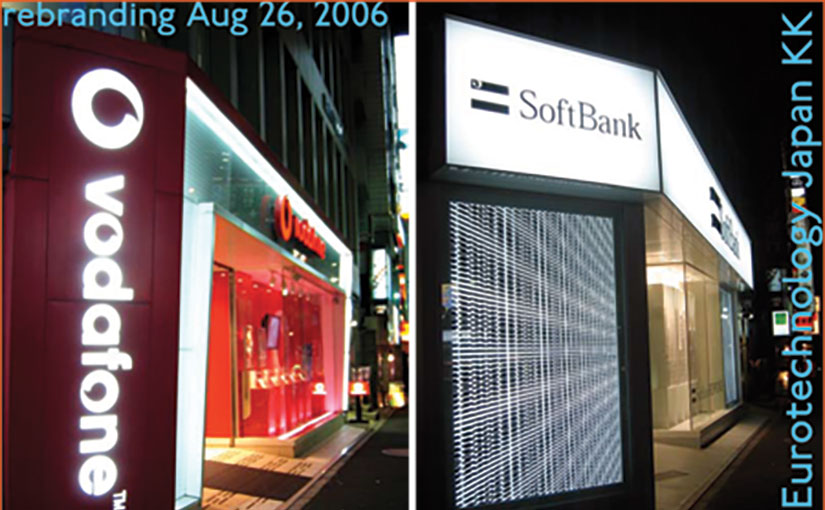
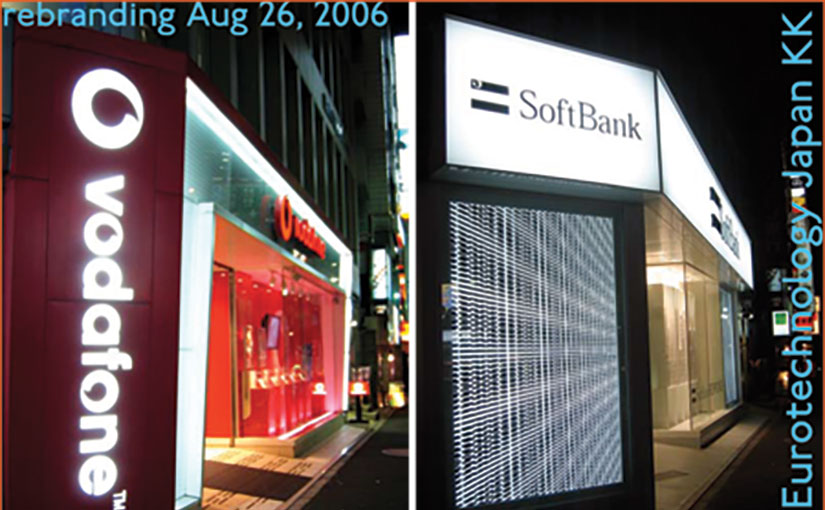
Yesterday (August 26, 2006) SoftBank opened the new Roppongi flagship store. SoftBank’s white/silver/grey colorscheme replaces Vodafone’s bright red:
Rebranding Vodafone KK’s former Roppongi flagship store to the SoftBank brand, after acquisition of Vodafone KK by SoftBankRebranding Vodafone KK’s former Roppongi flagship store to the SoftBank brand, after acquisition of Vodafone KK by SoftBank
Understand Softbank: our report: “SoftBank today and 300 year vision”
Japan is a couple of years ahead of Europe and US in mobile communications by most measures
What are GOOGLE and YAHOO doing in Japan’s mobile sector?
GOOGLE started mobile operations in Japan by partnering with KDDI (Japan’s No. 2 mobile operator with about 25 million mobile subscribers) to develop mobile search.
YAHOO-Japan made a large step forward when SoftBank acquired Vodafone’s Japan operations in March this year
Following the acquisition of Vodafone-Japan, SoftBank quickly turns round the company
Today, August 26, 2006, SoftBank (read our report on SoftBank here) opened the remodeled and rebranded Roppongi flagship store. The SoftBank Roppongi store is designed in light colors using a color scheme including mainly white, silver and grey, replacing Vodafone’s red. While Vodafone focussed on cost-cutting in Japan, SoftBank is now investing heavily, creating new stores and hiring store managers and assistants to revive and expand the chain of SoftBank stores.
“Flagship” stores are a concept which Vodafone introduced into Japan’s mobile industry – before Vodafone’s entrance to Japan, DoCoMo, J-Phone and KDDI/AU did not have specific flagship stores. Vodafone opened a flagship store in Shibuya, and shortly afterwards KDDI opened the KDDI Designing Studio in response. Because Vodafone’s initial Shibuya flagship store is in the middle of Shibuya’s entertainment district, the Roppongi-store, which was newly acquired by Vodafone, took a flagship role.
Vodafone recently decided to terminate business in Japan, and sold all Japan operations to SoftBank – Vodafone’s investment in Japan was the largest investment ever by any European company in Japan, about 7 times larger than Renault’s initial investment in Nissan…
This picture shows the flagship store in the new SoftBank dress, which opened on August 26, 2006
SoftBank transforms former Vodafone Roppongi flagship store
This picture shows the flagship Roppongi store before (left hand picture) and after (right hand picture) the brand change from Vodafone to SoftBank. The SoftBank branded store opened on August 26, 2006:
Vodafone’s former Roppongi flagship store rebranded as SoftBank store after SoftBank acquired Vodafone-Japan
An elegant color scheme based on silver/white/grey replaces Vodafone’s red:
odafone’s x-Roppongi flagship store rebranded as SoftBank store after SoftBank acquired Vodafone Japan
SoftBank’s white/grey/silver color scheme replaces Vodafone’s previous bright red dress – the “YAHOO-Cafe” (there is no coffee…) represents SoftBank’s strong cooperation with YAHOO-Japan – SoftBank is largest shareholder of YAHOO-Japan:
SoftBank Roppongi storeSoftBank Roppongi store
SoftBank’s 705SH mobile phone by SHARP includes a YAHOO-Button for direct access to YAHOO-Japan mobile content and services.
Yahoo! button on SoftBank phones
SoftBank’s flagship store includes a YAHOO spot – at the moment the YAHOO-spot is an empty place holder. The YAHOO-Spot is labelled YAHOO-Cafe – but there is no coffee…
Yahoo! Cafe inside the SoftBank store
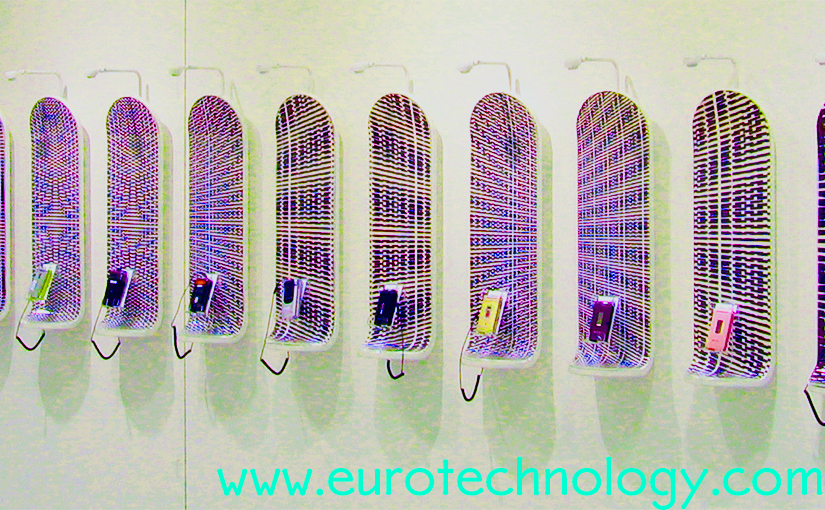
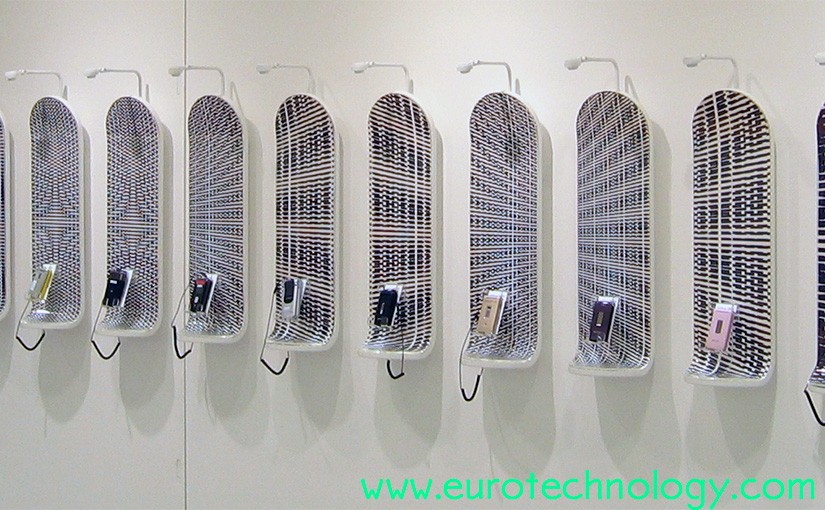
SoftBank’s phones are presented on surfboards:
SoftBank mobile phone display
Understand Softbank – our report: “SoftBank today and 300 year vision”
There is a lot of discussions about whether Steve jobs is going to announce an iPhone or iPod-Phone at the Apple Computer Developer’s Conference in SF – according to the headline report on Saturday May 13th, 2006 in Nihon Keizai Shinbun ( the world’s largest business daily ) it’s already known since May this year that Apple and SoftBank are developing such a joint mobile phone with iPod and iTunes functions.
On March 17 SoftBank announced the full acquisition of Vodafone’s Japan subsidiary – the former J-Phone – jointly with YAHOO-Japan as a co-investor – so with about 15 million mobile subscribers in the world’s most advanced mobile market (Japan), SoftBank/Apple will have the firepower to make such a phone a success, provided it’s tuned to Japanese consumers’ needs and dreams – my guess is that it probably will be.
By pure coincidence, the Apple/SoftBank headlines appeared one or two days after DoCoMo and Microsoft announced a music cooperation.
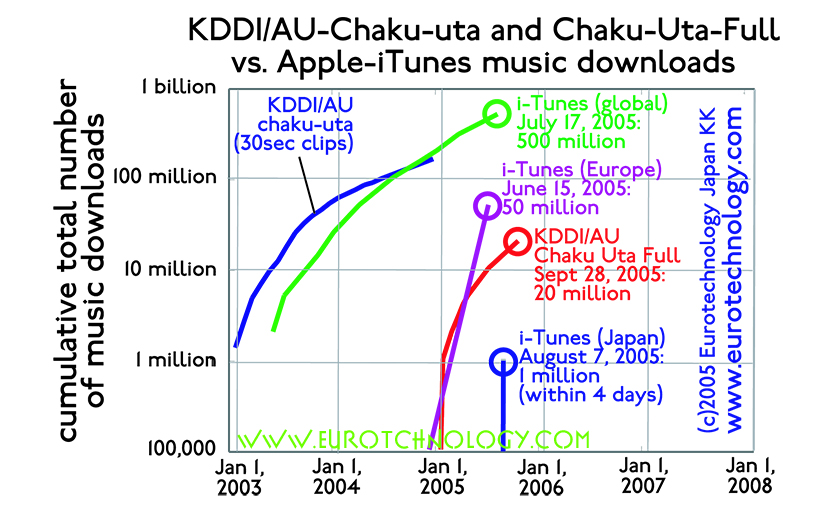
Apple/SoftBank iPod mobile phones coupled to iTunes could have quite a lot of impact on Japan’s music industry: about 20% of Japan’s music sales are to mobile phones. Of all music downloads in Japan about 6% are fixed line internet downloads, and 94% are music downloads to mobile phones: internet music downloads are almost neglibile in comparison to mobile phone music downloads.
Therefore even if iTunes has a huge market share in the fixed line internet world, iTunes cannot have much impact in Japan overall if limited to fixed line internet downloads. iTunes downloads to mobile phones will change the business models of Japan’s music industry – at the moment music downloads to mobile phones cost a lot more than iTunes downloads. An iPod/iTunes music store could reshape the mobile music market in Japan.