Category: telecommunications

mobile communications industry

  • GPS required for mobile phones in Japan from April 2007

    Japan’s Internal Affairs and Communications Ministry (Soumusho) is working to change regulations so that GPS is required on Japan’s mobile phones from April 2007.

    This move has been expected for some time, but apparently details will be announced later in 2005. Nikkei reports that the accuracy of the location determination should be on the order of 150 meters.

    Japan’s police receive about 9 million emergency calls per year, and Nikkei reports that about 1/2 of these are from mobile phones. For emergency calls from fixed line phones the precise location is communicated directly to the police and emergency service operators, however for mobile phones this is not the case, and the operators need to rely on the information given by the (often distressed) caller.

    The regulations will require for the mobile operators to communicate the location of emergency callers to the Police and Fire Service emergency center operators.

    Already for sometime KDDI sells almost all mobile phones with chips with built-in GPS (from Qualcomm), while all operators in Japan have developed a dense array of location based services which are deeply embedded in many mobile internet services. Today about 20% of mobile phones in Japan have GPS built-in, and we expect this ratio to increase to close to 100% around 2008-2010 (for more information consult our report on location based mobile services in Japan).

    Copyright·©1997-2013 ·Eurotechnology Japan KK·All Rights Reserved·

  • US$ 0.5 Billion/year m-commerce on a single train line?!

    We worked out that about US$ 0.5 Billion/year worth of train tickets for the Tokyo-Osaka Shinkansen train line are sold by mobile phone. Not a bad m-commerce record for a single train line. For details see our Mobile Payment report. The picture shows a Shinkansen train preparing to stop for 2-3 minutes in Nagoya on the way to Osaka:

    In 2005, the Tokyo-Osaka Shinkansen high-speed train line alone sold about US$ 0.5 billion in tickets via mobile commerce
    In 2005, the Tokyo-Osaka Shinkansen high-speed train line alone sold about US$ 0.5 billion in tickets via mobile commerce

    Copyright·©1997-2013 ·Eurotechnology Japan KK·All Rights Reserved·

  • KDDI may partner with Poweredcom/TEPCO

    Poweredcom has doubled investments in FTTH to YEN 44 Billion (US$ 0.4 Billion) for FY 2005/2006 from YEN 22 Billion in FY 2204/2005. (For details and analysis of Japan’s FTTH market read our report on Japan’s telecom sector).

    Partnership with KDDI‘s triple-play leverages Poweredcom’s present and future FTTH investments.

    Copyright·©1997-2013 ·Eurotechnology Japan KK·All Rights Reserved·

  • KDDI absorbs TuKa

    KDDI absorbs TuKa

    KDDI – Japan’s second largest telecom operator – streamlines the group

    KDDI’s AU with TuKa acquires 3.5 million additional subscribers

    KDDI announced to absorb the three TuKa companies into AU: with the stroke of a pen, AU will be stronger by 3.5 million subscribers.

    The three TuKa companies managed a successful turnround by focusing on the silver market. We think that KDDI will probably switch off TuKa’s 2G PDC network quite soon, as they have done with their own 2G/PDC network.

    TuKa had managed a successful turn-round recently, so it will not be a financial load on AU. KDDI will gain efficiency and economies of scale by concentrating all mobile services under the single AU brand with a single CDMA2000 network.

    Learn about KDDI and AU, Japan’s No. 2 telecom operator

    Report on “KDDI, AU and UQ Communications: pioneers of mobile music and flat data rates, analysis report” (approx 200 pages, pdf file)

    Copyright 1997-2013 Eurotechnology Japan KK All Rights Reserved

  • Wireless Japan 2005 Show (July 13-15, 2005 in Tokyo)

    Wireless Japan 2005 Show (July 13-15, 2005 in Tokyo)

    Six years into the wireless internet revolution which started February 1999 in Japan

    Docomo’s and KDDI’s latest wireless innovation, concept mobile phones, mobile payments

    Wireless Japan 2005 marks six years of mobile internet in Japan, which started February 1999 in Tokyo. Now in the sixth year, wireless internet, i-Mode and EZweb and J-Sky are maturing, mobile payment solutions are being introduced.

    Some highlights:

    • VOIP – 3G
    • fixed line – wLAN integration
    • first push-to-talk (PTT) appearance in Japan – will PTT arrive in Japan?
    • KDDI joined DoCoMo’s mobile FeliCa camp, and demos first EZ-FeliCa handsets and mobile SUICA
    • new 3G-entrant e-Mobile shows it’s flag
    • PHS-carrier Willcom from strength to strength
    • Vodafone again absent – focuses on turn-round

    Wireless Japan 2005: Mobile FeliCa wallet phones and mobile payment

    KDDI has timed it’s entry to DoCoMo’s mobile FeliCa camp to coincide with the time, when the railway nearfield payment card SUICA with 10 million users will join the mobile FeliCa system. KDDI demonstrated the first EZ-FeliCa phones:

    EZ-Felica: RFID payments for KDDI's AU mobile phones
    EZ-Felica: RFID payments for KDDI’s AU mobile phones

    DoCoMo is expanding the penetration for mobile FeliCa, demonstrating “TownPocket”: TownPocket is a FeliCa terminal, where users can link their phones via the FeliCa reader/writer interface to pick up local information. Possibilities are to bookmark automatically the URL of a shop or a sightseeing spot, or to send or receive an email with local information.

    “TownPocket”: information terminals linking RFID equipped phones to local area information
    EZ-FeliCa: RFID mobile payment gates for KDD-AU mobile phones
    EZ-FeliCa: RFID mobile payment gates for KDD-AU mobile phones
    Townpocket RFID check-in point
    Townpocket RFID check-in point

    Popularity of DoCoMo’s 901iS series accelerates DoCoMo’s transition to 3G.

    3G phones by Fujitsu: F3091iS
    3G phones by Fujitsu: F3091iS

    Fuel cells for mobile phones

    With mobile phones quickly becoming pocket sized music centers in competition to iPod’s but in much larger numbers, battery life is a problem. Fuel cells give hope for longer life till the next recharge. As you can see in the picture, the prototype fuel cells are still too large for daily use:

    Fuel cells for KDDI phones: fuel cell demonstrations for mobile phones have been demonstrated for many years at trade shows in Japan, but they have not made it to the market yet
    Fuel cells for KDDI phones: fuel cell demonstrations for mobile phones have been demonstrated for many years at trade shows in Japan, but they have not made it to the market yet

    Hitachi shows a prototype future generation phone with:

    • ultra-3G
    • digital terrestrial TV tuner
    • hard disk
    • fuel cell

    also shown is the recharge for the fuel-cell:

    Hitachi prototype: fuel cell powered mobile phone
    Hitachi prototype: fuel cell powered mobile phone

    Concept multimedia phones

    Futuristic concept phones are a tradition at the Wireless Japan show. The following images show multi-media concept phones:

    Concept phone models
    Concept phone models

    This flask-stile multimedia presenter shows images on flake-like suspended displays. Presentation of particular images helps to create the mood of the moment:

    Concepts
    Concepts

    Media phone:

    Concept phone
    Concept phone

    Digital rights management (DRM) concept study. Digital rights are sold in the style of wrapped sweets, and can be played or eaten. Dropping a digital-right-sweet into the receptacle plays the music or the video corresponding to this right. The sweets/DRMs can be eaten up after their value has been used up:

    Digital Rights Management (DRM) concepts
    Digital Rights Management (DRM) concepts

    e-Mobile

    e-Mobile is preparing for it’s debut in Japan’s mobile phone market, most likely from 2006 or 2007. While new mobile entrant Softbank was not at the Wireless Japan show, e-Mobile had a massive prototype and concept presentation.

    First presentations by new market entrant
    First presentations by new market entrant “em” eMobile
    First presentation by new entrant eMobile
    First presentation by new entrant eMobile “em”
    New entrant eMobile
    New entrant eMobile

    e-Mobile showed a range of concepts for the services being developed with partners Fujitsu and Lucent. Good phones and solid concepts, but nothing surprising yet at this stage.

    KDDI

    KDDI had a very large impressive show of AU’s range of mobile phones, business software applications, it’s range of mobile portals including comics, books, auctions, music and shopping, and EZ-FelIca’s debut as shown higher up. An attraction was a robot display, the robot is controled via blue-tooth by mobile phone:

    KDDI demonstration: mobile phone as a remote control for robots
    KDDI demonstration: mobile phone as a remote control for robots
    KDDI presents mobile phones as controllers for robots
    KDDI presents mobile phones as controllers for robots
    Mobile phones control robots
    Mobile phones control robots
    Mobile phones control robots
    Mobile phones control robots

    We have substantial documentation about the Wireless Japan 2005 exhibition, and most other year’s Wireless Japan exhibitions. If you need information or documentation for prior art or other investigations, please contact us.

    Learn more: report on Japan’s telecom sector (269 pages, pdf file):

    Copyright 1997-2013 Eurotechnology Japan KK All Rights Reserved

  • QR codes everywhere

    QR codes are everywhere in Tokyo – they have become probably one of the most important input tools for mobile phones…

    QR codes for mobile phones and smart phones all over Tokyo - here in Shinjuku
    QR codes for mobile phones and smart phones all over Tokyo – here in Shinjuku

    We published our brand-new QR code report today

    Copyright·©1997-2013 ·Eurotechnology Japan KK·All Rights Reserved·

  • IP backbone for Japan’s mobile operators

    Japan’s telecom operators are investing to build IP (Internet Protocol) backbone networks:

    IP backbone networks of Japan's mobile telecom operators
    IP backbone networks of Japan’s mobile telecom operators

    More: Japan Telecommunications report

    Copyright·©1997-2013 ·Eurotechnology Japan KK·All Rights Reserved·

  • Mobile operators invest US$ 15 billion

    Japan’s top three mobile operators DoCoMo, KDDI and Vodafone announced plans to invest about US$ 15 billion during FY 2005 (April 2005 – March 2006):

    Infrastructure investments (capex) by Japan's mobile phone operators - Vodafone's investments were systematically reduced and are by far the lowest of Japan's three large operators
    Infrastructure investments (capex) by Japan’s mobile phone operators – Vodafone’s investments were systematically reduced and are by far the lowest of Japan’s three large operators

    For recent financial data and analysis of Japan’s telecom and mobile sector: Eurotechnology report on Japan’s telecom industries

    Find details about SoftBank’s acquisition of Vodafone KK (Vodafone’s Japan company) in our SoftBank report

    Copyright·©1997-2013 ·Eurotechnology Japan KK·All Rights Reserved·

  • Location based services in Japan

    About 20% of mobile phones have GPS in Japan, and both KDDI and DoCoMo are integrating location based services into their mobile internet services EZweb and i-Mode. We completed a report on location based services in Japan Eurotechnology Report on location based services and mapping in Japan.

    Copyright·©1997-2013 ·Eurotechnology Japan KK·All Rights Reserved·

  • KDDI’s net income increases +71%

    On April 28, 2005 KDDI‘s CEO Tadashi Onodera, announced spectacular results for the financial year April 2004 – March 2005. Net income increased by 71% and KDDI announced approximately US$ 4 Billion in investment capital expenditure for the financial year 2006 (April 2005 – March 2005).

    We prepared a 230 page analysis of KDDI’s businesses

    Net income of KDDI
    Net income of KDDI

    KDDI investments (capex)
    KDDI investments (capex)

    Copyright·©1997-2013 ·Eurotechnology Japan KK·All Rights Reserved·

  • Mobile Payment Forum meeting in Tokyo

    Mobile Payment Forum meeting in Tokyo

    Mobile Payment Forum and Eurotechnology Japan KK jointly organize the Mobile Payment Forum meeting in Tokyo

    Japan leads the world in mobile payments and m-commerce

    by Gerhard Fasol

    The Mobile Payment Forum promotes usage of mobile phones for payments, and works on interoperability, usability and standardization issues.

    The major credit card companies (VISA, Mastercard, American Express…) together with the leading mobile phone makers (Nokia, Motorola, NEC…), and mobile operators (Vodafone, DoCoMo, TIM, T-Mobile, Sprint…) lead the Mobile Payment Forum.

    On April 4, 2005, the Members and Directors for the first time held their meeting in Tokyo

    On April 4, 2005, the Members and Directors for the first time held their meeting in Tokyo. Eurotechnology Japan KK took part in the organization of the meeting, and Gerhard Fasol gave an almost 2 hour long keynote presentation about mobile payment in Japan.

    Mobile Payment Forum discovers KDDI, introduced by Eurotechnology Japan KK

    At this meeting, I also had the opportunity to introduce KDDI to the Mobile Payment Forum – there was no previous relationship between KDDI and Mobile Payment Forum.

    KDDI gave a keynote, and explained KDDI’s mobile payment business, and in particular also the recent success of mobile books, mobile novels, and mobile manga: ebooks, novels and manga specially produced for mobile phones.

    Mobile Payment Forum Member’s meeting in Tokyo: “Mobile Payment Forum is a cross-industry organization launched in November 2001 to create a framework for standardized, secure and authenticated mobile payments, based on payment card accounts. The Forum intends to quickly and efficiently act as the bridge between the mobile and financial industries to accelerate the maturity of the mobile marketplace”.

    Mobile payment Japan, e-money and mobile credit report:

    Copyright (c) 1997-2013 Eurotechnology Japan KK All Rights Reserved

  • Chaku-Uta-Full: 5 million mobile music downloads in Japan

    Chaku-Uta-Full: 5 million mobile music downloads in Japan

    KDDI pioneers full lengths mobile music song downloads via 3G

    Chaku Uta Full achieves 5 million downloads by April 3, 2005

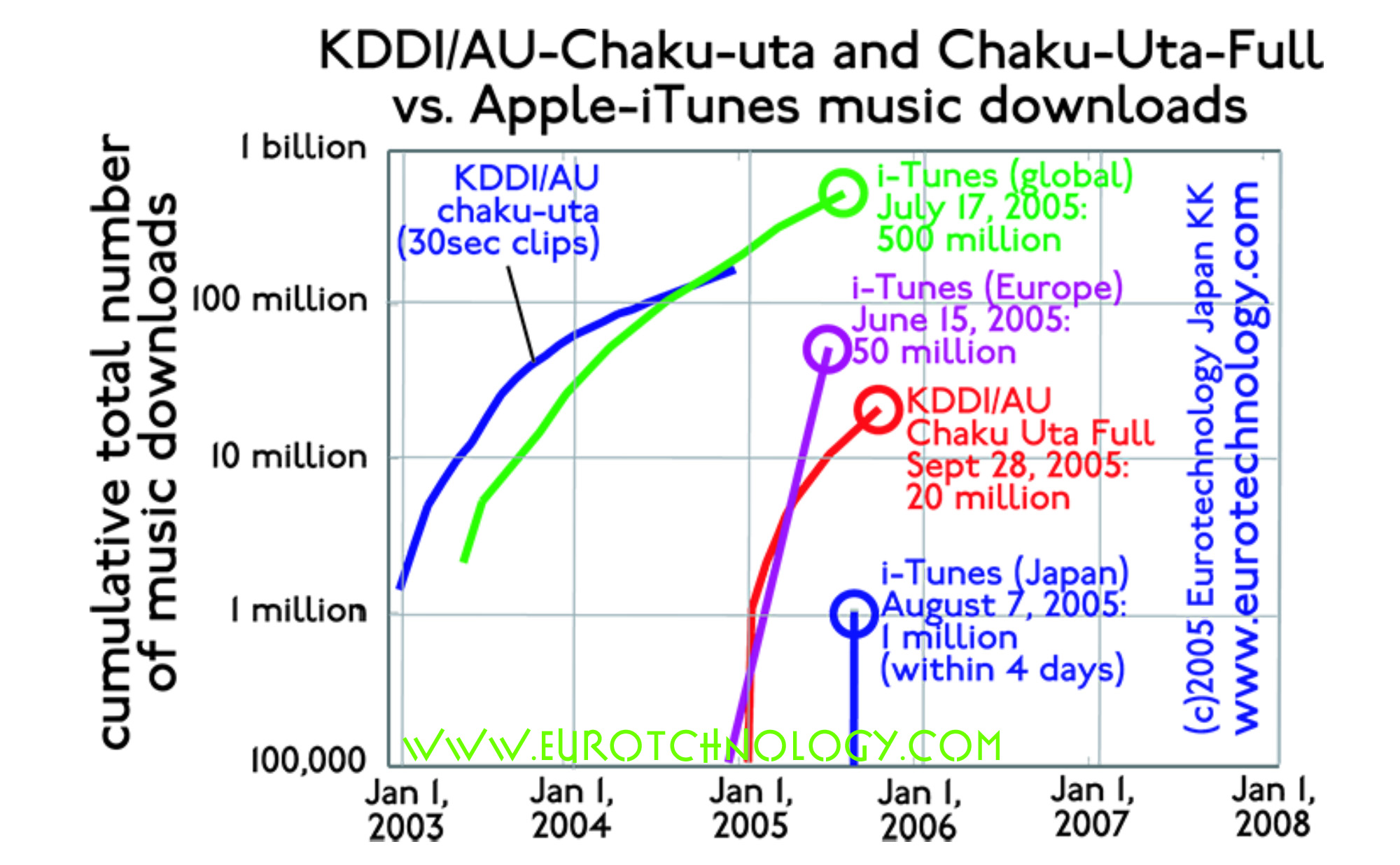
    KDDI/AU announced that 5 Millions Chaku-Uta-Full songs have been downloaded until April 3, 2005.

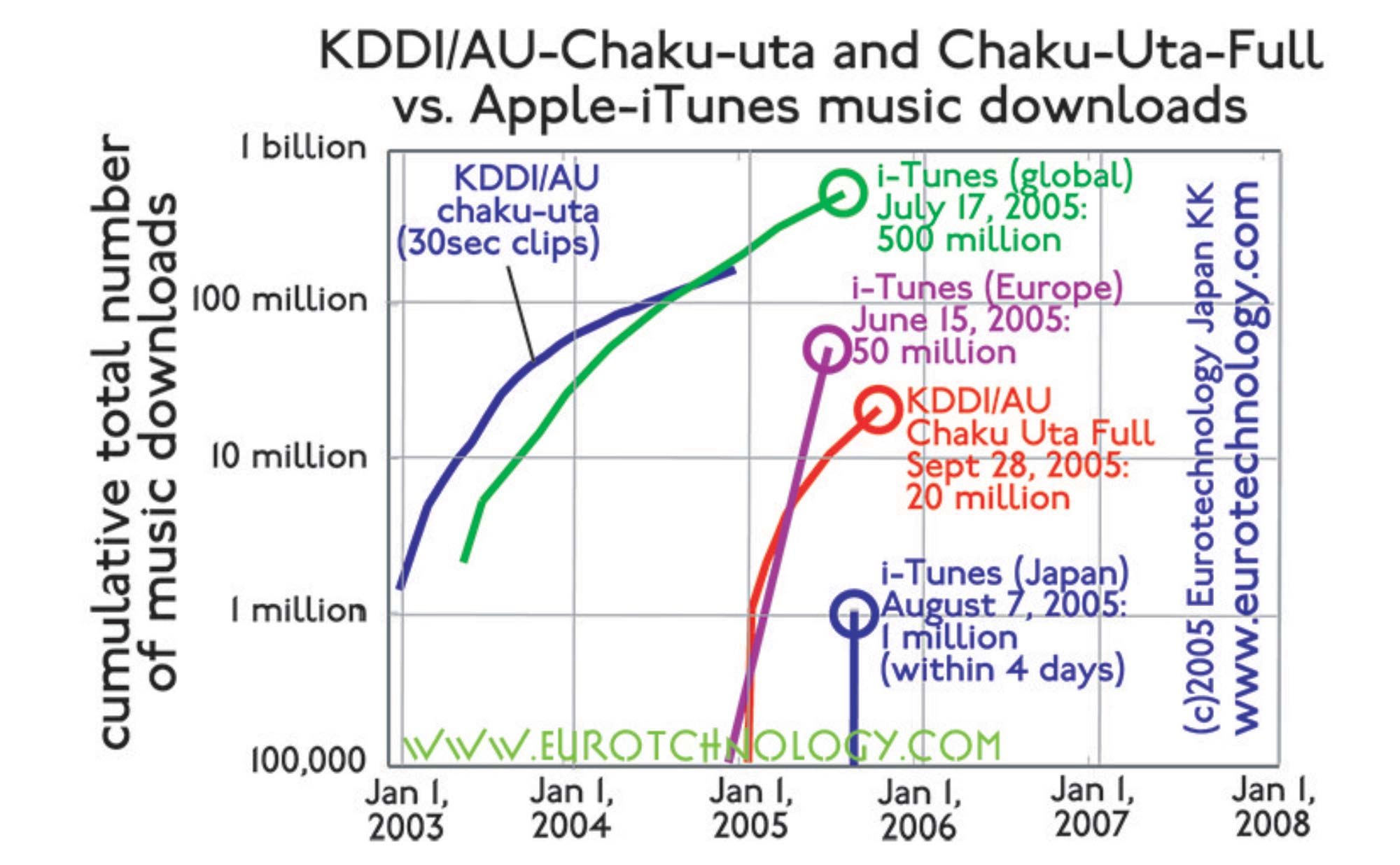
    KDDI/AU chaku-uta and chaku-uta-full music downloads vs iTunes global downloads
    KDDI/AU chaku-uta and chaku-uta-full music downloads vs iTunes global downloads

    Download our 230 page analysis of KDDI/AU

    Download our “mobile music” report

    Note added: on June 15, 2005, KDDI reported 10 million Chaku-Uta-Full downloads…

    Copyright (c) 1997-2013 Eurotechnology Japan KK All Rights Reserved

  • Japan’s mobile subscriber data for March 2005

    March is the month when new subscriptions peak in Japan. During March 2005 around one million new subscribers signed up for mobile services in Japan, the net gain (new subscriptions minus cancellations) was 930,500. New subscribers were shared as follows between carriers:

    DoCoMo: + 480,200 (+ 51.6%)
    KDDI/AU: + 436,100 (+ 46.9%)
    WILLCOM: + 33,300 (+ 3.6%)
    KDDI/TuKa: – 2,600 (- 0.3%)
    Vodafone: -7,400 (-0.8%) (previous counting method: -58,400)
    Astel: – 9,100 (- 1.0%)

    TOTAL: + 930,500 (100%)

    Vodafone announced a new method to calculate numbers. Without this new way of calculating, Vodafone’s loss would have been: -58,400

    Net growth (loss) of subscribers per month for Japan's mobile operators - Vodafone drops into the red, losing subscribers despite a new way of counting them
    Net growth (loss) of subscribers per month for Japan’s mobile operators – Vodafone drops into the red, losing subscribers despite a new way of counting them

    Net growth (loss) of mobile internet subscribers (i-Mode, EZweb and Vodafone Live!): since Vodafone renamed Jsky to Vodafone Live!, its rapidly losing market share
    Net growth (loss) of mobile internet subscribers (i-Mode, EZweb and Vodafone Live!): since Vodafone renamed Jsky to Vodafone Live!, its rapidly losing market share

    Copyright·©1997-2013 ·Eurotechnology Japan KK·All Rights Reserved·

  • Briefing the President of Germany, Horst Köhler: Japan is a technology super power full of creativity and power to innovate

    Briefing the President of Germany, Horst Köhler: Japan is a technology super power full of creativity and power to innovate

    Japan technology briefing for the President of Germany, Horst Köhler

    Japan is a technology super power full of creativity and power to innovate

    Tokyo, April 3, 2005

    Briefing given to the President of Germany, Horst Koehler, and his wife, by Gerhard Fasol in the German Embassy, Tokyo, on April 3, 2005, at the beginning of the President’s official visit to Japan to open the “German Year in Japan”. Accompanying President Horst Koehler were 20-30 leaders of Germany, including Members of Parliament, the President of the German Federation of Industry – the German Ambassador to Japan was chairing the meeting.

    1 Excellency, Dear President: Japan is a technology super power

    Japan is a technology super power, with strong creativity and power to innovate. I would like to illustrate this fact with a few examples, how innovation in Japan creates new industry sectors and new employment, I would like to describe some consequences for Germany and for Europe, and express some recommendations.

    • Many inventions, which change the world and which create employment, come from Japan. I would like mention two examples here:
      • Gallium-Nitride light emitting diodes replace light bulbs and fluorescent tubes for illumination and displays
      • The mobile internet changes our life, started in Japan and it’s development is most advanced in Japan
      • There are many more technology breakthroughs and inventions from Japan, for example carbon nano-tubes or electronic money
    • Interaction with Japan enforced total restructuring of leading US companies, including INTEL and MOTOROLA. According to my knowledge, there are almost no European companies yet which were forced to totally restructure their business due to interaction with Japan. I feel that this may happen in the future.
    • Was does this mean for Germany and Europe?
      • In Japan, as everywhere else, innovation is driven by individual ‘heroes’— not by industry associations or government: Europe should even more than today empoyer individuals
      • One way to empower creative European ‘heroes’ is for Europe to introduce as quickly as possible a single, cheap and efficient European Patent
      • Technology cooperation is not an aim in itself, but it should achieve well defined and measurable targets

    2 Gallium-Nitride light emitting diodes (blue LEDs) are changing the illumination industry and our lives

    Thomas Alva Edison invented light bulbs in 1879 (US Patent No. 223, 898). Glass tubes in radio and television receivers have been replaced a long time ago by semiconductors. Semiconductors use far less energy, have a longer operational lifetime, and are much more friendly to the environment.

    About 15 years ago, Shuji Nakamura invented the technologies[1] to replace light bulbs and fluorescent tubes by semiconductors, in same way as this has happened in radios and television receivers a long time ago. Shuji Nakamura invented these technology in a small company, Nichia Kagaku Kougiyou, located in Anan, about two hours by airplane from Tokyo. He achieved these breakthrough inventions essentially on his own and with great personal sacrifice.

    3 Japan is pioneering the mobile internet

    • Today the mobile internet is a major component of the economy of Japan
    • While “third generation” (3G, UMTS) mobile communication systems with 384 kbps data transfer rates is being introduced this year in Europe after many delays, mobile internet deployed nationwide in Japan since 2003 by the Japanese company KDDI already has six times higher speed (2.4 Mbps = 2400 kbps) since several years ago. This higher speed enables for example the transmission of full music works, which is not yet practical in Europe, and contributes to the development of new industries in Japan, which cannot yet thrive in Europe, because the infrastructure is not yet in place in Europe.
    • Mobile music is revolutionizing the music industry. Already today about 20% of music sales is via the mobile internet.
    • Mobile books revolutionize our literary culture. During January 2005 alone, KDDI/AU (Japan’s second largest mobile operator) sold 50,000 electronic books on the mobile internet.
    • Why was the mobile internet developed in Japan and not in Europe? A determining factor is research and development: NTT does considerably more research and development than European telecommunications companies. Therefore, already in 1997, Japan had a national packet switched mobile data network, many years before Europe introduced GPRS (Europe’s first version of a packet switched mobile data network).
    • Japan’s mobile internet was enabled by a small number of heroic pioneers: I would like to emphasize the work by a Japanese woman—Matsunaga Mari. The mobile internet in Europe also owes much to her genius.

    4 Interaction with Japan changes technology industries

    Japan’s technology industries some years ago caused US electronics companies including INTEL and MOTOROLA to restructure totally. Could the German automobile industry expect similar interactions with Japan?

    What is the significance for Germany? Technologies and business models are globally valid. Therefore Japanese innovations, such as light emitting diodes or mobile phones unavoidably reach Germany. Interaction with Japan have forced leading US corporations including INTEL and MOTOROLA to totally restructure: INTEL switched it’s entire business from memory chips to CPUs because of Japanese competition. With increasing interaction between Japan and Germany, I expect similar impact by Japan on Germany in the future.

    As an example, I would like to mention the automobile industry sector. Toyota’s market capitalization is US$ 122 Billion, while DaimlerChrysler’s is around US$ 45 Billion, almost three times smaller. It is therefore obvious that Toyota by increasing business activities in Europe, can have major impact on the largest European car companies. Similar factor three ratios exist between the valuations of Honda and Volkswagen, Nissan and BMW: Honda as well as Nissan enjoy about three times higher valuations by the international investment community than Volkswagen and BMW. I recommend therefore European companies not to neglect Japan.

    As an example, we are at present preparing project work with a US company, which will invest about US$ 2 Billion globally this year in new production—100% of this high-technology production investment will be in Japan.

    5 Empower individual inventors and engineers: The European Patent

    Researchers and companies in Japan and the USA have a great home advantage compared to European researchers and companies, because Japan and the USA have a simple and cost efficient patent system. The table below, taken from an official EU-Website[2] shows that obtaining patent protection for Europe is much more complicated and much more expensive than for USA and Japan. In actual fact, the real situation is even more dramatic than the official table from the EU website shows: in real life, US patents are obtained much cheaper than shown in this table, and obtaining patent coverage for all European countries is much more expensive than the case of 8 countries shown in the table, which only gives protection in a minority of European countries.

    A cost efficient and simple European Patent is necessary to correct this European home-disadvantage

    6 Why technology cooperation?

    An eminent US committee of experts some time ago examined technology cooperation with Japan and optimization with respect to US interests. This committee concluded that technology cooperation is not an aim in itself, but there should be measurable targets. The committee found that a suitable target is the creation of highly paid employment in the USA.

    I would recommend, that in case increased technology cooperation with Japan is discussed during the German Year in Japan, that in the same way as the USA did, also Germany examines technology cooperation with Japan overall, and orients technology cooperation towards measurable targets. I can well imagine that creation of highly paid employment in Germany could also be a good way to measure the value of individual cooperation projects.

    7 My recommendations for Germany and Europe:

    • In Japan as anywhere else, innovation and break throughs are driven by single individuals, not by institutions or government authorities. Therefore: empower individual researchers and developers and engineers
    • A user friendly, quick, simple and cost efficient European Patent should be introduced to remove Europe’s handicap for research and innovation compared to US and Japan
    • For many German companies the best strategy is not China or Japan, but: China and Japan
    • For many US companies Japan is the largest and most important foreign market. For a long time, Japan has been neglected in Germany. Business with Japan creates jobs in Germany.
    • Technology cooperation with Japan is not an aim in itself. There must be a measurable target. An eminent US committee examined this question, and reached the conclusion that technology cooperation with Japan should create highly paid employment in the USA. I recommend that German technology cooperation with Japan should also be targeted to achieve a desirable target, such as the creation of highly paid employment in Germany.

    Japan technology – References

    1. Shuji Nakamura, Gerhard Fasol, Stephen J. Pearton, ‘The Blue Laser Diode: The Complete Story’, Springer Verlag (Heidelberg, 2nd Edition, October 2, 2000), ISBN: 3540665056
    2. http://europa.eu.int/comm/internal−market/en/indprop/patent/2k-41.htm
    3. Gerhard Fasol, ‘New Opportunities versus old Mistakes: foreign companies in Japan’s high-tech world’, presentation at Stanford University, (Oct 28, 1999)

    Copyright notice: photograph of the The President of Germany Horst Köhler is public domain, see Wikipedia here.

    Download Gerhard Fasol’s presentation to German President Horst Koehler

    If you need the German original or the English translation of Gerhard Fasol’s presentation to German President Horst Koehler please contact us

      Copyright 1996-2019 Eurotechnology Japan KK All Rights Reserved

    • e-Access and Lucent announce HSDPA tests in Japan

      e-Access Chairman & CEO, Sachio Semmoto and Lucent Chairman & CEO Patricia Russo on March 30, 2005 in Tokyo, explained their joint tests of HSDPA services in Tokyo. e-Access is preparing to enter Japan’s mobile communications industry with the brand “e-Mobile”, and is currently conducting tests with Lucent and Fujitsu as equipment providers.

      Former US Ambassador to Japan, Thomas Foley, presenting his wishes for the Lucent-eAccess cooperation:

      US Ambassador Foley speaks a the conference announcing the cooperation between Fujitsu and Lucent to trial HSDPA network equipment for eMobile, while Lucent CEO Patricia Russo and eAccess/eMobile CEO Sachio Semmoto watch
      US Ambassador Thomas Foley speaks a the conference announcing the cooperation between Fujitsu and Lucent to trial HSDPA network equipment for eMobile, while Lucent CEO Patricia Russo and eAccess/eMobile CEO Sachio Semmoto watch

      Sachio Semmoto and Patricia Russo answering questions having presented their visions of new mobile services in Japan:

      Lucent CEO Patricia Russo and eAccess/eMobile CEO Dr Sachio Semmoto at the conference announcing their joint network tests
      Lucent CEO Patricia Russo and eAccess/eMobile CEO Dr Sachio Semmoto at the conference announcing their joint network tests

      e-Mobile’s logo:

      em = e-Mobile's interim logo (which was later changed)
      em = e-Mobile’s interim logo (which was later changed)

      Copyright·©1997-2013 ·Eurotechnology Japan KK·All Rights Reserved·

    • Japan mobile subscriber data for Feb 2005

      Japan’s mobile subscriber numbers for Feb 2005 came out yesterday…

      DoCoMo is ahead again after a soft period on the strength of services and handsets, and KDDI/AU is still going strong driven by the designer series, good tariffs/discounts, music, WIN etc.

      Willcom (the former DDI-Pocket) is strengthening under new management, new name and new campaigns and network upgrades, TuKa is falling back after it’s great “TuKa-S” success… and Vodafone succeeded to stabilize subscriber losses somewhat which is a mild step in the right direction and might be the first indication of Mr Tsuda’s influence…

      Stimulated by the needs of our customers, who need to roll out services across the networks in Japan, we have started market surveys, interviewing mobile phone customers of all kinds on Tokyo’s streets in “focus groups”, as we do when required for our customers to get a feel for the market. I always make a point to take part personally in such consumer research, and often do some myself. In the case of mobile phone habits, the first approach at interviewing just reflects back the messages of the commercials and publicity campaigns. Only in-depth interviewing and discussion then reveals the real thoughts which are normally quite different. We learnt a lot about what average Japanese consumers think about DoCoMo, AU and Vodafone, building up a good picture. But the numbers also tell a clear story:

      Subscriber net growth/loss for Japan's mobile phone and PHS operators
      Subscriber net growth/loss for Japan’s mobile phone and PHS operators

      Copyright·©1997-2013 ·Eurotechnology Japan KK·All Rights Reserved·

    • Chaku-uta-full: 3 million mobile music downloads

      Chaku-uta-full: 3 million mobile music downloads

      Japan is the pioneer of mobile music

      Ringing tones and mobile music are pioneered in Japan

      Put until mid-2004, cumulatively KDDI (Japan’s No. 2 mobile operator) sold more “chaku-uta” mobile music song clips in Japan alone than Apple sold music via iTunes globally.

      This fact shows both the power of mobile music, and also the size of Japan’s mobile markets in terms of cash sales.

      KDDI/AU reports 3 million Chaku-uta-full (full song) downloads since it’s start on November 19, 2004:

      KDDI sells approximately as many chaku-uta music clips as iTunes sells music globally demonstrating the enormous size of Japan's mobile music market
      KDDI sells approximately as many chaku-uta music clips as iTunes sells music globally demonstrating the enormous size of Japan’s mobile music market

      More in our “Mobile Music Japan” report.

      Copyright (c) 1997-2013 Eurotechnology Japan KK All Rights Reserved

    • Vodafone CEO Arun Sarin wants Vodafone to be in Japan for 10, 20, 30 years

      Vodafone CEO Arun Sarin wants Vodafone to be in Japan for 10, 20, 30 years

      Shiro Tsuda, 津田志郎, CEO of Vodafone Japan

      Vodafone CEO Arun Sarin wants to stay in Japan for the long term according to Bloomberg

      by Gerhard Fasol

      In February 2005 Shiro Tsuda (津田志郎, CEO of Vodafone KK for a few weeks) told Bloomberg that global “Vodafone CEO Arun Sarin wants Vodafone in Japan for 10, 20, 30 years”.

      Vodafone recruits Shiro Tsuda, 津田志郎, the No. 1 founding employee of NTT’s mobile division

      It appeared that Vodafone KK – with the help of a major headhunting firm – had staged a major success, when Vodafone KK headhunted Mr Shiro Tsuda as their Japan-CEO as of December 1, 2004. Mr Shiro Tsuda was the founding employee No. 1 of NTT’s mobile phone division, which later became NTT-docomo.

      Shiro Tsuda quits a few months later

      This temporary success turned into an embarrassment for Vodafone KK when a few months later, Mr Shiro Tsuda, resigned from his Vodafone KK-CEO position, became non-executive Chairman of Vodafone KK, and soon after left Vodafone altogether.

      About one year after Vodafone-CEO Arun Sarun declared in February 2005 that Vodafone had the intention to remain in Japan for 10, 20, 30 years, on Friday March 17, 2006, Vodafone and Softbank announced that Vodafone sells Vodafone KK (the totality of all Vodafone operations in Japan) to Softbank, and terminated all operations in Japan.

      Understand Softbank: our report: “SoftBank today and 300 year vision”

      pdf file, approx 120 pages, 47 figures 18 photos, 7 tables

      Copyright 2013 Eurotechnology Japan KK All Rights Reserved
    • Vodafone’s challenges in Japan: Businessweek and Economist analyze the facts

      Vodafone’s challenges in Japan: Businessweek and Economist analyze the facts

      Vodafone’s challenges in Japan’s advanced telecommunications markets catch attention

      Will Vodafone stay in Japan or give up and pull out?

      Vodafone’s challenges in Japan: BusinessWeek and The Economist both analyze and comment on Vodafone’s business situation in Japan, where the mobile internet was first implemented successfully starting in February 1999, far earlier than anywhere else in the world.

      Understand Softbank: our report: “SoftBank today and 300 year vision”

      pdf file, approx 120 pages, 47 figures 18 photos, 7 tables

      Copyright 1997-2013 Eurotechnology Japan KK All Rights Reserved

    • Financials: DoCoMo, KDDI, Vodafone

      The following figure compares Sales (Financial year ending March 31, 2004), Net profits after taxes(Financial year ending March 31, 2004), and market capitalization (as of February 17, 2005) for DoCoMo, KDDI and Vodafone (in each case consolidated for the global company):

      Sales, net income and market cap for docomo, KDDI and Vodafone
      Sales, net income and market cap for docomo, KDDI and Vodafone for the financial year 2004

      Copyright·©1997-2013 ·Eurotechnology Japan KK·All Rights Reserved·

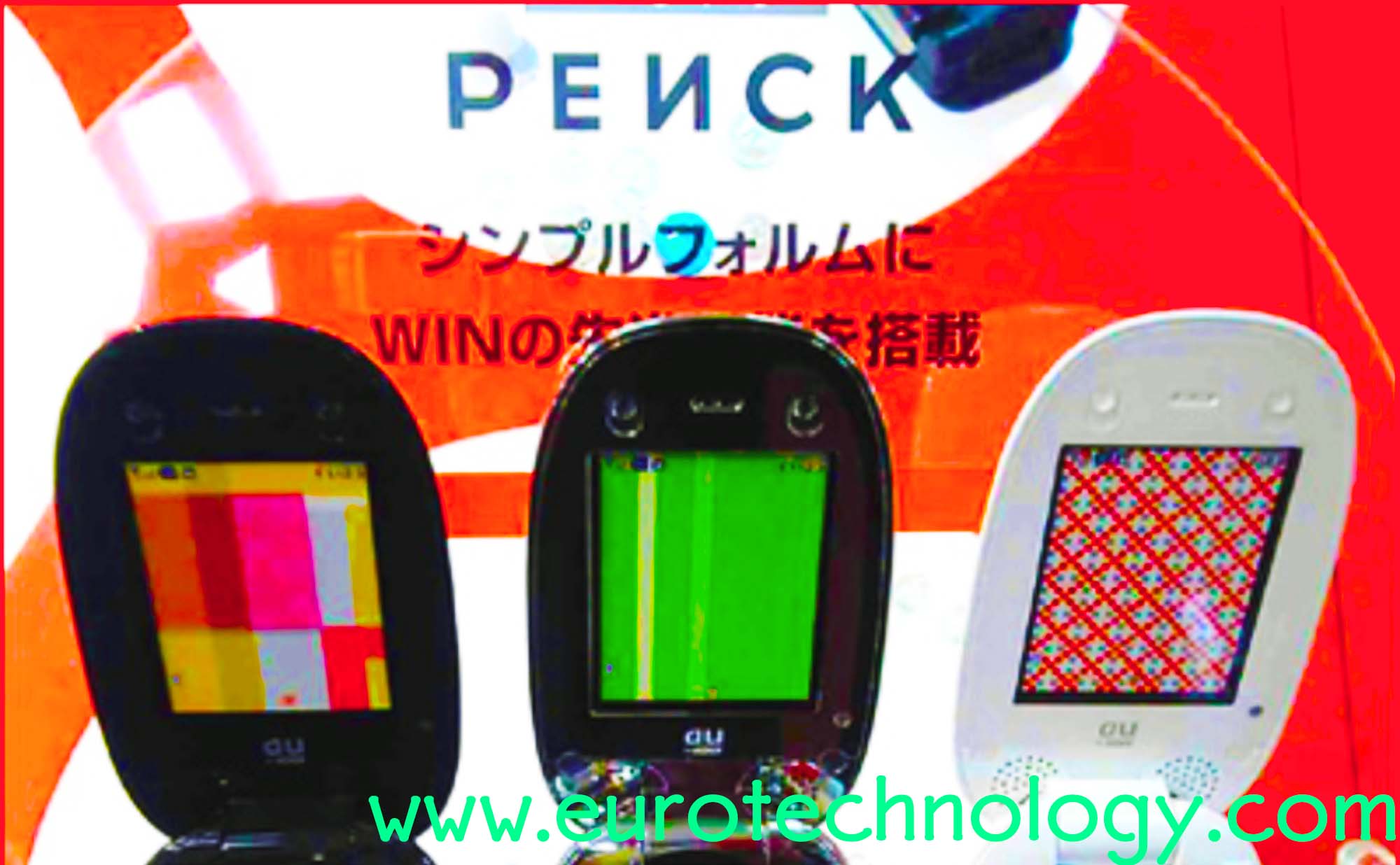
    • PENCK (KDDI-AU Designer Series)

      PENCK (KDDI-AU Designer Series)

      KDDI/AU Designer Series Model PENCK

      designed by Makoto Saito Design Office Inc.

      Today, February 18, KDDI-AU introduced PENCK – the latest model in the Designer Series, designed by Makoto Saito Design Office Inc.:

      Designer: Makoto Saito Design Office Inc.
      Data rate = 2.4 Mbps
      Music = Chaku-Uta-Full, stereo speakers
      Camera = 1.24 Megapixel, incl QR barcode reader
      GPS = incl. Naviwalk navigation
      and more…

      When I was asked to brief the President of Germany, Horst Koehler, on Japan’s technology sector, KDDI kindly loaned me PENCK-phones, which I used in one of the demonstrations for President Koehler of Japan’s mobile phone industry.

      PENCK phone by Makoto Saito Design Office for KDDI designer series
      PENCK phone by Makoto Saito Design Office for KDDI designer series
      PENCK phone by Makoto Saito Design Office for KDDI designer series
      PENCK phone by Makoto Saito Design Office for KDDI designer series

      Japan telecommunications industry report

      Copyright (c) 1997-2013 Eurotechnology Japan KK All Rights Reserved

    • QR-codes everywhere…

      QR-codes everywhere…

      QR-codes (QR =Quick Response) seem to be everywhere. Amazon.co.jp has an i-Appli, which reads the ISBN from the barcode on the back of a book and takes you directly to the Amazon.co.jp i-mode site to order the book instead of buying it in the bookshop.

      People in the mobile industry have QR-codes on their business cards:

      QR code on business cards
      QR code on business cards

      Download our report on QR code applications for mobile phones in Japan
      Download our report on QR code applications for mobile phones in Japan

      Copyright·©1997-2013 ·Eurotechnology Japan KK·All Rights Reserved·

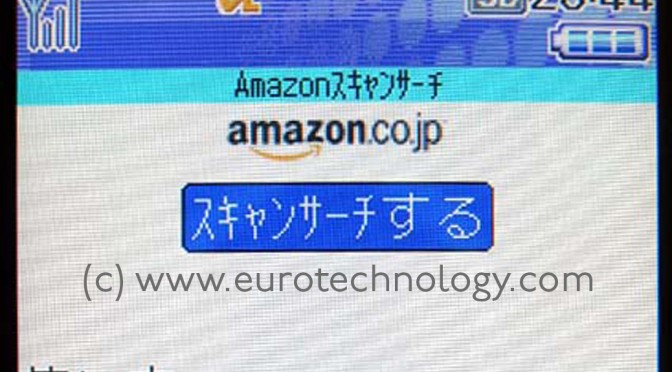
    • Amazon.co.jp captures mobile purchases directly inside competing brick-and-mortar stores with barcode i-appli

      Amazon.co.jp captures mobile purchases directly inside competing brick-and-mortar stores with barcode i-appli

      Amazon.co.jp introduced a barcode reader i-Appli (JAVA application for DoCoMo’s i-Mode phones), with which shoppers in brick-and-mortar stores can directly compare the prices with Amazon.co.jp’s mobile webstore prices. If the shopper prefers, he/she can order directly by i-Mode mobile phone from Amazon.co.jp online while still standing in front of the shelves of the brick-and-mortar store.

      With this barcode reading mobile phone application (i-Appli), Amazon.co.jp is directly taking the competition into brick-and-mortar stores, battling on the same ground.

      User interface of Amazon.co.jp’s barcode reading i-Appli – click to scan:

      With Amazon.co.jp's barcode scan application customers shopping in a store can compare prices with Amazon.co.jp's ecommerce prices, and if cheaper, can order from Amazon.co.jp directly
      With Amazon.co.jp’s barcode scan application customers shopping in a store can compare prices with Amazon.co.jp’s ecommerce prices, and if cheaper, can order from Amazon.co.jp directly from the mobile phone

      The customer can directly scan the barcode with his/her Docomo i-Mode phone, and the Amazon.co.jp barcode i-Appli:

      Customer scans the barcode in a store using the Amazon.co.jp bar code application on a DoCoMo i-mode phone
      Customer scans the barcode in a store using the Amazon.co.jp bar code application on a DoCoMo i-mode phone

      On the next screen Amazon.co.jp’s i-Appli shows the same product’s page in the Amazon.co.jp mobile store. The customer can directly order with one click if he/she prefers Amazon.co.jp’s offer instead of the brick-and-mortar store, where he/she is currently shopping. This i-Appli allows Amazon.co.jp to catch customers from within traditional stores.

      After scanning the barcode, the Amazon.co.jp i-appli directly shows the price and order page of the same product on the Amazon.co.jp mobile site
      After scanning the barcode, the Amazon.co.jp i-appli directly shows the price and order page of the same product on the Amazon.co.jp mobile site

      Read our QR-code report for in-depth analysis and lots of applications of QR-codes and bar codes in Japan.

    • Music on mobile – as a killer application

      Music on mobile – as a killer application

      More Chaku-Uta mobile music downloads by KDDI in Japan than by Apple’s iTunes globally

      Turns out that music is a killer application on mobile – we are working on a number of projects in the mobile music field. We just completed our “Mobile Music Japan” report.

      With an incredibly much smaller potential customer base KDDI/AU delivered more downloads of 20-30 second songs (chaku-uta) than Apple’s i-Tunes. Motorola reportedly announced a mobile phone incorporating i-Tunes at the recent CES show in Las Vegas. KDDI/AU‘s tremendous success with chaku-uta indicates that combining Motorola phones with i-Tunes will be very successfull indeed. AU reported 1 million Chaku-Uta-Full downloads within the first 48 days of service (chaku-uta-full started on November 19, 2004).

      Copyright (c) 1997-2013 Eurotechnology Japan KK All Rights Reserved

    • Scenarios for Japan’s mobile eco-systems (for Finland’s technology agency TEKES)

      Finland’s Government R&D and technology agency TEKES engaged our company to prepare input for the planning of TEKES’ five year VAMOS project on mobile services.

      Download one of our reports entitled “Scenarios for Japan’s mobile eco-systems” from the TEKES website

      Copyright·©1997-2013 ·Eurotechnology Japan KK·All Rights Reserved·

    • Cisco-VP: "In the future Internet business models will come from Japan"

      In today’s Wallstreet Journal (Dec 7, 2004), Mike Volpi, Senior VP of CISCO’s routing technology group, is quoted as saying:

      “In the past the internet business models, technologies and applications were all coming from the US, but today, through broadband, Japan is about to become the number one country in the area of Internet. In the future, I believe Internet business models will come from Japan.”

      More about broadband and internet in Japan in our report: “Japan’s Telecommunication Industry” (pdf-file)

      For the full article, see: “Fujitsu, Cisco plan to team up on routers” (Wallstreet Journal, Dec 7, 2004, subscription required)

      CISCO announced to open an R&D Center in Japan in the first half of 2005: “Cisco Invests US $12 Million in Japanese R&D Center”.

      Read an interview with Mike Volpi here: “Mike Volpi on Why Cisco is Investing in a New R&D Center in Tokyo, Japan”.

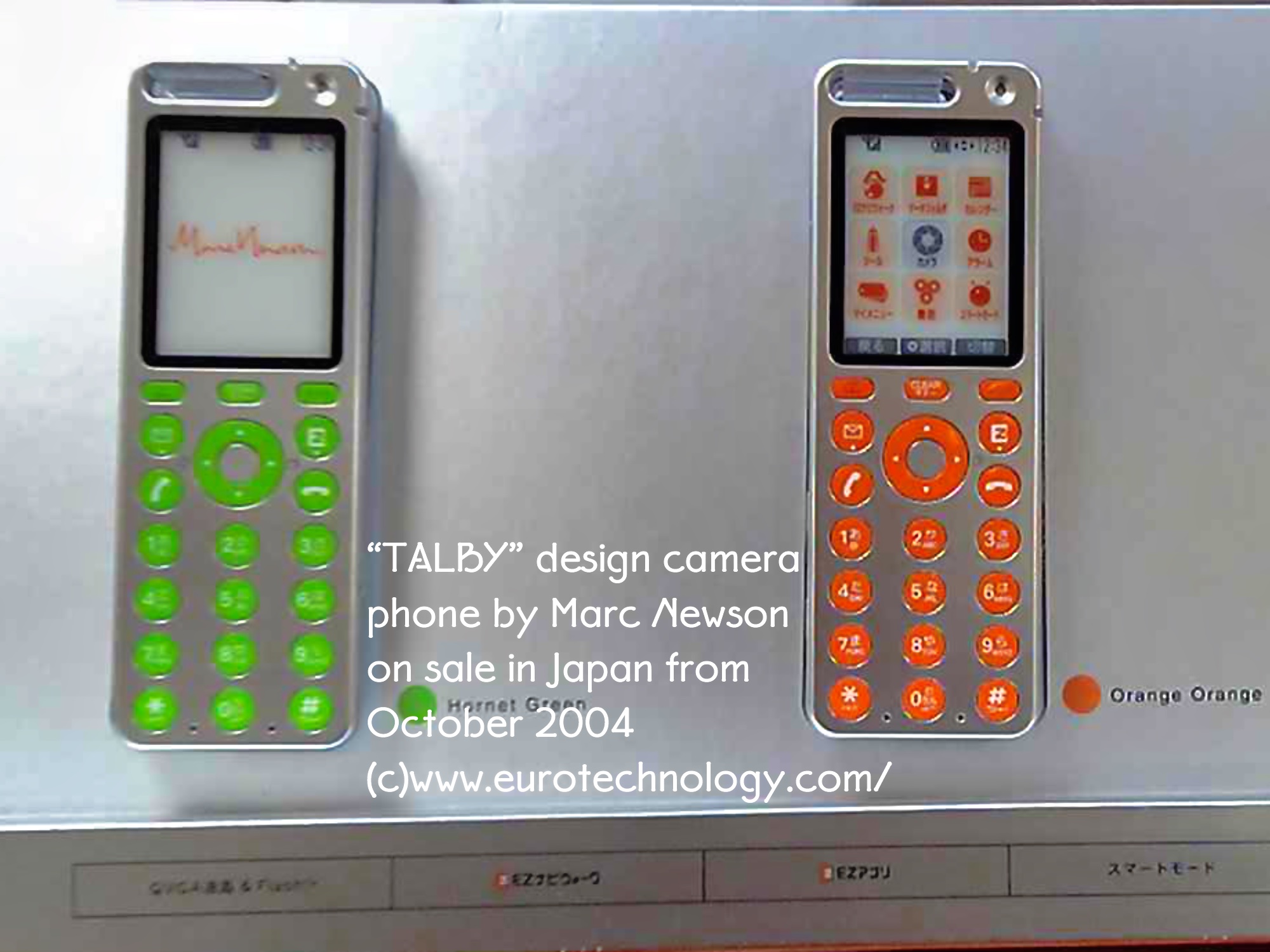
    • Marc Newson designed Talby concept phone announced by KDDI

      Marc Newson designed Talby concept phone announced by KDDI

      KDDI Design Project (today branded iida)

      Marc Newson designed Talby concept phone for Japan’s mobile operator KDDI – au

      On 13 October 2004, KDDI/AU announced “talby”, the third phone in their “AU design series”. Volume sales start in December 2004. We expect that “talby” will be similarly successful as “infobar” one year ago.

      “talby” is a fully featured 3G phone with camera (640×480 pixel), QVGA display, EZappli/BREW, Chaku-uta, email, EZweb, PIM, GPS/EZnaviwalk,…

      Marc Newson - KDDI-AU design series: talby by Marc Newson
      KDDI-AU design series: talby by Marc Newson

      Japan telecommunications industry report

      Copyright (c) 1997-2013 Eurotechnology Japan KK All Rights Reserved

    • NTT to invest US$ 45 Billion over 6 years

      Softbank is rapidly becoming the third universal telco in Japan, targeting NTT’s most important income streams. KDDI of course is also targeting NTT’s fixed line income.

      On November 2, 2004, NTT announced plans to compete: NTT will invest 5 Chou YEN (YEN 5000 Billion = US$ 45 Billion) over 6 years (2005-2010), i.e. about US$ 7.5 Billion/year. 60% of this investment will be for optical IP networks. NTT plans to build about 30 million FTTH lines.
      NTT fibre to the home (FTTH) contracts
      NTT fibre to the home (FTTH) contracts

      read more here in our report on Japan’s telecom sector…

      Copyright·©1997-2013 ·Eurotechnology Japan KK·All Rights Reserved·

    • Update on Prepaid Phones in Japan

      According to newsreports, Japan’s ruling coalition decided on a draft law, which will make identification requirements for obtaining prepaid phones more strict, instead of totally outlawing prepaid phones. It is reported that according to this bill the transfer of mobile phones to third parties would become a punishable offence. So if this bill becomes law, you risk a prison sentence if you lend your prepaid mobile phone to others in Japan – be warned.

      For detailed statistics on size, market shares and analysis of Japan’s prepaid phone market, consult the latest edition of our report on Japan’s telecom sector.

      Copyright·©1997-2013 ·Eurotechnology Japan KK·All Rights Reserved·