Category: Japan’s electronics industry

Japan’s electronics industry

  • SONY revival prospects and shareholder meeting (BBC interview)

    SONY revival prospects and shareholder meeting (BBC interview)

    SONY needs to leave 1990 structures behind and more more than commodities

    SONY revival from record YEN 455 billion loss for FY2010

    SONY (6758) announced a record YEN 455 Billion (US$ 5.7 Billion) loss for financial year 2011, which ended March 31, 2012, and held the annual shareholder meeting on Wednesday.

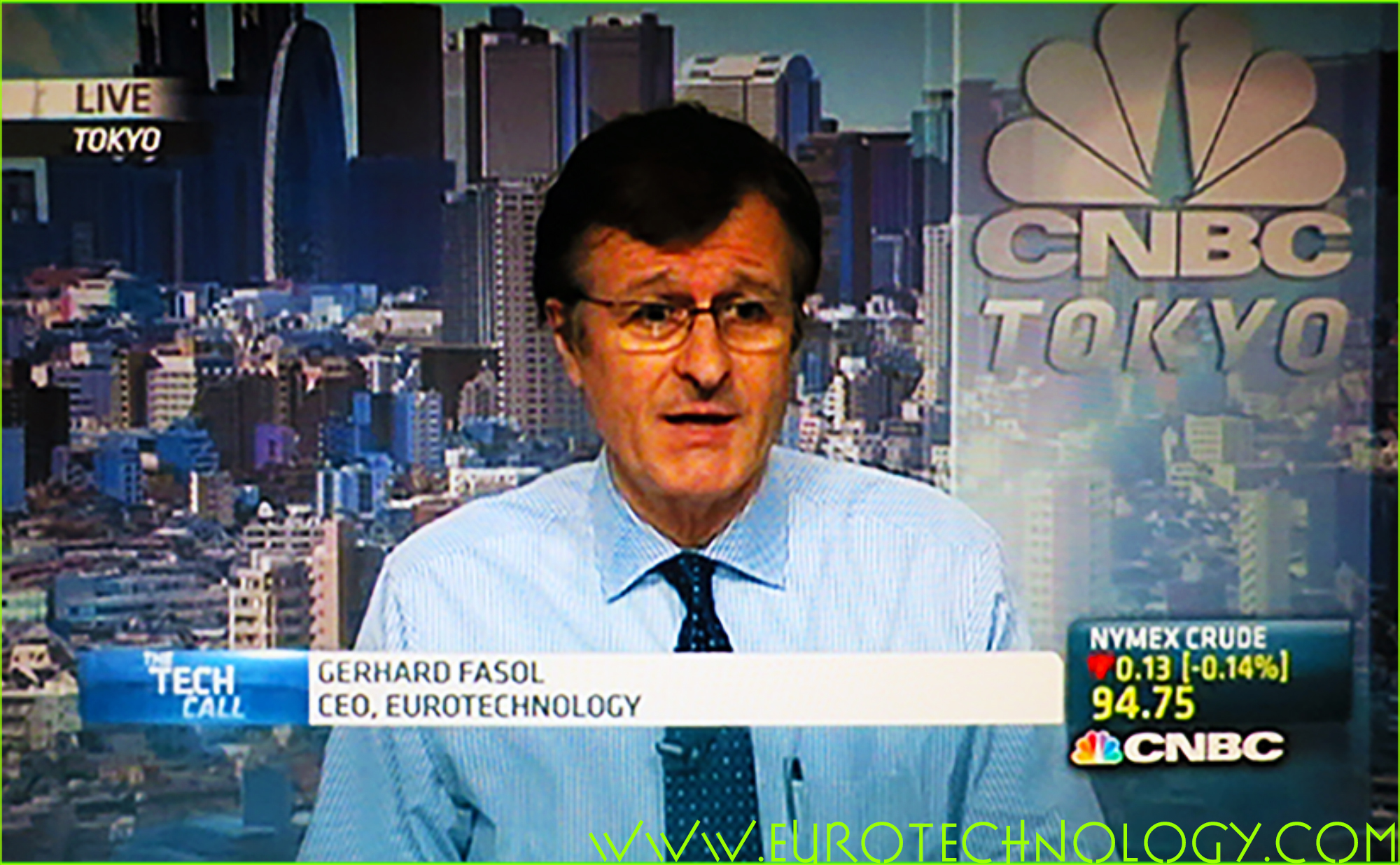
    Gerhard Fasol on BBC TV about "Sony executives face weary shareholders at AGM"
    Gerhard Fasol on BBC TV about “Sony executives face weary shareholders at AGM”

    SONY revival: My points in the BBC interview are

    1. Stuck with 1990’s structures: SONY’s case is representative for many Japanese companies and also for many aspects of Japan as a whole today: SONY grew very rapidly until around 1995, when growth stopped. Since around 1995, there is no growth and averaged over the years zero profit. It’s very clear, that many of the management structures and ways of doing things during the pre-1995 rapid growth phase don’t work at all any more today.
    2. A commodity maker? SONY needs to decide either to build an attractive ecosystem including attractive high-margin products – such as Apple does – or if SONY continues to shoot for the commodity business, with low margins, then it needs to be No. 1 in that space.
    3. No diversity? in 2012? When we look at SONY’s website describing SONY’s top management, we can see that SONY’s top managers are almost all Japanese men – almost no diversity. SONY’s overwhelmingly Japanese male managers know Japan best – so it’s no surprise that SONY’s best performing division is the Financial Services division: a mainly domestic Japanese consumer credit card and life insurance company.
    SONY's sales stopped growing in 1998 ...
    SONY’s sales stopped growing in 1998 …
    .. while net margin and net profits have been around zero
    .. while net margin and net profits have been around zero

    Read our report on Japan’s electronics industry sector:

    Copyright 1997-2013 Eurotechnology Japan KK All Rights Reserved

  • Taiwan’s Hon Hai Group invests in SHARP

    Taiwan’s Hon Hai Group invests in SHARP

    Crunch time? – reviving Japan’s huge electrical/electronics sector

    SHARP fighting for survival

    SHARP (6753) last month forecast a record YEN 290 Billion (US$ 3.5 Billion) loss for this financial year – more than 1/2 of SHARP’s market cap, and SHARP’s new Sakai factory is reported to work at 1/2 capacity.

    Taiwan’s Hon Hai Group (which includes Foxconn, which is known to assemble Apple’s iPhones and iPads), and founder Terry Gou invest about YEN 133 Billion (about US$ 1.6 Billion in SHARP:

    1. Hon Hai Group will invest YEN 66.9 Billion in newly issues SHARP-shares corresponding to a 9.9% holding, and will become SHARP’s largest share holder
    2. Hon Hai’s Chairman Terry Gou and related investment companies will buy 46.5% of SHARP Display Products Corporation for YEN 66 Billion reducing SHARP’s holding from 93% to 46.5% (note that SONY preferred not to increase its holding in SHARP Display Products Corporation, which operates the Sakai factory)
      click below to watch video clip (initial plan for the interview was to discuss the ELPIDA bankruptcy, but at the last minute we switched the interview to the Hon Hai investments in SHARP, because of the potentially much bigger impact on Japan)

    There is a wide range of implications

    • Clearly the business models which have sustained Japan’s huge electrical sector for several decades have reached end-of-live, and restructuring as well as much more opening to the outside, non-Japanese world are becoming more and more urgent. Much of our Post-Galapagos Working Group efforts last year were devoted to this urgent need.
    • SHARP’s financial problems may not be solved yet, and further investments by Hon Hai or others might well be on the horizon
    • APPLE – although not directly involved in the transaction – is the center of power. With the investment Hon Hai may hope, that a combination of Hon Hai and SHARP may become a stronger supplier to APPLE than each company alone. SHARP has been reported to use Hon Hai’s investment to increase production of LCD displays for smart phones, and tablets.
    • Comparing market capitalization, it’s clear who the stronger partner is:
      • SHARP = US$ 6.6 Billion market cap
      • Hon Hai = US$ 39 Billion market cap

    For data and detailed analysis download our report on:

    Japan’s electronics industry sector

    Copyright (c) 1997-2013 Eurotechnology Japan KK All Rights Reserved

  • Japan’s Galapagos effect on market caps

    Japan’s Galapagos effect on market caps

    Japan’s electronics giants market caps are remarkably low

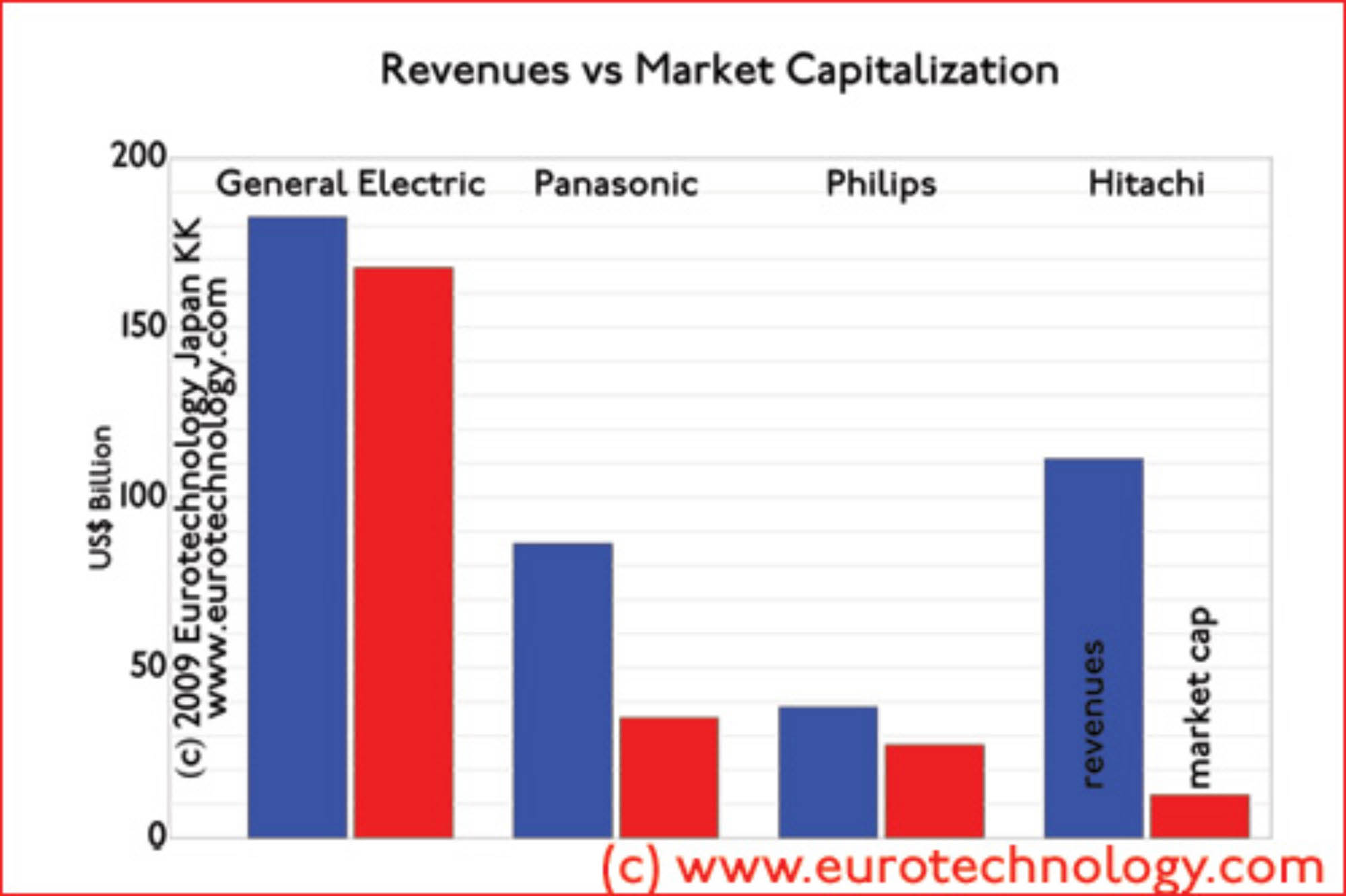
    General Electric’s market cap is about 13 times higher that of Hitachi

    Some of Japan’s electrical corporations have remarkably low market capitalizations: General Electric has 1.6 x more sales than Hitachi, but has 13.3 x the market capitalization. Philips has 1/3 x Hitachi’s sales, but has 2.2 times higher market cap.

    Low market values do not help big recent public share offerings:
    Hitachi raising YEN 250.7 Billion (US$ 2.8 Billion),
    Toshiba raising YEN 298.7 Billion (US$ 3.3 Billion), and
    NEC raising YEN 115.5 Billion (US$ 1.3 Billion).

    Low valuations increase the pressure for change in Japan’s electrical sector, and the SANYO-Panasonic merger is an indication of changes to come.

    In the “post-Galapagos committee” we are working with some of Japan’s brightest leaders on understanding the reasons and on how to drive this change.

    Benchmarking Japan’s electrical companies – Philips= 1/3 x Hitachi’s sales and 2.2 x Hitachi’s market cap:

    GE= 1.6 x Hitachi’s sales and 13.3 x Hitachi’s market cap

    More in our report on Japan’s electrical industries.

    Japan electronics industries – mono zukuri

    Copyright (c) 2013 Eurotechnology Japan KK All Rights Reserved

  • Post-Galapagos Japan? – globalizing Japan’s fantastic technologies…

    Post-Galapagos Japan? – globalizing Japan’s fantastic technologies…

    Japan Galapagos effect: “Why do Japanese companies make so beautiful mobile phones with fantastic functions, and have almost no global market share?”

    I asked this question back in 2003 to NTT-DoCoMo’s CEO Dr. Tachikawa (see my article “Leadership questions of the week” in Wallstreet Journal of June 12, 2006, page 31), and offered several proposals to Dr. Tachikawa, of which he accepted one.

    A related question is: “why can Samsung, LG and Apple beat Japan’s initially far more advanced mobile phone makers, and why have Japan’s phone makers taken no effective action to build global business in order to avoid extinction?”

    Now six years after my initial presentation to DoCoMo’s CEO, I have been invited as the only non-Japanese to work on Japan’s “Post-Galapagos Committee”. For most of this year our small group of industry CEOs, academics, government officials and other leaders have been working on understanding the reasons for Japan’s “Galapagos effect” and how to overcome it.

    Read about this work here in the New York Times, about my (Japanese language) presentation to the committee on the IT-Media website here (in Japanese)

    The “Galapagos effect” has not been created by a single factor. Instead a collection of choices by the management teams of Japan’s electrical conglomerates have prevented leverage of their domestic success stories into global success stories. These choices can be overcome. In our “Post-Galapagos committee” we have worked all-year on how to overcome these choices.

    Unfortunately the “Galapagos effect” is only one symptom of the crisis of Japan’s electrical giants: most have shown little or no growth in sales over the last 10 years, while at the same time margins tend to be small or negative. Over the same period, General Electric has increased sales by a factor of about three, while at the same time earning healthy margins.

    Overcoming this crisis will create many opportunities. If at least some of the conclusions of our “Post Galapagos Committee” can be realized, then our committee’s hard and totally voluntary work during most of this year and many late nights will not be wasted.

    For an analysis of Japan’s electrical industry sector see our

    Copyright (c) 2013 Eurotechnology Japan KK All Rights Reserved

  • Japan’s games sector overtakes electrical sector in income

    Japan’s games sector overtakes electrical sector in income

    Japan’s games sector is booming – and net annual income of Japan’s top 9 game companies combined has now overtaken the combined net income of all Japan’s top 19 electronics giants (including Hitachi, Panasonic, SONY, Fujitsu, Toshiba, SHARP… at the top, and ROHM, Omron… further down the ranking list).

    Why does it make sense to compare electronics giants with game companies? In many areas, especially home electronics and personal portable devices these two sectors compete for exactly the same consumer spending budgets and mind share.

    Pressure on Japan’s electrical giants for much more fundamental restructuring is increasing. More details below and find our calculations and analysis explained in our reports: Report on Japan’s electrical industry sector and our Report on Japan’s game industries.

    Figure compares the added total net income of Japan’s top 18 electrical companies (Hitachi, Panasonic, SONY…) with the combined total net income of Japan’s top 9 games companies (Nintendo, Bandai Namco…, not including SONY Computer Entertainment, because net income is not available).

    The games sector – lead by Nintendo – shows stable net income all through the current crisis years. While pressure on the electrical giants for more fundamental restructuring is increasing.

    -Money as a percentage of total money in Japan
    -Money as a percentage of total money in Japan

    Combined total net annual income of Japan’s games sector. (SONY Computer Entertainment is not included, since net income is not available)

    Combined annual income of Japan's top game companies
    Combined annual income of Japan’s top game companies

    Detailed analysis in our report on Japan’s games sector.

    Copyright (c) 2013 Eurotechnology Japan KK All Rights Reserved

  • Japan electronics groups: global benchmarking

    Japan electronics groups: global benchmarking

    Japan electronics groups have far lower income/profits than EU or US comparable corporations

    Ripe for drastic reform and transformation: 18 years no growth and almost no profits

    Lets look at global benchmarking of Japan’s top electrical groups Panasonic and Hitachi (representative of Japan’s top ten electrical giants) – in our previous blog we suggested that full recovery to 2008 (FY2007) levels may take until 2016 – about seven years in terms of income, and about 3-4 years in terms of revenues – UNLESS major restructuring happens. Will it be done?

    We also take a look at specialist ROHM, which used to have outstanding margins because of the focus on highly specialized electrical and electronic components. ROHM’s shareholder proposals recently made headlines.

    Comparing Japan’s top electrical groups Panasonic and Hitachi with GE and SIEMENS clearly shows the different philosophies in US, EU and Japan:

    US based GE aims for 15% net margin.

    Germany based Siemens and Japanese giants Panasonic and Hitachi in the 1990s all had net margins close to zero. However, while Panasonic and Hitachi maintained their margins close to zero since the 1990s, Siemens clearly aims for US level margins – and achieved a slow and steady upward trend.

    Very dramatic restructuring would be necessary to bring Japan’s electric giants onto such a path. I think it is quite obvious exactly which restructuring is necessary. I also believe that if carried out it will actually create more employment in Japan than maintaining the existing structure of Japan’s electrical industry sector. However, actually carrying such restructuring will require superhuman effort… will this happen?

    Resistor maker ROHM

    Rohm is another interesting story – and a fascinating Kyoto-culture company (with headquarters not so far from superstar Nintendo). Rohm was founded in 1958 by today’s CEO Sato Kenichiro to make resistors, and he later changed the name to R.ohm and then ROHM – today 80% of products are semiconductors. With increasing competition ROHM’s initially very high margins melted away. To counter the trend towards commoditization, ROHM invests heavily in R&D with technology centers around the world. Last week ROHM made global headlines: US fund Brandes had proposed a US$ 157 million share buy back, which was rejected at the shareholder meeting. Looking at ROHM’s margin over the years, its clear that action is required to bring margins again from today’s zero to the previous 20% level. I can sympathize with shareholders who think that a Shuji Nakamura / Nichia-type R&D breakthrough would be more likely to deliver such a comeback rather than a share buy back.

    Note that not all shareholder proposals by US or European funds are rejected summarily at Japanese company shareholder meetings… some well prepared proposals have actually been accepted successfully.

    Margins of Panasonic, Hitachi, Rohm with Siemens and GE
    Margins of Panasonic, Hitachi, Rohm with Siemens and GE

    Starting from similar positions in the 1990s:

    GE, Siemens, Hitachi and Panasonic all four had almost the same size in terms of annual sales back in the 1990s – today GE is twice the size of Hitachi or Siemens and 2.5 the size of Panasonic

    Today, GE is about twice the size as Hitachi or Siemens, and about 2.5 the size of Panasonic. It seems that successful globalization is a necessary factor to achieve GE-style growth – necessary, but not sufficient… (see: our analysis of dramatic differences in globalization of Japan’s electric groups). The current crisis is a big opportunity for further growth by strong companies.

    Revenue growth of Hitachi and Panasonic compared with SIEMENS and GE
    Revenue growth of Hitachi and Panasonic compared with SIEMENS and GE

    Japan electronics industries – mono zukuri

    Copyright 2013 Eurotechnology Japan KK All Rights Reserved

  • Japan’s electronics companies & the crisis

    Japan’s electronics companies & the crisis

    Japan’s top 20 electronics companies combined are about as large as The Netherlands economically, and have big impact on the world economy. Our analysis shows how dramatically Japan’s electronics companies have been hit by the current crisis (except for Nintendo). We suggest that full recovery to 2008 (FY2007) levels may take until 2016 – about seven years in terms of income, and about 3-4 years in terms of revenues.

    The crisis has thrown Japan’s electrical companies back to 2002 in terms of combined annual net incomes. It has taken Japanese electricals 7 years to climb from the 2002 crisis to the 2008 (FY2007) boom. Since Japan’s electrical companies have made relatively soft adjustments, but not a full fundamental industry restructuring yet, we think that it is likely that developments will proceed along a similar path as in the past: following such an analysis we think that it will take about 7 years from 2009 (ie. until 2016) for Japan’s electrical companies to work their way back up to 2008 net income levels. (Find detailed financial data and analysis in our report on Japan’s electronics industries)

    net income of Japan's electronics companies
    net income of Japan’s electronics companies

    Back to FY2003:

    Combined annual sales for the financial year ending March 31, 2010, are at a similar level as in FY 2003, ie Japan’s electrical industry has been taken back 6 years in terms of revenue growth. Again, since a dramatic and fundamental industry restructuring has not yet taken place, we believe that we can expect it will take about 4 years for Japan’s electronics industry to grow again to 2008 (FY2007) size in terms of annual revenues.

    net revenues of Japan's electronics companies
    net revenues of Japan’s electronics companies

    The crisis spreads the field…

    During the “good” years of FY1997 – FY2007 the differences between top and bottom performing electrical companies became steadily smaller: the field narrowed.

    This figure shows that during the current crisis the spread between best and worst performing companies became more than twice as wide. The crisis clearly differentiates winners (Nintendo) from losers in terms of operating margins.

    operating margins of Japan's electronics companies
    operating margins of Japan’s electronics companies

    Read more details in our report about Japan’s electrical industries:

    Japan electronics industries – mono zukuri

    Copyright 2013 Eurotechnology Japan KK All Rights Reserved

  • New opportunities versus old mistakes – foreign companies in Japan’s high-tech markets (presentation at Stanford University)

    New opportunities versus old mistakes – foreign companies in Japan’s high-tech markets (presentation at Stanford University)

    About 10 years ago, on October 28th, 1999, I was invited to give a talk about this topic at Stanford University’s US-Japan Technology Management Center for Stanford Faculty, alumni and Silicon Valley entrepreneurs. 10 years is a good period to check out how much of that is still valid today, and how much Japan has changed during the last 10 years.-

    Gerhard Fasol’s lecture at Stanford University “New opportunities vs old mistakes – foreign companies in Japan’s high-tech markets”

    Copyright 2013 Eurotechnology Japan KK All Rights Reserved

  • More Drastic Changes Needed at Sony (CNBC TV interview)

    More Drastic Changes Needed at Sony (CNBC TV interview)

    SONY needs drastic changes: from commodities to networks and communities

    More Drastic Changes Needed at Sony (CNBC Airtime: Thursday, May 14, 2009)

    Read more about SONY and Japan’s electrical industry sector

    Copyright (c) 2013 Eurotechnology Japan KK All Rights Reserved

  • Investor Club: What crisis? Meet some booming Japanese companies

    It’s not all doom and gloom here in Japan. Nintendo’s sales and operating profits are rising 8.8% year-on-year. KDDI saw its net profits increasing 59% year on year. Yahoo Japan increases dividends by 22%-25% for 2008. Who are today’s winners in Japan’s IT industry? Gerhard Fasol will show us how and why some great Japanese companies excel in today’s crisis.

    The talk reviews today’s status of Japan’s electrical companies, the telecommunications sector and the internet sector, and introduces seven different companies, which show rapid growth of revenues, operating income and net income despite the crisis. These seven companies we introduce turn the crisis into an opportunity.

    Mr Fasol is one of the best specialists of Japan’s IT industry. After 12 years in Japan working for the most prestigious Japanese institutions and companies (the University of Tokyo, NTT, Hitachi…), he founded the strategy and M&A firm Eurotechnology Japan KK in 1996. Mr Fasol has advised some of the greatest companies, including NTT, SIEMENS, Deutsche Telekom, Cubic, Unaxis and about 100 fund managers on strategy for Japan, as well as the President of Germany. He helped a French pharmaceutical company acquire a factory in Japan.
    He comments regularly on CNBC on Japan’s tech sector.

    Schedule: March 24th, 2009 (Tuesday) from 18:30
    The conference will be followed by a light cocktail.
    Place: French Chamber of Commerce and Industry in Japan, meeting room
    Iida bldg 1F, 5-5 Rokubancho, Chiyoda-ku, Tokyo 102-0085
    Tel.: 03-3288-9624
    Access map: www.ccifj.or.jp
    Language: English
    Fees: 5.000 yens (to pay in cash at the door)
    Payment will be required for cancellations or no-show after this deadline.
    Announcement on the website of the French Chamber of Commerce
    read a report on the talk here in the monthly newsletter of the French Chamber of Commerce in Japan (in French)

    Background reading: our J-ELECTRIC report about Japan’s electric companies
    and our Eurotechnology Japan Blog

    Copyright (c) 2013 Eurotechnology Japan KK All Rights Reserved

  • Kyocera expands in Europe via acquisition of TA Triumph-Adler

    Kyocera is one of Japan’s powerful electronics companies, which together are about as large economically as the whole of the Netherlands.

    Taking advantage of low EURO exchange rates and the high YEN, and low valuations during the current economic crisis, Kyocera acquired 93.84% of TA Triumph-Adler AG for a total purchase price on the order of EURO 98.7 Million.

    Triumph was founded 1896 as a bicycle maker, and has grown into a major European office equipment manufacturer and sales company. Triumph used to be famous for typewriters, with the disappearance of typewriters, Triumph went through a long sequence of restructuring and through many merger and acquisition transactions.

    Kyocera acquired TA Triumph-Adler for its distribution network: TA Triumph-Adler has about 35,000 companies as customers in 33 countries, with 70% of sales in Germany, giving Kyocera a much larger distribution footprint in Germany and EU.

    For an overview and analysis of Japan’s formidable electronics companies read our J-ELECTRIC report.

    Copyright (c) 2013 Eurotechnology Japan KK All Rights Reserved

  • 72.5% of all digital mobile TV on this planet earth is in Japan

    72.5% of all digital mobile TV on this planet earth is in Japan

    About 50 million mobile phones equipped with digital terrestrial mobile TV (“oneseg”) have been delivered up until today – not counting “oneseg” tuners for PCs, car navigation units and stand-alone units. Comparing this number with reports of mobile TV roll-out in other countries around the world, we conclude that 72.5% of todays mobile phones with mobile TV are in Japan.

    How much mobile TV do Japanese people watch on their mobile phones?
    In the latest version of our mobile-TV report, we explain in detail our methods to determine that averaged over all of Japan’s population of 125 million (including those who don’t have a mobile-TV yet), the average viewing time is between 0.4 – 2.3 hours of mobile TV / month. WOW!

    Mobile TV 2.0 (OneSeg-2)
    Not surprisingly, Japan’s media giants are now starting to move, and develop programming specially designed for mobile TV: for example “lunchbox” mobile TV broadcast to mobile phones from 12:00noon – 12:40pm weekdays with news, weather, diet information, summaries of TV shows… it’s only a question of weeks or months now in Japan for mobile TV to develop into a totally new advertising and m-commerce medium, and some has started already.

    Starting the global mobile internet revolution with i-Mode in February 1999, we can see Japan’s leadership emerging in the mobile TV arena. Japan’s challenge is to leverage this know-how globally, Japan missed this chance with i-Mode and left the field to iPhone and friends!

    In December 2008 97.5% of global mobile TV was in Japan and S-Korea
    In December 2008 97.5% of global mobile TV was in Japan and S-Korea

    72.5% of all mobile phones with digital TV globally are in Japan:
    In the same way as with mobile internet (i-mode), Japan is again the global forerunner in mobile TV, together with South Korea.

    Copyright (c) 2013 Eurotechnology Japan KK All Rights Reserved

  • Foggy Outlook for Global Tech Sector (CNBC TV interview)

    Foggy Outlook for Global Tech Sector (CNBC TV interview)

    Foggy Outlook for Global Tech Sector (Airtime: Tues. Feb. 10 2009)

    Copyright (c) 2013 Eurotechnology Japan KK All Rights Reserved

  • Wild differences in operating margins for mobile, TV media groups and electricals

    Wild differences in operating margins for mobile, TV media groups and electricals

    We analyze the effect of the crisis on operating margins in three different sectors in Japan:

    (1) electronics,
    (2) mobile communications
    (3) TV media groups.

    In sector (1), Nintendo‘s margins are above 30% and increasing despite the crisis, while traditional electronics companies’ margins are evaporating.

    (2) for mobile operators DoCoMo, KDDI and SoftBank margins are 10%-20% and increasing despite the crisis! Could mobile phone usage be crisis resistant?

    (3) TV media groups had healthy margins in the 10%-20% range back around 2001- however these margins have been slowly melting away, and TV group margins are heading to cross the zero line into the red zone by 2010-2011. Watch out for a TV media crisis. Read more below.

    Consumer electronics sector operating margins:

    Nintendo bucks the trend: while Japan’s electronics firms’ margins are dropping into the red, and have never been much higher than 5% during the last 10 years, Nintendo‘s operating margins are above 30% and rising despite the crisis.

    Margins of top Japan's electronics multinationals and Nintendo
    Margins of top Japan’s electronics multinationals and Nintendo


    (Find full data, fully labeled graphics and analysis in our report on Japan’s electrical companies)

    Mobile phone sector margins are 10% – 20% and rising despite the crisis.

    Mobile phones seem to be resistant to the current crisis. DoCoMo‘s, KDDI‘s and Softbank‘s margins are healthy and improving despite the crisis.

    Operating margins of Japan's top 3 mobile operators
    Operating margins of Japan’s top 3 mobile operators


    (Find full data, fully labeled graphics and analysis in our JCOMM Report)

    Margins of TV media groups have been melting away since their peak in 2001.

    Back in 2001 Japan’s TV media groups used to enjoy healthy margins of up to 20%. Over the last 8 years these healthy margins have molten away, and Japan’s large TV media groups are likely to all simultaneously go into the red from 2010 onwards, unless dramatic action is taken. Media groups will need to grow profitable new business, e.g. mobile-TV, and other cross-media growth areas.

    Could it be that recent anti-takeover measures have made the large TV media groups complacent?

    Operating margins of Japan's TV media groups
    Operating margins of Japan’s TV media groups


    (Find full data, fully labeled graphics and analysis in our J-MEDIA Report)

    Copyright (c) 2013 Eurotechnology Japan KK All Rights Reserved

  • Japan trends 2008/2009

    One of our clients in the financial industry asked me several trend questions:

    1. Q1: Biggest surprises in Japan in 2008?
      • Collapse of Japan’s mobile phone handset market (read our blog). In this context the Japanese telecom equipment makers association invited me to give a presentation, which was booked out 2-3 weeks ahead – about 100 Japanese telecom equipment maker managers attended! The General Affairs Vice-Minister / Secretary of State attended….
      • The dramatic increase of acquisitions by Japanese companies:
    2. Q2: Biggest changes for 2009?
      • Hopefully LED/Solid state lighting going mainstream to save energy
      • Batteries and solar cells in combination starting to replace petrol for cars
      • Solar cell battle (between Q-cells, SHARP and others)
    3. Q3: Key topics in Japanese media for 2009?
      • Financial crisis and reviving the economy
      • Crisis of the car industry – and car industry’s paradigm shift

    Copyright 2013 Eurotechnology Japan KK All Rights Reserved

  • ICT trends for Japan for 2009

    ICT trends for Japan for 2009

    Smartphones, European exits from Japan, and M&A

    ICT trends for Japan: Ericsson and Nokia Siemens Networks (NSN) remain engaged in Japan’s ICT sector

    by Gerhard Fasol

    One of the Embassies here in Tokyo asked me to write a report about ICT trends for Japan…

    ICT trends for Japan: Mobile phone sector

    Pushed by the Government the mobile operators changed the business model for mobile phone sales from a straight subsidy model to an installment payment system. As a consequence the mobile phone sales collapsed, creating huge difficulties for Japan’s mobile phone makers, but greatly improving the financial results of mobile operators.

    Smart phones grow market share in Japan

    An interesting trend is the growth of the “smart-phone” market (Blackberry, HTC-Windows-Mobile phones, iPhone etc.) and mini-PCs, which can be acquired for YEN 1 with subsidy from eMobile.

    In this context the Japanese telecom equipment makers association invited me to give a presentation, which was booked out 2-3 weeks ahead – about 100 Japanese telecom equipment maker managers attended! The General Affairs Vice-Minister / Secretary of State attended…

    Nokia terminates mobile phone business in Japan

    On November 27th, 2008, global press announcements announced that NOKIA will stop making mobile phones for Japan’s mobile operators with immediate effect. DoCoMo and SoftBank had NOKIA phones in preparation and had already started marketing efforts – these were cancelled a few days after NOKIA’s press announcement.

    NOKIA had founded the Japan subsidiary on March 3rd, 1989, almost exactly 20 years ago, thus NOKIA has given up entering Japan’s mobile phone market after 20 years of efforts. NOKIA will not totally shut down in Japan, NOKIA announced that R&D and procurement will continue, and VERTU announced to enter Japan’s market with a mobile vertual network operator (MVNO) model renting network capacity from DoCoMo, and opening own shops.- However the opening of these direct VERTU stores keep being postponed.

    NOKIA joins the row of European telecom companies which have given up operations in Japan: Vodafone, Cable & Wireless.

    Nokia Siemens Networks (SNS) is continuing business in Japan as well, so NOKIA will not be entirely gone from Japan.

    M&A

    European company’s acquisitions in Japan are currently at low levels, including the ICT sector. By far the largest acquisition in Japan by a company from the European/Mediterranian area was not by an EU company, but by the Israeli company Iscar which acquired the Japanese company Tungaloy for around US$ 1 Billion. However, this acquisition was driven by US capital. Read details in our blog here.

    In the opposite direction, Japanese acquisitions in EU and elsewhere, there is a boom of acquisitions by Japanese companies abroad. For example, TDK acquired the German company EPCOS, Fujitsu acquired the outstanding 1/2 of Fujitsu-Siemens, NTT-Data acquired 72.9% of Cirquent which was a 98% subsidiary of BMW before. SONY acquired the outstanding 1/2 of the SONY-Bertelsmann Music Group from Bertelsmann.

    The current trend is definitely a strengthening of Japanese acquisitions in Europe.

    The most important issue however are not the acquisition transactions themselves, but the crucial issue will be whether these acquisitions create or destroy value. In many cases the difficulties to overcome “cross-cultural” issues are enormous. Many huge wrecks line the road: Vodafone-Japan, Cable-Wireless-Japan, NOKIA’s mobile phone business in Japan, or DoCoMo’s overseas acquisitions. There are also many success stories – the most impressive and famous one Nissan-Renault, however there are many more. An interesting case in progress is Nippon-Sheet-Glass (now NSG Group)’s acquisition of Pilkington Glass (read about a presentation by NSG’s CEO here in our blog).

    Copyright 2013 Eurotechnology Japan KK All Rights Reserved
  • Panasonic negotiates to acquire SANYO to form US$ 110 billion group

    Panasonic negotiates to acquire SANYO to form US$ 110 billion group

    SANYO suffered from Niigata Chuetsu earthquake of Oct. 23, 2004

    Panasonic attracted to SANYO’s battery and energy technologies

    On November 7, 2008 Panasonic (“Ideas for Life”) and Sanyo (slogan: “Think GAIA”) announced that they entered negotiations which can potentially lead to an acquisition of Sanyo by Panasonic to form one of the largest electronics groups in the world. Sanyo’s market capitalization is currently US$ 3.9 billion and Panasonic’s is US$ 38 billion, combined sales are about US$ 110 Billion.

    The Niigata Chuetsu earthquake of Oct. 23, 2004 caused an estimated total of US$ 30 Billion in damages, damaged Sanyo’s semiconductor factory and contributed to large losses at Sanyo. As a consequence Daiwa Securities SMBC Co, Sumitomo Mitsui Banking Corporation and Goldman Sachs hold preferential shares in Sanyo with voting rights corresponding to 70% of outstanding shares. The current global financial crisis contributes to the potential acquisition, since Daiwa, Sumitomo-Mitsui and especially Goldman Sachs are motivated to sell their preferred shares when contractually possible, and it is also these three financial institutions which will have strong influence on whether this transaction will take place. Goldman Sachs is reported to have said that the price will decide.

    Annual revenues of Japan’s electrical groups:

    Panasonic and Sanyo combined (red curve in the figure below) will be one of the largest electrical groups globally. Note that Japan’s electrical groups showed strong growth from FY 2003.

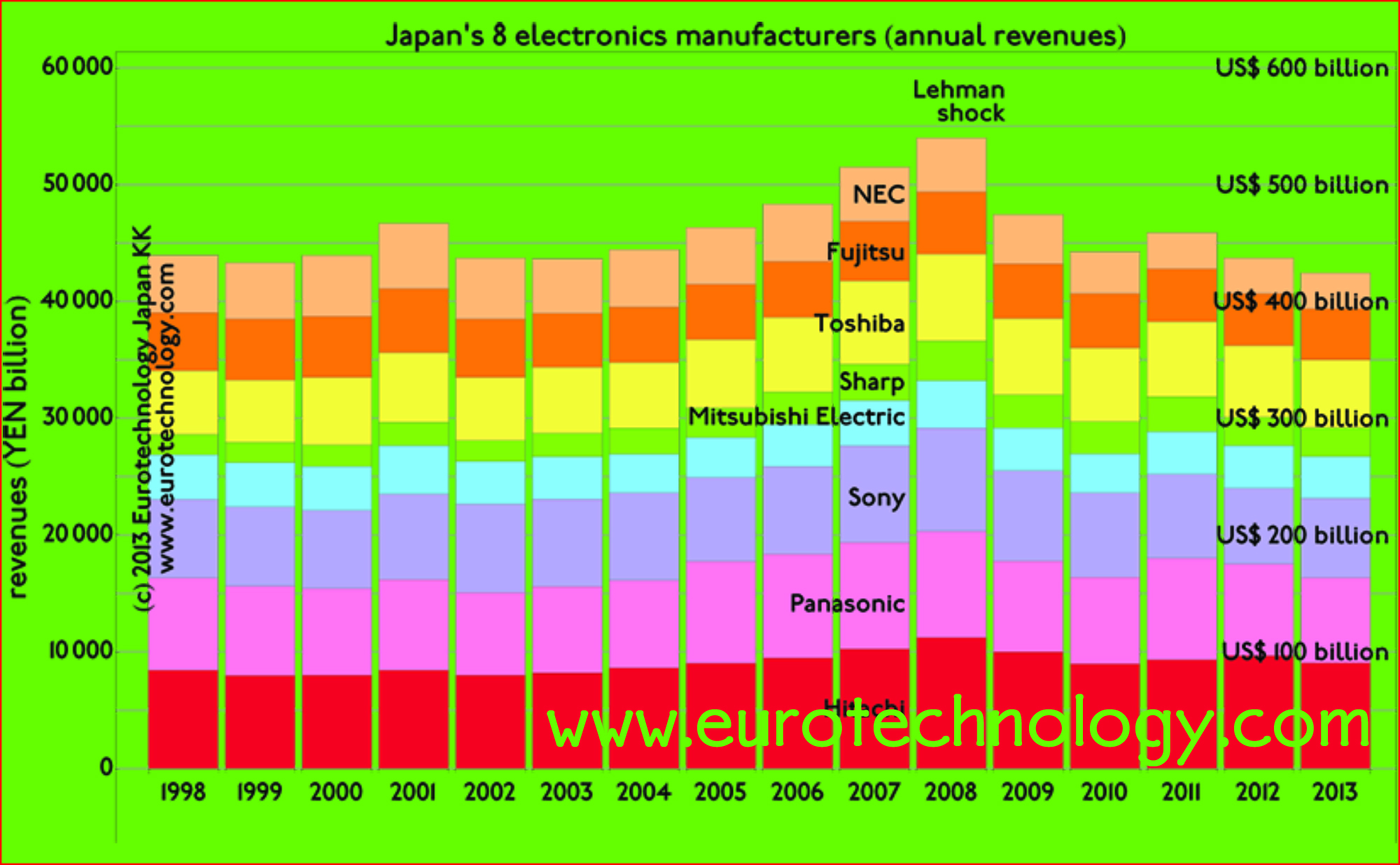
    Revenues of Japan's top electronics manufacturers
    Revenues of Japan’s top electronics manufacturers

    Annual operating margins of Japan’s electrical groups:

    Panasonic’s high operating margins helped Panasonic to reach a position of financial strength, enabling this acquisition. Expect more acquisitions by Japanese electrical companies.

    Electrical differentiation:

    High margin (> 5%) vs low margin (The figure below shows that there is a clear differentiation of Japan’s electrical groups: Mitsubishi Electric, Sharp and Panasonic have high margins – above 5%.

    The other electrical groups (Fujitsu, Toshiba, Sanyo, Hitachi, Sony and NEC) have chosen a low-margin path (margins below 4%).

    There is a clear gap (4% to 5%) separating these two fields. Panasonic’s margin will suffer with a Sanyo acquisition – expect Panasonic management to bring Sanyo up to Panasonic margins.

    Operating margins of Japan's top electronics manufacturers
    Operating margins of Japan’s top electronics manufacturers

    Globalization of Japan’s electronics groups:

    With 36.8% of sales outside Japan, Sanyo is more globalized than Panasonic. NEC, Fujitsu and Mitsubishi Electrical still have much way to go to globalize.

    Globalization ratios of Japan's top electronics manufacturers
    Globalization ratios of Japan’s top electronics manufacturers

    Read more in our report: “Japan’s electrical companies”

    Copyright (c) 2013 Eurotechnology Japan KK All Rights Reserved

  • Yamaha Mobile Orchestra – mobile phones musical instruments

    Yamaha Mobile Orchestra – mobile phones musical instruments

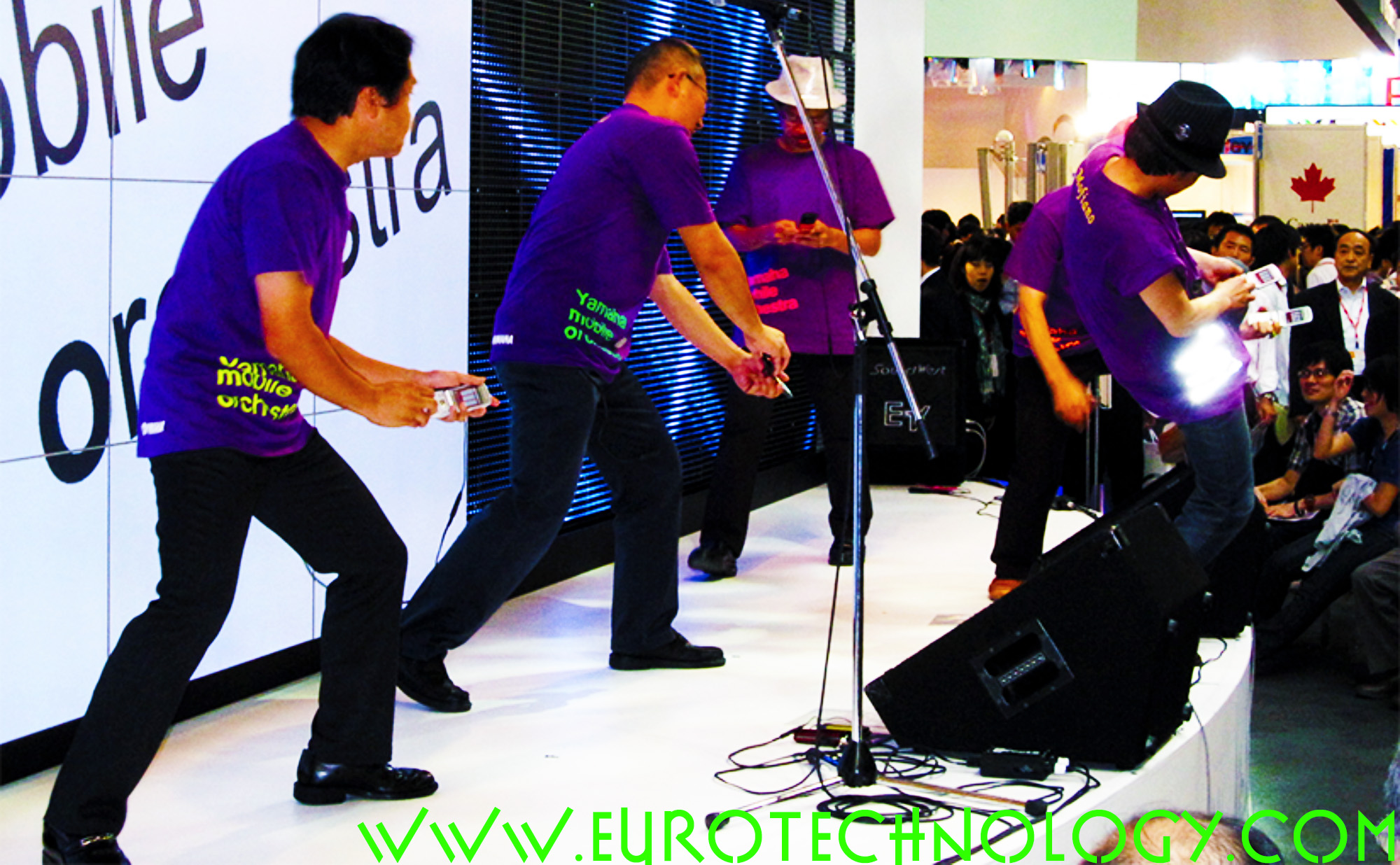
    Using the motion, acceleration and position sensors to convert smart phones into musical instruments

    Yamaha Mobile Orchestra uses mobile phones equipped with motion and acceleration sensors as musical instruments

    yamaha mobile orchestra
    yamaha mobile orchestra
    yamaha mobile orchestra
    yamaha mobile orchestra
    yamaha mobile orchestra
    yamaha mobile orchestra
    yamaha mobile orchestra
    yamaha mobile orchestra
    yamaha mobile orchestra
    yamaha mobile orchestra

    Copyright (c) 2008-2013 Eurotechnology Japan KK All Rights Reserved

  • Apple Nintendo Sony: The power of focus

    Apple Nintendo Sony: The power of focus

    Lets benchmark three iconic companies:

    Apple Nintendo Sony

    Apple Nintendo Sony: three iconic companies evolving along very different paths. Apple’s current physical products famously all fit onto a single mid-sized table. Nintendo’s current physical products as well, for SONY you’d need a warehouse.

    • APPLE: Wednesday October 22 APPLE announced spectacular full-year results with a year-on-year net income increase of 38%. The results are even better than they look, because iPhone sales and income are spread forward over 2 years due to accounting rules. (See our comments on CNBC here)
    • NINTENDO: on August 29, 2008 Nintendo revised the forecast for full-year net income upward by +26.2% (See our comments on CNBC here)
    • SONY: in contrast, on October 23, 2008, SONY said that full-year net income (for the financial year ending March 2009) is expected to be 37.5% lower than previously predicted (see our comments on SONY’s 1Q results here on CNBC)

    Apple Nintendo Sony – Lets look at today’s market caps:

    • APPLE market cap = US$ 85.6 Billion (about 4 x SONY)
    • NINTENDO market cap = US$ 37.2 Billion (about 2 x SONY)
    • SONY market cap = US$ 19.9 Billion

    Apple Nintendo Sony – Why this dramatic difference in market caps? We believe its focus.

    Apple and Nintendo are companies with clear focus. Lets look at the details below:

    Comparing revenues (sales):

    SONY = 3 x APPLE
    SONY = 4 x NINTENDO

    Annual revenues of Apple, Nintendo and SONY
    Annual revenues of Apple, Nintendo and SONY

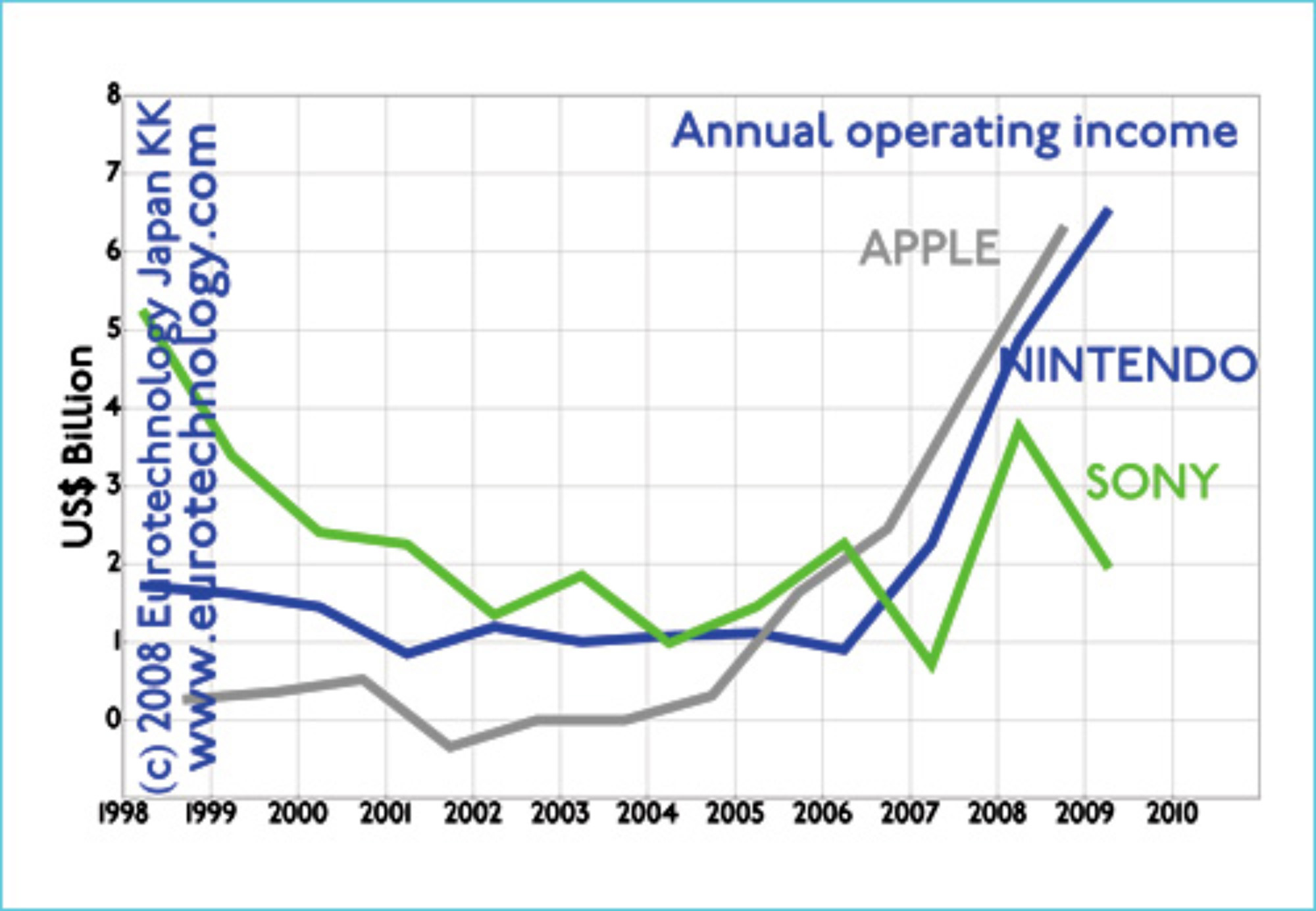
    Comparing annual operating income:

    APPLE = 3 x SONY
    NINTENDO = 3 x SONY

    Operating income of Apple, Nintendo and SONY
    Operating income of Apple, Nintendo and SONY

    Comparing operating margin:

    APPLE = 9 x SONY
    NINTENDO = 15 x SONY

    Operating margin (operating income as a ratio of revenues) for Apple, Nintendo and SONY
    Operating margin (operating income as a ratio of revenues) for Apple, Nintendo and SONY

    Read our report on Japan’s electronics industry sector

    Japan electronics industries – mono zukuri

    Copyright (c) 2008-2013 Eurotechnology Japan KK All Rights Reserved

  • Today’s APPLE 4th quarter results vs NINTENDO

    Today’s APPLE 4th quarter results vs NINTENDO

    A few hours ago (Oct 22, 2008, 6am Tokyo Time) APPLE announced 4th Quarter and Full Year results – we are here updating our comparison between APPLE and NINTENDO. With 6.9 million iPhones sold in APPLE’s 4th Quarter (July + August + September 2008), APPLE has achieved 2.76% market share of all mobile phones globally.

    APPLE strongly accelerates lead over NINTENDO in term of sales (see figure below) – even more dramatically, if we take into account that the iPhone in 4th Quarter now accounts for 39% of APPLE’s sales. APPLE accounts for iPhone sales in terms of a subscription model over two years because of free software updates for iPhones. If we would use APPLE’s non-GAAP figures, which book iPhone sales fully at the point of sale, then APPLE’s sales lead over NINTENDO would be even stronger.

    In terms of margins we see the opposite trend: NINTENDO‘s lead over APPLE in terms of higher margins expands (see below).

    Watch our interview about APPLE’s 4Q results today 11:50am (Tokyo time) on CNBC as a video clip.

    Apple accelerated lead over Nintendo in terms of revenues.

    Apple’s lead would be more dramatic if correcting for Apple’s subscription model used for iPhone sales according to GAAP rules.

    Annual revenues, operating income and net income of Apple vs Nintendo
    Annual revenues, operating income and net income of Apple vs Nintendo

    While Apple’s lead over Nintendo in terms of sales is growing, Nintendo’s lead in terms of operating margins is expanding.

    Operating margins: Apple vs Nintendo
    Operating margins: Apple vs Nintendo

    Copyright (c) 2013 Eurotechnology Japan KK All Rights Reserved
  • Games: Nintendo – the winner takes it all

    Games: Nintendo – the winner takes it all

    Game industries in total are MUCH bigger than music industries… in Japan game industries are about 10 times bigger business than music industries… Last weekend we had the Tokyo Game Show – read some key points below! From 2006 Japan’s game sector changed dramatically- Nintendo created several paradigm shifts, and “took off”. Read more about Nintendo driven paradigm shifts below. US games giant Electronic Arts (EA) would rank 5th in sales, was EA Japanese. Japan’s games industries are big!

    Nintendo income takes off: Nintendo broke the PC-style race for faster machines, and broke out of the limited market of hard core gamers. From FY 2007 Nintendo’s income takes off:

    Operating income for Japan's  game  companies
    Operating income for Japan’s game companies

    Nintendo’s DS: braintraining instead of shooting.

    SONY’s PSP goes for power, and Nintendo’s DS changed the paradigm + went for lower price. By the way, we see a shift from TV video games to portable and mobile phone games in terms of numbers: for current 7th generation game platforms portables outsell TV video consoles 2:1. DS’s success encouraged Nintendo to develop the Wii.

    sales of SONY-PSP vs Nintendo DS in Japan and globally
    sales of SONY-PSP vs Nintendo DS in Japan and globally

    Avoid the dinosaurs:

    global sales of Nintendo Wii, SONY Playstation PS3, and Microsoft Xbox-360

    “Too many powerful consoles are like ferocious dinosaurs. They might fight and hasten their own exinction” (Nintendo’s Shigeru Miyamoto in an interview). Nintendo’s Wii has much less power, lower screen resolution, and is much cheaper to make and cheaper to buy than PS3 and Xbox360. Nintendo makes money on every Wii sold.

    Sales of Nintendo-Wii vs SONY-PSP vs Microsoft XBOX
    Sales of Nintendo-Wii vs SONY-PSP vs Microsoft XBOX

    Report: “Nintendo and Japan’s games industries” (9th edition, 181 pages, release October 15, 2008, pdf-file for download):

    Eurotechnology report on Nintendo and Japan's game industry
    Eurotechnology report on Nintendo and Japan’s game industry

    Copyright (c) 2013 Eurotechnology Japan KK All Rights Reserved

  • Paradigm change of the global mobile phone business and opportunities for Japanese mobile phone makers

    Presentation at the CEATEC Conference, talk NT-13, Meeting Room 302, International Conference Hall, Makuhari Messe, Friday October 3, 2008, 11:00-12:00.

    See the announcement here [in English] and in Japanese [世界の携帯電話市場のパラダイム変更と日本の携帯電話メーカーのチャンス]

    The emergence of iPhone, Android, open-sourcing of Symbian, and the growth of mobile data services are changing the paradigm of the global mobile phone business opening new opportunities for Japanese mobile phone makers. Japan’s mobile phone handset makers have missed most opportunities during the first wave of mobile phone opportunities. The developing paradigm change opens new opportunities for Japanese makers. The talk will explain the paradigm shifts and trends of the global mobile phone handset market, and resulting opportunities for Japanese mobile phone makers, and will indicate how these opportunities can actually be realized.

    Copyright 2013 Eurotechnology Japan KK All Rights Reserved
  • Review of Japan Tech Earnings (CNBC TV interview)

    Review of Japan Tech Earnings (CNBC TV interview)

    More in our J-ELECTRIC report: http://www.eurotechnology.com/store/j_electric/

    Operating margins of Japan's top electronics manufacturers
    Operating margins of Japan’s top electronics manufacturers

    Copyright (c) 2013 Eurotechnology Japan KK All Rights Reserved

  • Sony Plans LCD TV Expansion

    Sony Plans LCD TV Expansion

    Read our report on Japan’s electronics industry sector:
    Copyright 2013 Eurotechnology Japan KK All Rights Reserved·