It is well known that mobile internet, mobile payments and mobile content business and many other areas of mobile broadband are much more developed in Japan and South Korea than in other countries.
NOKIA and Vodafone and some other western mobile phone companies had the opportunity to take part in Japan’s mobile payment systems, mobile TV solutions and many other mobile businesses – instead they preferred not to do so and to withdraw from Japan’s mobile market.
Similarly it seems that mobile payments, mobile TV developments outside Japan are being developed from scratch without much regard to what has been learnt in Japan in debugging such mobile businesses both from the technology viewpoint as well as the usability, security, convenience etc viewpoints.
Lets discuss if the “not invented here syndrome” could be a factor.
[My answer to a recent LinkedIn discussion group question: “Mobile Internet Device will replace Cell Phone!”]
This is too narrow a view.
I would say: today’s state of the art cell phones already include the role of internet device + many other functions, mobile internet devices cannot do.
1. For several years practically all Japanese cell phones have been “mobile internet devices” + camera + barcode reader + digital & analog TV + GPS navigator + movie camera + wallet + cash + train ticket + appartement key + comic book + e-book reader + alarm clock + etc. read the details in our reports:
2. have you read Karl Popper? – he is a philosopher. He says it makes no sense to discuss terminology. He would object to this discussion topic – because he would say that this is just mincing definitions and has no substance.
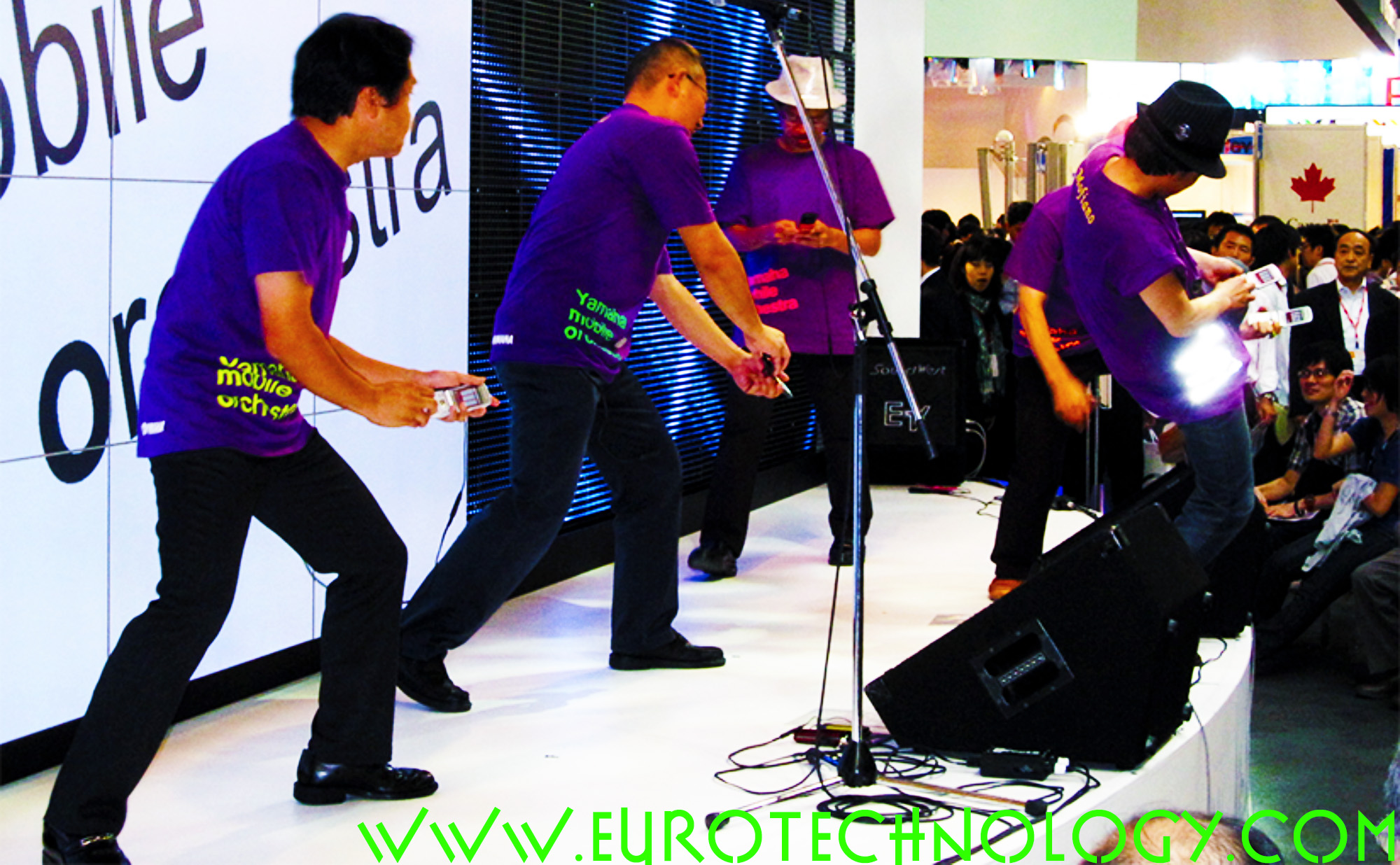
KDDI created a new brand: “iida” for the long running best selling AU design series mobile phones. KDDI introduced some of the most recent iida design series models at the KDDI Designing Center. In addition to the earlier Yamaha musical instruments phones, KDDI introduced a spectacular phone created by Yayoi Kusama.
Fun is the green leaved charger….
KDDI iida chargerKDDI iida design series – by Yayoi KusamaKDDI iida design series – by Yayoi KusamaKDDI iida design series – by Yayoi Kusama
About 50 million mobile phones equipped with digital terrestrial mobile TV (“oneseg”) have been delivered up until today – not counting “oneseg” tuners for PCs, car navigation units and stand-alone units. Comparing this number with reports of mobile TV roll-out in other countries around the world, we conclude that 72.5% of todays mobile phones with mobile TV are in Japan.
How much mobile TV do Japanese people watch on their mobile phones? In the latest version of our mobile-TV report, we explain in detail our methods to determine that averaged over all of Japan’s population of 125 million (including those who don’t have a mobile-TV yet), the average viewing time is between 0.4 – 2.3 hours of mobile TV / month. WOW!
Mobile TV 2.0 (OneSeg-2) Not surprisingly, Japan’s media giants are now starting to move, and develop programming specially designed for mobile TV: for example “lunchbox” mobile TV broadcast to mobile phones from 12:00noon – 12:40pm weekdays with news, weather, diet information, summaries of TV shows… it’s only a question of weeks or months now in Japan for mobile TV to develop into a totally new advertising and m-commerce medium, and some has started already.
Starting the global mobile internet revolution with i-Mode in February 1999, we can see Japan’s leadership emerging in the mobile TV arena. Japan’s challenge is to leverage this know-how globally, Japan missed this chance with i-Mode and left the field to iPhone and friends!
In December 2008 97.5% of global mobile TV was in Japan and S-Korea
72.5% of all mobile phones with digital TV globally are in Japan: In the same way as with mobile internet (i-mode), Japan is again the global forerunner in mobile TV, together with South Korea.
(2) for mobile operators DoCoMo, KDDI and SoftBank margins are 10%-20% and increasing despite the crisis! Could mobile phone usage be crisis resistant?
(3) TV media groups had healthy margins in the 10%-20% range back around 2001- however these margins have been slowly melting away, and TV group margins are heading to cross the zero line into the red zone by 2010-2011. Watch out for a TV media crisis. Read more below.
Consumer electronics sector operating margins:
Nintendo bucks the trend: while Japan’s electronics firms’ margins are dropping into the red, and have never been much higher than 5% during the last 10 years, Nintendo‘s operating margins are above 30% and rising despite the crisis.
Margins of top Japan’s electronics multinationals and Nintendo
Mobile phone sector margins are 10% – 20% and rising despite the crisis.
Mobile phones seem to be resistant to the current crisis. DoCoMo‘s, KDDI‘s and Softbank‘s margins are healthy and improving despite the crisis.
Operating margins of Japan’s top 3 mobile operators
(Find full data, fully labeled graphics and analysis in our JCOMM Report)
Margins of TV media groups have been melting away since their peak in 2001.
Back in 2001 Japan’s TV media groups used to enjoy healthy margins of up to 20%. Over the last 8 years these healthy margins have molten away, and Japan’s large TV media groups are likely to all simultaneously go into the red from 2010 onwards, unless dramatic action is taken. Media groups will need to grow profitable new business, e.g. mobile-TV, and other cross-media growth areas.
Could it be that recent anti-takeover measures have made the large TV media groups complacent?
Operating margins of Japan’s TV media groups
(Find full data, fully labeled graphics and analysis in our J-MEDIA Report)
It will soon be 8 years since DoCoMo started commercial location based services (LBS) for mobile phones in Japan in July 2001. During these 8 years, Japan’s mobile LBS industry has grown and a range of differentiated mobile LBS services has emerged – indicative of how the LBS industry might develop in other countries in the next few years (Read our LBS-FAQ here, and our mobile LBS report here).
NOKIA’s recent acquisition of Navteq for US$ 8.1 Billion has drawn much attention to LBS for mobile phones.
The world’s first commercial location based service (LBS) for mobile phones – “i-Area” – was rolled out by DoCoMo in Japan in July 2001 – eight years ago! – is still going strong, and for some time also includes location dependent mobile search: you type “ramen” into the search box and back comes a list of ramen noodle restaurants for the neighborhood near you. “i-Area” is a pre-GPS service – no GPS is necessary. Like so much about Japan’s mobile internet eco-system, i-Area has a non-obvious complex business model fine-tuned over 8 years now.
GPS came later – KDDI introduced the first GPS phone in December 2001 – a little more than seven years ago – and today about 1/2 of all mobile phones have GPS in Japan. Japan’s Government requires all cellphones to have GPS built in. Therefore, within a few years, as users replace their older phones, 100% of Japan’s cellphones will have GPS, giving a boost to the mobile LBS industry.
Interesting companies? An undisputed leader is Navitime – offering “total navigation” to about 2 million subscribers – almost 2% of the population of Japan. Many people in Japan, including the author of this newsletter, cannot live without total navigation….
Bombarding subscribers with mobile discount coupons by SMS for shops in the neighborhood is often mentioned in western blogs about mobile LBS. I have not yet received a single one during the last 8 years of mobile LBS in Japan – although these do exist if you want them.
Japan’s telecom operators are a very bright spots in a dismal economic crisis. I think that’s not a coincidence.
Why? The deeper purpose of Japan’s location based services, QR-codes, mobile music, e-moji, wallet phones and keitai credit etc. has always been to make mobile phones inseparable from people’s daily lives, so that people would use their mobile phones a lot, even if there is an economic crisis. This strategy seems to work.
Japan’s second largest operator KDDI was the first to announce financial results this round: – quarterly net income increased +49% year-on-year, and – operating income increased +18.5% compared to same quarter last financial year.
KDDI is particularly interesting because KDDI is a model for the 3G roll-out by China Telecom in China, which was awarded a license to build a 3G network using the same CDMA2000 technology as KDDI.
KDDI was initially far more successful than both DoCoMo and Vodafone (now Softbank) to roll out 3G in Japan – as documented in detail in our 3G report. Analyzing carefully what KDDI did right, and the difficulties DoCoMo and Vodafone encountered, as well as proper exploitation in differences between technologies will be a must.
KDDI introduced many advanced services such as GPS (global positioning and related location base services LBS), full song mobile music, etc several years earlier than DoCoMo and Vodafone -> Softbank, helping the image of the brand and raising revenues (ARPU). This advance allowed KDDI to overcome the handicap of lower market share compared to DoCoMo. Read more below, and in our reports.
KDDI’s 3rd quarter net profits rose by 49% yoy.
Comparing 3rd quarter FY2009 (Oct. – Dec. 2008) with 3rd quarter FY2008 (Oct. – Dec. 2007) operating income increased +18.5% and net income increased +49%. These are spectacular results considering the terrible economic crisis going on now.
Notice also KDDI‘s very aggressive income growth targets forward to year FY2011 (shown for operating income, thin orange line).
Steadily increasing net annual incomes on the order of US$ 2 billion/year is not bad in times such we have now. Find a detailed analysis in our KDDI report.
China’s Ministry MIIT granted three different 3G cellphone licenses on January 7, 2009:
a TD-SCDMA license to China Mobile (457 million GSM subscribers)
a wCDMA license to China Unicom (133 million GSM subscribers)
a CDMA2000 license to China Telecom (43 million CDMA subscribers acquired in 2008 from China Unicom, 216 million fixnet phone subscribers, 38 million broadband subscribers)
MIIT estimates that the operators will invest about US$ 41 Billion for 3G over the next two years, ie about US$ 20.5 Billion/year – about the same annual rate as Japan’s 3G investments every year over the last 8 years since 3G introduction.
Network technology diversity (instead of the Government deciding on a single radio technology standard) means that China’s mobile market a few years down the road may have some similarities to Japan’s today. Several Japanese companies, including “time machine company” SoftBank are working to bring 3G mobile services and technologies from Japan to China.
In our opinion, competition between different 3G radio network technologies is one of the factors driving Japan’s 3G success story.
MIIT decided not to abandon CDMA2000, in order to enhance competition between technologies. Another factor may have been that Japan’s CDMA2000 operator KDDI was initially much more successful in bringing 3G to market than competitors DoCoMo and Vodafone (which sold Japan operations to SoftBank).
In Japan it was not market leader DoCoMo or Vodafone, but KDDI with CDMA2000 winning the 3G introduction battle. Better be prepared for surprises in China too, and don’t underestimate China Telecom.
US$ 41 billion for 3G in China over 2 years is similar to the figures for Japan.
Japan’s mobile operators have invested a around US$ 15 – 20 Billion every year for more than 10 years (for details see our JCOMM report), very similar in size to expected annual 3G investments for all of China.
Japan’s 3G introduction took about 8-9 years (from October 2001 until 2009/2010 – Japan’s last 2G phone was shipped in December 2007). Therefore we expect 3G introduction to take about 10 years for China – could be faster because China can learn from 3G introduction in other countries.
China’s planned 3G investments compared to Japanese mobile phone network investments
China opts for network diversity – like US and Japan
The figure below – from our JCOMM report about Japan’s telecom sector – shows the 2G -> 3G transition in Japan, where several networks with different technologies compete in the market place. We believe this competition between different technologies is a key factor for the rapid success of 3G in Japan.
China having chosen multiple competing technologies, we may see a similar 3G success story as in Japan, however with much larger subscription numbers.
Japan’s mobile network diversity – overview of competing networks
If your business requires interacting with lots of people in Japan, if you are offering services to consumers, or just as a convenience offered on your business cards – think about QR codes:
Answering the question: “What are the 5 top tips for mobile marketing”
Our company worked for several of the world’s largest consumer companies on mobile marketing here in Tokyo/Japan.- Many of Japan’s mobile trends usually move to Europe and US within about 3-5 years. So here are some tips from our work on mobile marketing in Tokyo/Japan:
Leverage spontaneity: use the “here & now” effect of mobile
Mobile phones are among the very few privileged items almost all people carry on their body at all times and allow people to react on the spot. Mobile phones allow people to buy “here and now”, on the street, on the toilet, from bed, changing trains, waiting for a bus etc. Successful mobile marketing campaigns use this “here and now” effect. As an example, see the iPod campaign in Tokyo-Shibuya, or the North-West Airlines campaign in Tokyo/Shinjuku (discussed in detail in our QR-code report).
Provide real value
Things work best when people perceive and actually receive real value. For example, an airline seat, or a share purchasing/selling transaction at the moment they want it. Don’t disappoint people by promising value, which you don’t deliver.
Make it fast: close a transaction in seconds not minutes
Mobile phones are mostly used in short bursts. Attention span is short. Apple’s iPod campaign allowed people to buy an iPod from the Apple store via mobile phone here and now, in a very short time (find a detailed description in our QR-code report)
Do innovate if its really new – but don’t re-invent the wheel
Japan is a huge mobile laboratory – many mobile business models discussed in Europe or US now have already been tested out years ago in Japan. Read our reports,
Treasure security – your mobile sites need to be more secure than websites, not less secure
Customer data lost via mobile phones, or a hacked mobile banking site is just as disastrous as if the same occurs for a fixed line traditional website. Mobile sites can potentially be broken from remote locations in your own country or from a country you wish you never had to deal with.
We worked on security of mobile financial industry sites.
ICT trends for Japan: Ericsson and Nokia Siemens Networks (NSN) remain engaged in Japan’s ICT sector
by Gerhard Fasol
One of the Embassies here in Tokyo asked me to write a report about ICT trends for Japan…
ICT trends for Japan: Mobile phone sector
Pushed by the Government the mobile operators changed the business model for mobile phone sales from a straight subsidy model to an installment payment system. As a consequence the mobile phone sales collapsed, creating huge difficulties for Japan’s mobile phone makers, but greatly improving the financial results of mobile operators.
Smart phones grow market share in Japan
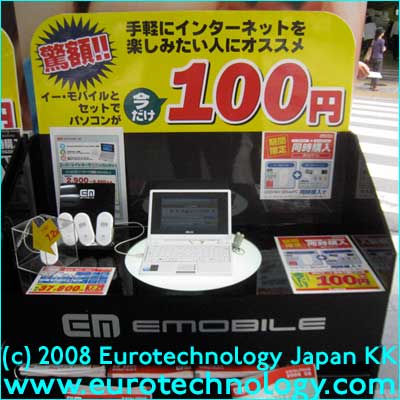
An interesting trend is the growth of the “smart-phone” market (Blackberry, HTC-Windows-Mobile phones, iPhone etc.) and mini-PCs, which can be acquired for YEN 1 with subsidy from eMobile.
In this context the Japanese telecom equipment makers association invited me to give a presentation, which was booked out 2-3 weeks ahead – about 100 Japanese telecom equipment maker managers attended! The General Affairs Vice-Minister / Secretary of State attended…
Nokia terminates mobile phone business in Japan
On November 27th, 2008, global press announcements announced that NOKIA will stop making mobile phones for Japan’s mobile operators with immediate effect. DoCoMo and SoftBank had NOKIA phones in preparation and had already started marketing efforts – these were cancelled a few days after NOKIA’s press announcement.
NOKIA had founded the Japan subsidiary on March 3rd, 1989, almost exactly 20 years ago, thus NOKIA has given up entering Japan’s mobile phone market after 20 years of efforts. NOKIA will not totally shut down in Japan, NOKIA announced that R&D and procurement will continue, and VERTU announced to enter Japan’s market with a mobile vertual network operator (MVNO) model renting network capacity from DoCoMo, and opening own shops.- However the opening of these direct VERTU stores keep being postponed.
NOKIA joins the row of European telecom companies which have given up operations in Japan: Vodafone, Cable & Wireless.
Nokia Siemens Networks (SNS) is continuing business in Japan as well, so NOKIA will not be entirely gone from Japan.
M&A
European company’s acquisitions in Japan are currently at low levels, including the ICT sector. By far the largest acquisition in Japan by a company from the European/Mediterranian area was not by an EU company, but by the Israeli company Iscar which acquired the Japanese company Tungaloy for around US$ 1 Billion. However, this acquisition was driven by US capital. Read details in our blog here.
In the opposite direction, Japanese acquisitions in EU and elsewhere, there is a boom of acquisitions by Japanese companies abroad. For example, TDK acquired the German company EPCOS, Fujitsu acquired the outstanding 1/2 of Fujitsu-Siemens, NTT-Data acquired 72.9% of Cirquent which was a 98% subsidiary of BMW before. SONY acquired the outstanding 1/2 of the SONY-Bertelsmann Music Group from Bertelsmann.
The current trend is definitely a strengthening of Japanese acquisitions in Europe.
The most important issue however are not the acquisition transactions themselves, but the crucial issue will be whether these acquisitions create or destroy value. In many cases the difficulties to overcome “cross-cultural” issues are enormous. Many huge wrecks line the road: Vodafone-Japan, Cable-Wireless-Japan, NOKIA’s mobile phone business in Japan, or DoCoMo’s overseas acquisitions. There are also many success stories – the most impressive and famous one Nissan-Renault, however there are many more. An interesting case in progress is Nippon-Sheet-Glass (now NSG Group)’s acquisition of Pilkington Glass (read about a presentation by NSG’s CEO here in our blog).
NOKIA’s Japan subsidiary was founded on April 3, 1989 – almost 20 years ago. On November 27, 2008 NOKIA announced to terminate selling mobile phones to Japan’s mobile operators, effectively withdrawing from Japan (except for purchasing, R&D and VERTU).
NOKIA’s sales figures in Japan were a well kept secret until last week when several Japanese newspapers wrote that NOKIA sold 200,000 phones during FY 2007: thus NOKIA’s market share was 0.39% – after 20 years of market entry efforts.
Considering the disastrous collapse of mobile phone handset sales in Japan, NOKIA’s move to quit sales in Japan actually makes a lot of sense. Nothing prevents NOKIA from re-entering Japan again in the future.
Japan’s mobile phone sector is admired the world over, and Japanese mobile phones are years ahead the rest of the world regarding functionality. However, Japan’s mobile phone industry may be heading for a disaster, similar to the European 3G spectrum license fee disaster which almost bankrupted Europe’s mobile phone operators – unless changes are made quickly. Statistics released today show that mobile phone deliveries in October dropped down to 1/4 of steady sales maintained over the last 8 years as the figure below shows.
Switch from subsidy business model to installment contract model causes Japan’s mobile phone handset market to collapse (temporarily)
What is the reason for the disastrous drop in mobile phone deliveries?
Until recently Japan’s mobile phone operators subsidized mobile phone handsets. Consumers would typically pay YEN 10,000 (about US$ 100) for handsets with built-in digital TV, GPS, movie camera with auto-focus, electronic money and tickets, QR-code reader, and much more, which cost the operators up to YEN 100,000 (US$ 1000) per handset.
Encouraged by Japan’s Government, mobile operators recently switched from the subsidy model to an installment plan, while discounting the monthly usage fees.
While previously consumers put YEN 10,000 (US$ 100) or in some cases YEN 1 (1 cent) on the counter to receive one of the world’s most advanced handsets, since a few weeks ago consumers are faced with a 2 year installment purchase contract where they pay the full YEN 60,000 (US$ 600) or YEN 80,000 (US$ 800) for a handset in installments of around YEN 3000 (US$ 30) each month for two years. Not surprisingly handset sales dropped into the cellar as shown above (the figure above actually shows the deliveries from manufacturers to mobile operators, not the actual retail sales).
What are the likely consequences?
continuing consolidation of Japan’s mobile phone handset makers
surviving handset makers will push into international markets
operators will push harder for cheaper handsets
operators might return to a modified subsidy model
presentation by Gerhard Fasol, at the Industry Association of Japanese telecom and networking equipment makers, Friday November 27, 2008, 15:00-16:30
Presentation was fully booked several weeks before the talk, attended by about 100 managers and executives of Japan’s telecom equipment makers, and included also the Vice-Minister/Secretary of State of Japan’s General Affairs Ministry, which is responsible for telecom regulation in Japan.
A few days ago the New Context Conference was held here in Tokyo, mainly about social network systems (SNS), top executives including CEO of LinkedIn, Facebook, and some exciting new photo, video conference and e-learning companies discussed market entry to Japan.
Japan’s two markets
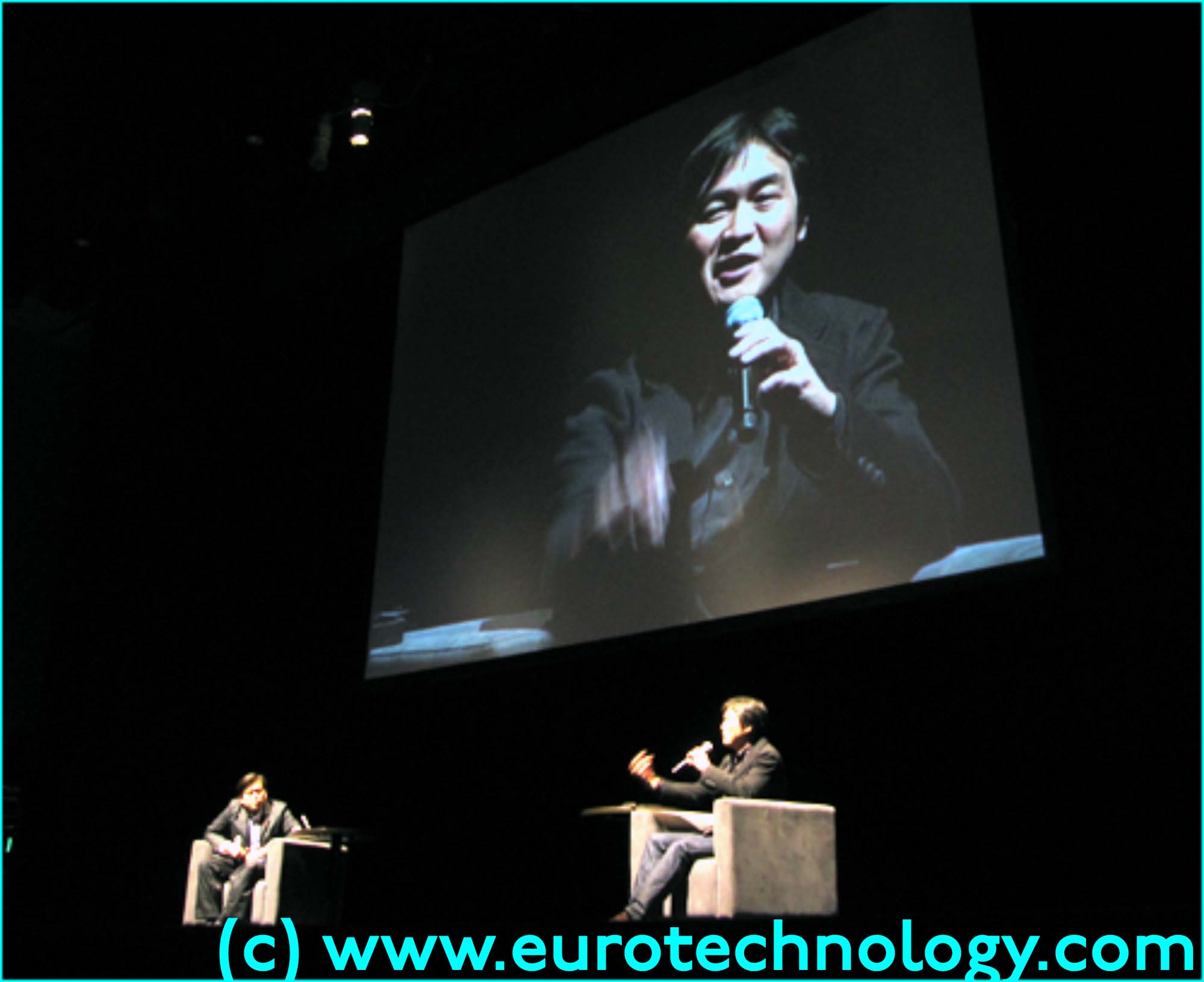
Takeshi Natsuno, one of the three key DoCoMo managers who together started i-Mode and arguably started the world’s mobile internet revolution launching i-Mode back in February 1999 gave the keynote discussion. Natsuno shared his very interesting observation, that Japan consists of two markets:
new Japan = people below 50 years age and
old Japan = above 50 years age
…and having managed i-Mode (today: 48 million paying subscribers) for almost 10 years Natsuno-san is certainly one of the best to know. (Natsuno-san’s main job today is to make Japan’s very cute equivalent of YouTube profitable – read more about this in a future issue of our newsletters).
New Japan vs Old Japan in my talk at Stanford University
Actually, you’ll find a similar observation about “old Japan and new Japan” in my presentation entitled “New opportunities versus old mistakes: foreign companies in Japan’s high-tech markets” which I gave some years ago at Stanford University to faculty, students, alumni and silicon valley managers.- (You can view and download the slides of the presentation below.)
Natsuno-san talking at the New Context conference in Tokyo about old Japan, new Japan, the future of the mobile internet, and the mobile industry. Natsuno-san is one of the three inventors of i-Mode.
New entrant challenging Japan’s mobile incumbents Docomo and KDDI and SoftBank. A discussion between Dr Sachio Semmoto and Dr. Gerhard Fasol
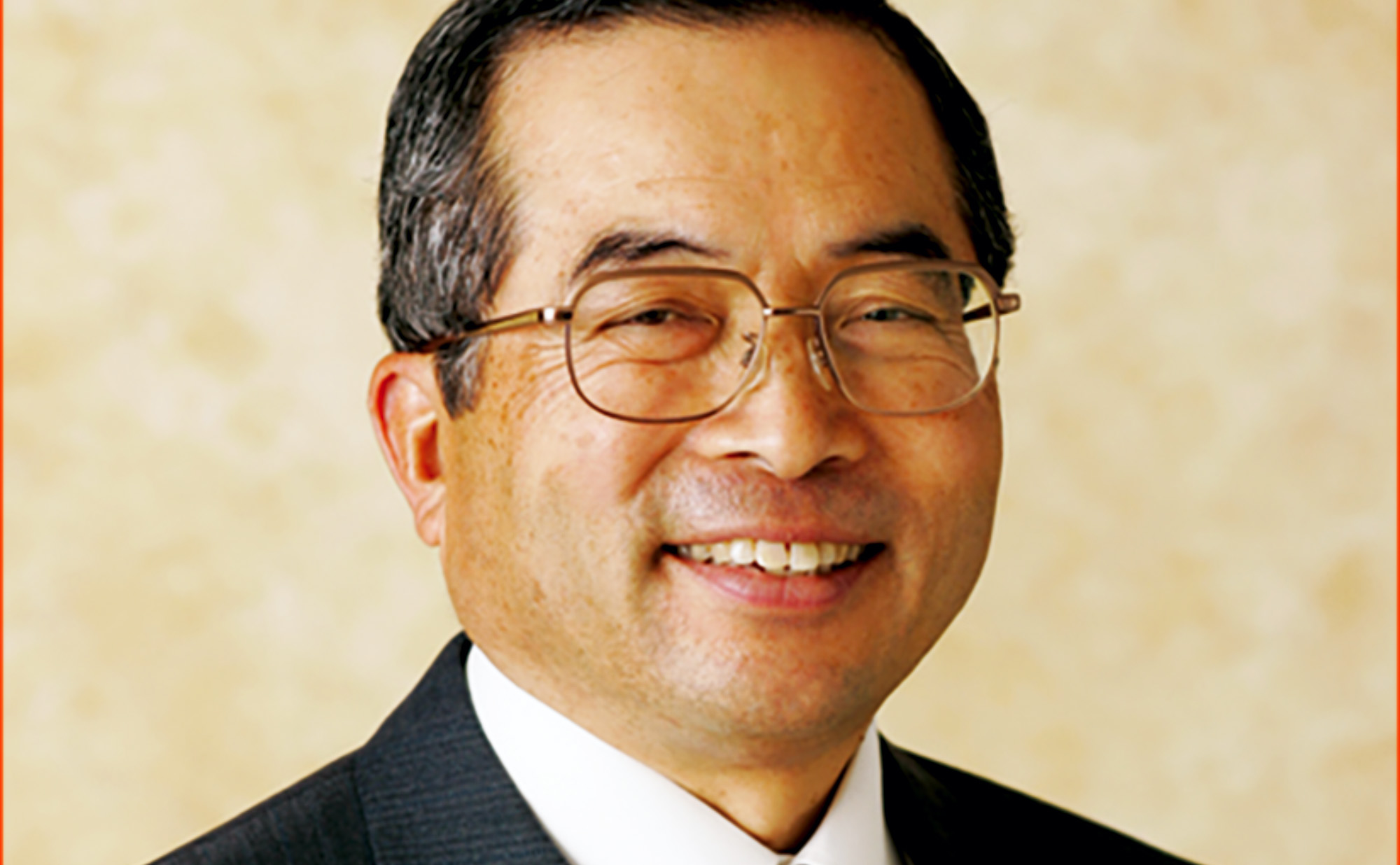
Dr Sachio Semmoto: one of Japan’s most successful serial entrepreneurs
eMobile is Japan’s newest & fastest growing mobile operator, focused on mobile broadband – currently at HSDPA speeds up to 7.2 Mbps and HSUPA/EUL upload speeds up to 1.4 Mbps from Nov 20, 2008 (possibly upgraded to 5.7 Mbps from 2009) covering all major urban areas of Japan. Read an exclusive interview with eMobile’s founder and CEO, Dr. Sachio Semmoto below. eMobile‘s start is a resounding success: subscriber numbers will soon reach 1 million, and in October 2008, eMobile could attract 102,500 new subscribers – three times more than market leader DoCoMo (32,700) and two times more than KDDI (46,700). eMobile‘s market share is growing. eMobile was founded by Dr. Sachio Semmoto on January 5, 2005, and obtained the 3G spectrum license after a tough “beauty show” from Japan’s General Affairs Ministry on November 9, 2005 – almost exactly 3 years ago. At that time the Ministry gave new 3G spectrum licenses to three companies, however eMobile is the only one which actually built a new 3G network – the two other licensees returned their licenses to the Government unused.
Dr. Sachio Semmoto has very kindly agreed to an exclusive interview for our newsletter – read Dr Semmoto’s interview below. We are very grateful to Mr Takashi Igarashi of eMobile for his help and assistance in producing the interview. Dr. Semmoto is an extremely successful Japanese multi-entrepreneur. He is one of the co-founders of DDI (today part of KDDI), he founded the ADSL provider eAccess, and in 2005 he founded eMobile. Read Dr Semmoto’s interview about eMobile below.
In September 2008 eMobile attracted three times more new users than NTT-DoCoMo, and two times more new users than KDDI. eMobile will soon reach 1 million subscribers.
eMobile subscription numbers
Dr. Sachio Semmoto co-founded DDI (today part of KDDI), he founded ADSL provider eAccess and in 2005 he founded eMobile. He is Chairman and CEO of eMobile. Read Dr. Sachio Semmoto’s interview below.
Dr. Sachio Semmoto, Founder and CEO of eAccess and eMobile
Dr. Gerhard Fasol: Your company’s main product are 7.2 Mbit/sec data connections at about YEN 6000 (US$60, EURO 50)/month without any usage limitation at all – even if your subscribers upload or download enormous amounts of data including Skype and VOIP, or watch or upload movies all-day you do not reduce such users connection speed, and you do not charge extra. In Europe such totally unlimited data subscriptions do not exist to my knowledge – in addition most European telecom operators exclude VOIP or Skype from mobile data subscriptions – they even talk about “unfair usage” in their subscriber contracts. European telecom managers tell me that unlimited data subscriptions are impossible because of network capacity limitations and high electricity costs etc. What is it the “secret” that enables eMobile to offer unlimited data plans – without any usage restrictions at all?
Dr. Semmoto: We at EMOBILE have successfully developed and constructed a low cost, but high quality mobile network from scratch, based on leading-edge 3.5G/HSDPA technology base stations. HSDPA technology improves the usability of spectrum and network performance. We also have rich experience in fixed broadband markets like ADSL through eAccess, our group company.
Our “secret” is very simple:
1) high usability of network based on state-of-the-art technology, competitive low cost construction and operations, and 2) operational know-how from fixed broadband market (through eAccess).
Incumbent carriers offer flat-rate data service only because competition forced them to. We believe we have great competitive advantages against incumbent carriers.
Dr. Gerhard Fasol: What were the main difficulties you had to overcome to start eMobile?
Dr. Semmoto:
Financing. We are a completely independent venture company with no financial support from big corporations. We won the confidence of international qualified financial institutions like Goldman Sachs, and Temasek of Singapore, and succeeded to attract funding as large as 3.6 billion US$. This was before our business launch, therefore all we had to show to investors was just our business model and our management team, and our plans for a successful future business.
Dr. Gerhard Fasol: What was the most surprising experience for you building a new mobile operator from scratch?
Dr. Semmoto:
1) We were very fortunate that we could complete full funding back in 2006 for the following 5 years until 2011, before the current worldwide financial crisis 2) We won a business license and spectrum allocation from the government in 2005 after a tough beauty contest.
Dr. Gerhard Fasol: I remember the Japanese government wanted to have three new mobile networks and gave three new licenses, and your eMobile was the only company which actually succeeded to build a new network from scratch as desired by the Government (SoftBank acquired Vodafone including Vodafone’s license, and returned the new license to the Government and IP-Mobile could not find the finance) – congratulations!
Dr. Semmoto: You are completely correct. Softbank and we were fighting against each other for 15MHz in the 1.7GHz band. But the government had not decided the number of licensees initially, that means it was possible that only one company would win the whole 15MHz. As a result of the beauty contest, Softbank and we were both qualified and won 5MHz each, and the other 5MHz was reserved for additional allocation.
Dr. Gerhard Fasol: One of the key issues for telecom operators is often said to be to “avoid becoming a dumb data pipe”, i.e. to avoid commoditization and ever decreasing ARPU. What is your strategy that your company and your network does not become “a dumb pipe”, a commodity?
Dr. Semmoto:
We are confident in providing “a pipe”. It is a pipe but a GREAT pipe, mobile broadband service, and it is what customers are willing to use. I believe other Japanese mobile carriers are “too intelligent”, too far from real customer needs. High speed, flat-rate mobile broadband data is in itself a differentiated service. We will maintain competitiveness by continuously upgrading our data service from 3.5G to next generations (HSPA+ and LTE).
Dr. Gerhard Fasol: Assuming an ARPU of YEN 5000 for 1 million subscribers we can calculate that eMobile has sales of about YEN 60 Billion for 2009, i.e. about US$ 600 Million. Is eMobile profitable now or if not, when do you expect eMobile to become profitable?
Dr. Semmoto:
We expect to achieve 85 billion yen (about US$ 850 million) revenue with an accumulated subscriber number of approx. 1.4 million by the end of March 2009. eMobile has not turned to profit as of today. Under our projection we expect eMobile to break even on an annual EBITDA basis in fiscal year ending March 2010, then break even on net profit basis in fiscal year ending March 2011.
Dr. Gerhard Fasol: Your investors will expect eMobile to show profits and growth. In which areas do you like eMobile to grow? Are you planning to bring your experiences in the world’s most advanced market to other markets – international growth of eMobile? What is your long-term growth strategy for growth?
Dr. Semmoto:
eMobile plans to acquire 5 million subscribers by March 2012, and assumes Japanese mobile penetration to grow to over 100%. In line with our corporate mission of “providing a new and more efficient broadband life for all”, we focus on the Japanese mobile broadband market, which has more than 100 million subscribers. We consider that the whole broadband market will be the mobile broadband market in the future. As for further expansion into other markets, eMobile started a data card bundling service with the UMPCs (Ultra Mobile PC) in July 2008. UMPC is a type of PC that very much relies on internet connection. As we provide high-speed, reasonable-priced mobile internet connection environment, we have already built a win-win relationship with the PC market. Therefore, our strategy will always focus on mobile broadband. Meanwhile, we firmly believe that we will create a brand new potential market following the growth of PC and smart phone market. We do not have a plan to go to international markets for the moment.
Dr. Gerhard Fasol: Many people think that Japan has the world’s most advanced mobile phone market. Do you agree? And why do you think Japan could achieve this?
Dr. Semmoto:
I dare say, NO. Mobile phone rates in Japan have not been declining regardless of rapid market growth for the past decade, due to lack of competition. ARPU has not been declining much for a decade before new licenses were permitted in 2005. After Softbank and EMOBILE’s entry into the market for the first time after 1994, ARPU started to decline. The nominal undiscounted voice call charges of approx. 40YEN/min. are high and quite stable. Data speed was slow just before we started our business and, as I stated above, Japanese incumbent mobile carriers are emphasizing “value added services” too much. Penetration rate remains 80%, ranking as low as 50th globally.
Japanese mobile phone manufacturer lost their international market because Japan adopted non-standard technology, PDC, in 2G.
We need to introduce more competition, standard technology and “big-boned” telecommunication. When I say “big-boned” telecommunications, I don’t mean additional “added value” services, but the essentials of telecommunications: connection and transmission with reasonable price and high speed.
Dr. Gerhard Fasol: Many countries have decided to use one single radio technology path: GSM and in parallel 3GSM / UMTS. Japan and US on the other hand take the view today that the government should not pick technologies, and you find several competing radio technologies in Japan: wCDMA, CDMA2000, PHS, now soon Wimax. What do you think is better for a country: one single radio technology without competition, or a “technology shoot out” like in Japan, where companies compete in a pretty free market with different technologies?
Dr. Semmoto:
Competition among technologies is not bad in itself, but the most important thing is that those technologies are worldwide standard and adopted by many operators. When Japan adopted an internationally isolated technology, like PDC for 2G mobile, its market would became “Galapagos Islands” (ie local Japanese products cannot be exported to other markets, and products from other markets cannot be imported, creating beautiful but dead-end product lines). In this sense, I doubt the future of CDMA2000, PHS and WiMAX because major worldwide operators are going to GSM/W-CDMA/LTE as the mainstream technology.
Dr. Gerhard Fasol: for many years I have been puzzled by the fact that so many fantastic mobile services, handsets, i-Mode, mobile commerce have been developed in Japan, but there has been almost no success by Japanese companies (and foreign companies) to build a global business based on these technologies. For example, Japanese companies build fantastic mobile phones, but have no sales success outside Japan. If Japanese mobile phone makers would ask you how to succeed to sell Japanese made mobile phones outside Japan, or if DoCoMo would have asked you how to succeed with iMode outside Japan, what would your advice be for them?
Dr. Semmoto:
The reason why Japanese mobile phone makers have no success outside Japan is simple. They were based on non-standard technology, PDC (which is Japan’s 2G standard, which was not used in any other country outside Japan. Still today, more than 10 million PDC 2G mobile subscribers remain in Japan). DoCoMo’s i-mode is also a closed business model. Both cases have “non-openness” in common. Broadband data service is more like “Internet” and needs open service, open business models and open technology.
Dr. Gerhard Fasol: On the other hand, DoCoMo tightly controls most aspects of mobile phone handsets – which makes the production very expensive, and many handset producers have stopped making phones for DoCoMo: Mitsubishi, SONY-Ericsson have stopped, and SANYO sold the handset division to Kyocera. What do you think is the future of DoCoMo’s model of controlling mobile phone specifications? And what is eMobile’s handset strategy? Do you want to accept as many handsets as possible on your network, which seems to be SoftBank’s strategy?
Dr. Semmoto:
We emphasize standardized technology and open business models. It is not our strategy to control mobile phone specifications too much by committing the purchasing numbers, and by subsidizing developing and manufacturing costs because this would lead us to lose cost competitiveness. We are willing to adopt high-quality, worldwide standard and state-of-the-art handsets.
Dr. Gerhard Fasol: What do you think about the current trends in mobile handsets?
Dr. Semmoto:
Current trends in handsets are in two directions: simple phones and smart phones. Firstly, Japanese incumbent carriers have to change their strategy to place more emphasis on customer retention, therefore, the shipment of handset is decreasing in Japan. Both carriers and phone makers cannot support heavy product costs therefore the retail prices are increasing. Customers choose simple and easy-to-use handsets. Secondly, mobile broadband requires more open, multi-function handsets like smart phones.
Dr. Gerhard Fasol: What do you think mobile communications markets will look like in 10 years from now? What is your vision for the industry?
Dr. Semmoto:
the mobile market will become more data-focused, furthermore, broadband focused, which we already have experienced in the fixed telecommunication market (from narrowband data/voice to broadband internet). We will see through these mega trends and we will enforce our competitiveness in order to create brand new markets.
“New Age” mobile operator eMobile started with a “green field” nationwide HSDPA 3G network offering commercial services since March 31, 2007. By August 2008, eMobile has attracted more than 750,000 subscribers. eMobile‘s network covers about 85% of Japan at this time.
At an investors conference, eMobile‘s CEO recently explained, how his company could reduce the costs of the radio network and base stations down to 1/5th – 1/8th of the costs his competitors pay, by carefully selecting the two best base station manufacturers/vendors. Read who these two base station manufacturers are (one of them may be an unexpected choice) in the newest edition of our eMobile – report.
The US$ 1 laptop:
eMobile offers a US$ 1 (YEN 100) laptop – in combination with a 2 year 7.2 Mbps true flat-fee data subscription.
(note that this flat data fee plan has absolutely no data limit. Totally unlimited data plans for laptops are uncommon in Europe and US, where most “flat” data plans come with a very low “fair use” limit above which prices increase dramatically). Low priced laptops are a huge market success in Japan and put pressure on traditional laptop makers. eMobile offers subsidized Asus EEE’s / ASUSTeK EEE’s – and many other laptops, including also iBooks.
Digital mobile TV started in Japan in 2005 – about 3 years ago: KDDI/AU sold the first phones with digital mobile TV starting in October 2005, at the same time mobile TV was available for public testing. The official commercial service of mobile TV started on April 1, 2006.
Today more than 75% ship with 1-seg mobile digital TV tuner and software, and the percentage is rapidly increasing as the figure below shows. Quite soon, almost all mobile phones in Japan will ship with digital mobile TV.
Percentage of Japanese mobile phones shipped with 1seg mobile TV built in2G vs 3G phones in Japan
KDDI/AU switched off 2G radio network in March 2008, Docomo and SoftBank to switch off 2G networks in 2009
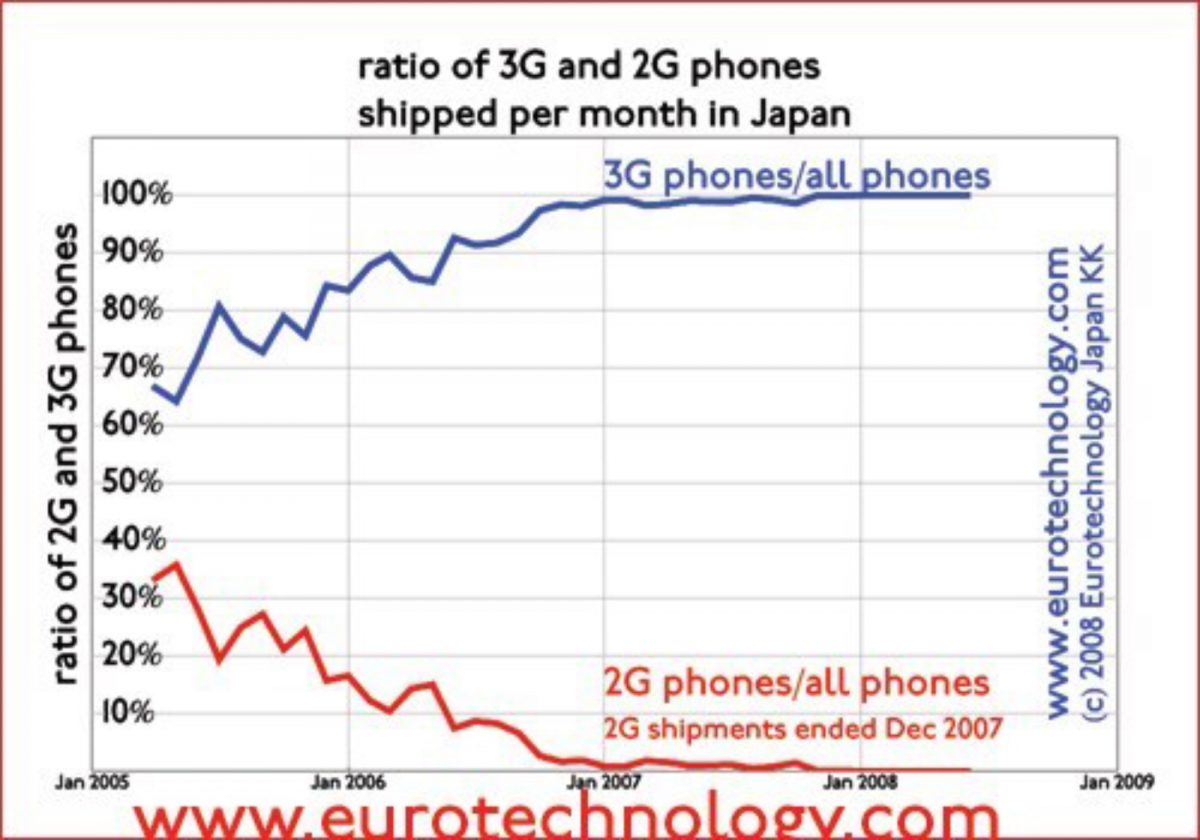
Second generation (2G) phones silently bowed out of Japan’s market 8 months ago: the last 2G phones in Japan were shipped in December 2007. KDDI/AU switched off their 2G radio network in March 2008, this year, and both DoCoMo and SoftBank announced that they will switch off their slow and expensive 2G networks in the very near future (about 2009). Almost all other countries in the world either depend on legacy 2G networks only, or keep legacy 2G going while building out third generation in parallel. (Today’s 3G HSDPA phones transmit data up to 250 times faster than 2G phones did on a good day).
2G vs 3G phones in Japan
The last 2nd generation (2G) phones shipped in Japan in December 2007. Almost all other countries keep legacy 2G networks running – Japan just switches them off. More in our JCOMM report.
Tetsuzo Matsumoto (Senior Executive Vice-President and Board Member of SOFTBANK MOBILE Corporation), Gerhard Fasol (CEO, Eurotechnology Japan KK) and Dennis Normile (Japan Correspondent of SCIENCE Magazine, and FCCJ) discuss about the future of Japan’s mobile phone market.
“Will the iPhone trigger a turning point in Japan’s mobile phone industry?” (Foreign Correspondents’ Club of Japan, Tokyo Wednesday, August 13, 2008, 12:00-14:00)
(Photo: Copyright Foreign Correspondents’ Club of Japan, used with permission)
panel discussion at the Foreign Correspondents’ Club of Japan on the topic “Will The iPhone Trigger A Turning Point In Japan’s Mobile Phone Industry?”
How many iPhones did SoftBank sell in Japan during July?
Our estimate: between 75,000 – 125,000. Read on about how we arrived at this estimate.
Net growth of mobile subscription numbers in Japan (Japan’s mobile market grows by about 5.5 million per year – for more analysis read our JCOMM-Report).
Growth/loss of mobile subscriptions of Japan’s mobile operators during the period 2006-2008
How did we arrive at the estimate of 75,000-125,000 iPhones sold in Japan during July?
When we analyze the Figure above, we can see that SoftBank‘s subscriber numbers increased by 158,900 during June 2008, and the monthly increase jumped to 215,400 during July 2008. We can also see that for no other month except for March 2006, March 2007, and March 2008 was there such a jump (in Japan March is the month of peak mobile phone sales, because new jobs traditionally start with the beginning of the financial year on April, 1). Since SoftBank did not introduce any other spectacular phones during July 2008, we can safely assume that most of the 56,500 net increase jump from June to July are iPhone sales to new subscribers, or new subscriptions for second phones, or number portability users moving over from DoCoMo or KDDI. However, this number would not count current SoftBank subscribers who are upgrading existing subscriptions from a previous older phone to an iPhone. Since we are not aware that SoftBank announces this number, we need to estimate it. If we assume that there were equal numbers of new subscriptions for iPhones as replacements, we would arrive at an estimate of 100,000 iPhones sold during July 2008 in Japan. If we estimate, that this second assumption has a +/- 50% error margin, then we arrive at an estimate of between 75,000-125,000 iPhones sold in Japan during July 2008.
Our estimate: about 640,000 – 1 Million iPhones may be sold in Japan during 2008:
If we assume that iPhone sales in Japan will continue at the current rate, then we can estimate that between 640,000 – 1 Million iPhones could be sold during the remaining part of 2008 in Japan, which would be about 1.2% – 2% of mobile phones sold during 2008.
In a terse one-line press announcement “SoftBank today announced it has signed an agreement with Apple to bring the iPhone to Japan later this year”. (Of course we are talking about the 3G i-Phone, because Japan has almost switched off the 2G networks, and has essentially stopped selling 2G phones for a couple of years now. The current initial 2G iPhone uses GSM and therefore cannot work in Japan, which has no GSM).
iPhone’s main competitors in Japan will be SHARP and KDDI’s design series, at least for the forseeable future – an entirely different story than in any other country in the world… read below.
Japan’s mobile phone handset market size and market shares in 2008 compared to the world market
About 25% of the global cellphone market in terms of cash value is in Japan. – Why? Japanese users want a lot more functions (navigation, mobile payment, QR code, mobile shopping, mobile music and video, mobile TV, …), and are happy to pay much more per phone. Japan is a totally different game: while NOKIA has about 40% of global market, NOKIA’s marketshare in Japan is almost zero.
Competing in Japan will be an entirely different story for the iPhone
Japan’s cell phone is entirely different than anywhere else in the world – recently some people including Japanese Government officials have used the nickname “Galapagos islands” for Japan’s insular and very advanced cellphone market. Indeed, our company in a project for the European Union Government documented in details how Japan’s cellphone services are 3-5 years ahead of Europe’s, ie a large range of cellphone services common in Japan have not yet been introduced in Europe.
For this reason, while the current 2G iPhone is at the high priced top-end in the US or in Europe, in Japan the 2G iPhone does not even work, because Japan has no GSM and essentially has not been selling any 2G phones any longer for a couple of years now. Many mobile services, which Japanese phone users have become accustomed to, are missing from the current 2G iPhone. Japan therefore will be a benchmark, and we expect that selling the iPhone in Japan together with Japanese customer feedback will help Apple to dramatically accelerate iPhone development. Competing in Japan will make the iPhone stronger we believe.
There are two YAHOO!s – YAHOO! Inc and YAHOO! KK. (ヤフー株式会社)
Yahoo! KK, ヤフー株式会社 is a Japanese corporation listed on the Tokyo Stock Exchange
Yahoo! KK (ヤフー株式会社) is not a full/100% subsidiary of Yahoo Inc, but Yahoo! KK is a publicly traded company, listed on the Tokyo Stock Exchange.
Ownership of Yahoo! KK (ヤフー株式会社)
35.45% by SoftBank
6.42% by SoftBank subsidiary SBBM
34.74% by Yahoo Inc.
23.39% other shareholders via Tokyo Stock Exchange
100% Total
Thus effectively:
SoftBank (SoftBank + SBBM) holds 41.87% of Yahoo! KK (ヤフー株式会社) shares
Yahoo Inc. holds 34.74% of shares
History background of Yahoo Japan
Masayoshi Son was one of the first and major investors in Yahoo Inc., and obtained the rights to build Yahoo Japan with part investment and license to trade marks and technology from Yahoo Inc.
Masayoshi Son and his SoftBank Group founded Yahoo Japan on January 31, 1996, and built Yahoo Japan into one of Japan’s most successful media and internet companies.
Yahoo KK started trading on the Tokyo Stock Exchange (Code 4689) with the IPO on October 28, 2003.
Market cap and size of Yahoo Inc vs Yahoo Japan
Yahoo Inc and Yahoo KK (ヤフー株式会社) are traded totally independently on different Stock Exchanges. Therefore share price and market capitalization are not directly related.
There are days when Yahoo KK (ヤフー株式会社) has higher market capitalization than Yahoo Inc minus the holding of Yahoo KK shares.
Yahoo Inc and Yahoo KK (=Yahoo Japan) market cap before and after Microsofts’ bidYahoo Inc vs Yahoo KK (Yahoo Japan) revenues and income
Preview – SoftBank today and 300 year vision report:
Our Report on “SoftBank today and 300 year vision” (approx 120 pages, pdf file)
Google, Apple, Nokia, HTC, Vodafone and are winning the driver’s seat of the global internet revolution. DoCoMo, KDDI and SoftBank essentially stay inside Japan for now – limiting their growth prospects and leaving global opportunities to others.
Market caps of Japan’s telecom operators compared to global telecom and internet companies
GOOGLE with Android and APPLE with iPhone are reaching for the driver’s seat of the global mobile data revolution. Global companies including GOOGLE, Vodafone, Apple and NOKIA grow to US$ 100s Billion valuations, while local companies NTT, DoCoMo, KDDI and SoftBank remain essentially limited to Japan’s market for now. Smartphone maker HTC increases impact – including in Japan.