Read our report on Japan’s electronics industry sector:
Copyright 2013 Eurotechnology Japan KK All Rights Reserved
Japan’s electronics industry
Read our report on Japan’s electronics industry sector:
Copyright 2013 Eurotechnology Japan KK All Rights Reserved
Read our report on Japan’s electronics industry sector:
Copyright 2013 Eurotechnology Japan KK All Rights Reserved
Read our report on Japan’s electronics industry sector:
Copyright 2013 Eurotechnology Japan KK All Rights Reserved
More in our J-ELECTRIC Report
Copyright (c) 2013 Eurotechnology Japan KK All Rights Reserved

On February 1, 2007, LENOVO announced excellent 3rd Quarter results. I commented live on CNBC-TV. Read comments on LENOVO’s results below.
Comments on LENOVO’s 3Q results
LENOVO (traded on the the Hong Kong stock exchange) for 3Q announced 23% higher profits compared to 3Q one year ago. Revenue increased slightly to US$ 4 billion, making LENOVO a US$ 12 billion/year company. LENOVO is very successful in it’s home market China, where it controls more than 35% of the PC market. While shipments in China rose 17% during the quarter ending Dec 31, 2007, global sales only increased 0.4%, held back mainly by performance problems and falling sales in the Americas. Globally, LENOVO is squeezed between ACER below, which grows much more rapidly (ACER’s growth was 32.4% in 3Q2006 compared to one year ago while LENOVO’s growth was only 10.1%) and Hewlett-Packard and Dell above. While Dell was struggling recently, Michael Dell came back as CEO of Dell, and I expect Dell to improve and become a much more difficult competitor for LENOVO. LENOVO’s challenge is to turn around the US operations, where it is losing ground. To do so, LENOVO will need to strengthen sales to consumer markets, maybe by learning attractive product design by watching APPLE, since competing on price will further hit profits. LENOVO risks to be overtaken globally by ACER.
Comments on LENOVO
LENOVO is more important than it’s size of US$ 12 billion in sales suggests for the following reasons. LENOVO is one of the first Chinese companies developing a global brand and a global business. With China’s growing economic importance on the world stage, if LENOVO manages to turn-round US operations and becomes globally successful, it’s management structure and methods may become a model for other Chinese companies to globalize. It is interesting to compare LENOVO’s relative success after the acquisition of IBM’s PC business with BENQ’s acquisition of SIEMENS-Mobile phones. If LENOVO succeeds to turn-round US operations, LENOVO may become a model case for futher take-overs of Western companies by Chinese companies. LENOVO is owned 27.3% by the Chinese Academy of Science. If LENOVO succeeds and continues to expand it’s success story, financial benefits will flow back to the Chinese Academy of Science, strengthening China’s science base and contributing to China’s further development. LENOVO is also China’s largest domestic mobile phone maker, after recently overtaking Ningbo-Bird. LENOVO sold 2.1 million mobile phone handsets in 3Q2006, a market share of 6.2%, and annual sales on the order of 8 million phones. This number is far below NOKIA’s sales on the order of 350 million phones/year globally, and recently global phone makers have been gaining ground over local makers in China. However, LENOVO does have a chance sometime in the future to become a global mobile phone player in the way SAMSUNG has succeeded.
Copyright (c) 2013 Eurotechnology Japan KK All Rights Reserved

Eurotechnology’s CEO was invited to attend Ericsson’s Strategy & Technology Summit in Tokyo on November 15, 2006.
Ericsson’s CEO, Carl-Henric Svanberg, Ericsson CSO – Chief of Strategy, Japan-CEO Rory Buckley and other Ericsson top management presented Ericsson’s strategy and vision. About 100 investors and investment bank analysts were invited to attend.
I was given the opportunity to share the lunch table with CEO Carl-Henric Svanberg and had a fascinating discussion (some of his comments flowed into our company’s project report to the European Union on benchmarking Japan’s vs EU’s fixed and mobile telecommunications and broadband sectors).
With some of the largest and most advanced mobile investments, Japan’s mobile market is one of the most important markets globally for Ericsson. Recently Ericsson won major contracts from SoftBank and eMobile.

Copyright (c) 2013 Eurotechnology Japan KK All Rights Reserved

With shock and surprise we recently found out that a very famous telecom and IT industry market research and strategy consulting firm with a globally famous brand apparently outsources market research of Japan’s mobile phone and telecom sector to India. The Indian employees apparently are diligently studying the Japanese language in evening classes, so that in a few years time, they will be able to read a little of the Japanese mobile market information which can be found on the internet, we assume.
We believe that this explains why so much information about Japan’s telecom and mobile phone markets circulating outside Japan is incomplete, or in many cases even wrong. As a consequence companies like Vodafone then take management decisions in Japan, which were totally unrelated to Japan’s market realities.
This fact also contributes we believe to the fact, that some of the most famous global companies in the telecommunications sector find it so difficult to succeed in Japan – not that Vodafone, Nokia (mobile phones and VERTU – except networks which are a great success), Cable & Wireless, Deutsche Telekom all withdrew from Japan – outsourcing market intelligence to low-cost countries such as China, India, Philippines etc. is certainly one of the contributing factors.
Indeed similar to Vodafone’s departure from Japan, famous global telecom consultancies have also closed shop in Japan, due to the very high costs and the continuous high investments necessary to achieve and maintain leadership in understanding Japan’s telecommunication markets.
We can assure our newsletter subscribers and our customers that our original Eurotechnology market reports and our strategy consulting is hand crafted in Tokyo/Japan. Our team members working on Japan market research and strategy consulting, all live in Japan, are mostly Japanese, and work daily with Japanese CEOs, telecom managers, and most importantly of all, daily interview and discuss with real-life Japanese mobile phones users: face-to-face here in Japan – not across one or more oceans.
Made in Japan: the Original “Eurotechnology” Japan-market reports
Copyright (c) 2013 Eurotechnology Japan KK All Rights Reserved
When BusinessWeek interviewed me for an article about SHARP in October 2004, the journalist interviewing me was very surprised that I was talking to him on a SHARP mobile phone.
While NEC and Matsushita are merging their mobile phone development, SHARP has leveraged the power to make the best displays into market leadership in Japan’s mobile phone market. While NOKIA leads outside Japan, in Japan’s market, NOKIA has a market share of around 0.5% and SHARP is No. 1.
Yesterday (July 25, 2006) SHARP announced quarterly results:
One year-on-year basis, sales for the April-June 2006 quarter have increased 13% to YEN 693.7 Billion (US$ 6 Billion), and revenues from mobile phones have increased 24% to YEN 131.6 Billion (US$ 1.1 Billion). Net profit increased 23% to YEN 23.8 Billion (US$ 0.2 Billion) for the April-June quarter.
SHARP focuses on the high quality top end of the market: while store prices of LCD TV’s have fallen by 30%, SHARP’s prices/unit have only fallen by 4%.
Similar to SONY (Qualia) and TOYOTA (Lexus), SHARP has introduced the new brand AQUOS for high-end liquid crystal displays. AQUOS features prominently in SoftBank’s rebranding campaign for Vodafone’s former Japan subsidiary, which will soon be called SoftBank-Mobile.

Copyright·©2013 ·Eurotechnology Japan KK·All Rights Reserved·
Was interviewed today about the announced JV between SANYO and Nokia for CDMA2000 phone handsets (I added some corrections here):
[Q1] How will SANYO benefit from this, since they are the ones who have the technology, what do they hope to gain from working with Nokia? Or is this merely a way to reduce costs for the company, since it’s struggling to remain profitable?
It is clear to me that NOKIA will benefit, since NOKIA needs 3G know-how from Japan because all markets where NOKIA is dominating are behind compared to Japan in 3G development, and also NOKIA needs a lot of other advanced technology from SANYO.
Of course who benefits depends both on the contract conditions and the relative strengths of the parties.
It’s clear that financially NOKIA is the much stronger of the two. NOKIA is financially very strong, while SANYO is in a very weak position, so it’s a very clever move for NOKIA.
[Q2] Is it already too late for Nokia to make such a move in the CDMA 2000 market, with strong players like Samsung, LG and Motorola already entrenched in the market?
I don’t think it’s too late – both Motorola and NOKIA demonstrated rebounds recently with new design initiatives such as Motorola’s RAZR and NOKIA did a successsful turn-round by introducing clam-shell phones a trend which NOKIA had missed by not being linked sufficiently into Japan before.
To succeed you need to make spectactular phones which match consumer needs, and you need the financial and manufacturing power as well as the brand. The combination of SANYO‘s technology with NOKIA’s financial strength and brand, as well as NOKIA’s efficient supply chain are a good basis.
[Q3] When would you expect to see the benefits of such a move to emerge?
I think one should not underestimate the cultural risks. NOKIA and SANYO have extremely different corporate cultures, and we have seen many cases where corporate cultures lead to great difficulties.
I think the key will be to manage the difference in corporate cultures of two very proud companies. Locating the JV in the USA might help.
SONY-Ericsson has demonstrated that such a JV can be successful. In the case of SONY-Ericsson it has taken several years for the JV to succeed. If one takes SONY-Ericsson as a measure, then it might take a couple of years (3-4 years) for this JV to succeed. If it’s faster than that it will be a positive surprise.
Copyright·©2013 ·Eurotechnology Japan KK·All Rights Reserved·
Wednesday Nov 16, 2005, I was interviewed live on CBNC’s Asia Market Wrap with Christine Tan about SANYO’s plans to sell it’s financial division. Some of my friends asked me what I sad in this program – so here is my transcript from memory.
Fundamentally I am very hopeful for SANYO. SANYO has some fantastic technologies and makes many fantastic electronics products. For example, SANYO makes some of the most fantastic mobile phones here in Japan for KDDI, and I heard just today that SANYO phones came top in customer satisfaction in the USA. Mr Kawahara at Kenwood and Mr Ghosn at Nissan and Ripplewood at Shinsei Bank have shown that it is possible to turn round Japanese companies in a very short time. What NISSAN, Ripplewood and Shinsei did, was to concentrate on their essential core business, on their strengths and sell or spin out all non-essential businesses. Nissan used to be in Aerospace and real estate business and lots of other areas which have nothing to do with cars. In the same way, I see much hope for SANYO, if SANYO focusses totally on core strengths and technologies.
On the other hand, we have a corporation here with about US$ 20 billion in sales making US$ 1 billion loss last year and US$ 2 billion loss this year. So we clearly have an unstable situation. SANYO must take drastic action to sell non-essential assets and it’s in this light that SANYO has plans to sell the financial business, which is essentially a general banking operation which is not at all SANYO’s core business and strength.
Christine Tan: “So which business areas do you think SANYO should sell”
GF: I am of course in no position to tell SANYO management what to do, however their steps to sell non-core assets is certainly a good start. Looking at Kenwood, Nissan and Shinsei Bank and many others I can see many examples where excellent management has turned around Japanese companies in a very short time. I am confident that with the right management this can also be done at SANYO.
See also: article in Wallstreet Journal about SANYO
Copyright 2013 Eurotechnology Japan KK All Rights Reserved

Tokyo, April 3, 2005
Briefing given to the President of Germany, Horst Koehler, and his wife, by Gerhard Fasol in the German Embassy, Tokyo, on April 3, 2005, at the beginning of the President’s official visit to Japan to open the “German Year in Japan”. Accompanying President Horst Koehler were 20-30 leaders of Germany, including Members of Parliament, the President of the German Federation of Industry – the German Ambassador to Japan was chairing the meeting.
Japan is a technology super power, with strong creativity and power to innovate. I would like to illustrate this fact with a few examples, how innovation in Japan creates new industry sectors and new employment, I would like to describe some consequences for Germany and for Europe, and express some recommendations.
Thomas Alva Edison invented light bulbs in 1879 (US Patent No. 223, 898). Glass tubes in radio and television receivers have been replaced a long time ago by semiconductors. Semiconductors use far less energy, have a longer operational lifetime, and are much more friendly to the environment.
About 15 years ago, Shuji Nakamura invented the technologies[1] to replace light bulbs and fluorescent tubes by semiconductors, in same way as this has happened in radios and television receivers a long time ago. Shuji Nakamura invented these technology in a small company, Nichia Kagaku Kougiyou, located in Anan, about two hours by airplane from Tokyo. He achieved these breakthrough inventions essentially on his own and with great personal sacrifice.
Japan’s technology industries some years ago caused US electronics companies including INTEL and MOTOROLA to restructure totally. Could the German automobile industry expect similar interactions with Japan?
What is the significance for Germany? Technologies and business models are globally valid. Therefore Japanese innovations, such as light emitting diodes or mobile phones unavoidably reach Germany. Interaction with Japan have forced leading US corporations including INTEL and MOTOROLA to totally restructure: INTEL switched it’s entire business from memory chips to CPUs because of Japanese competition. With increasing interaction between Japan and Germany, I expect similar impact by Japan on Germany in the future.
As an example, I would like to mention the automobile industry sector. Toyota’s market capitalization is US$ 122 Billion, while DaimlerChrysler’s is around US$ 45 Billion, almost three times smaller. It is therefore obvious that Toyota by increasing business activities in Europe, can have major impact on the largest European car companies. Similar factor three ratios exist between the valuations of Honda and Volkswagen, Nissan and BMW: Honda as well as Nissan enjoy about three times higher valuations by the international investment community than Volkswagen and BMW. I recommend therefore European companies not to neglect Japan.
As an example, we are at present preparing project work with a US company, which will invest about US$ 2 Billion globally this year in new production—100% of this high-technology production investment will be in Japan.
Researchers and companies in Japan and the USA have a great home advantage compared to European researchers and companies, because Japan and the USA have a simple and cost efficient patent system. The table below, taken from an official EU-Website[2] shows that obtaining patent protection for Europe is much more complicated and much more expensive than for USA and Japan. In actual fact, the real situation is even more dramatic than the official table from the EU website shows: in real life, US patents are obtained much cheaper than shown in this table, and obtaining patent coverage for all European countries is much more expensive than the case of 8 countries shown in the table, which only gives protection in a minority of European countries.
A cost efficient and simple European Patent is necessary to correct this European home-disadvantage
An eminent US committee of experts some time ago examined technology cooperation with Japan and optimization with respect to US interests. This committee concluded that technology cooperation is not an aim in itself, but there should be measurable targets. The committee found that a suitable target is the creation of highly paid employment in the USA.
I would recommend, that in case increased technology cooperation with Japan is discussed during the German Year in Japan, that in the same way as the USA did, also Germany examines technology cooperation with Japan overall, and orients technology cooperation towards measurable targets. I can well imagine that creation of highly paid employment in Germany could also be a good way to measure the value of individual cooperation projects.
Copyright notice: photograph of the The President of Germany Horst Köhler is public domain, see Wikipedia here.
If you need the German original or the English translation of Gerhard Fasol’s presentation to German President Horst Koehler please contact us
Copyright 1996-2019 Eurotechnology Japan KK All Rights Reserved
Eurotechnology Japan KK in the press:
Copyright·©1997-2013 ·Eurotechnology Japan KK·All Rights Reserved·
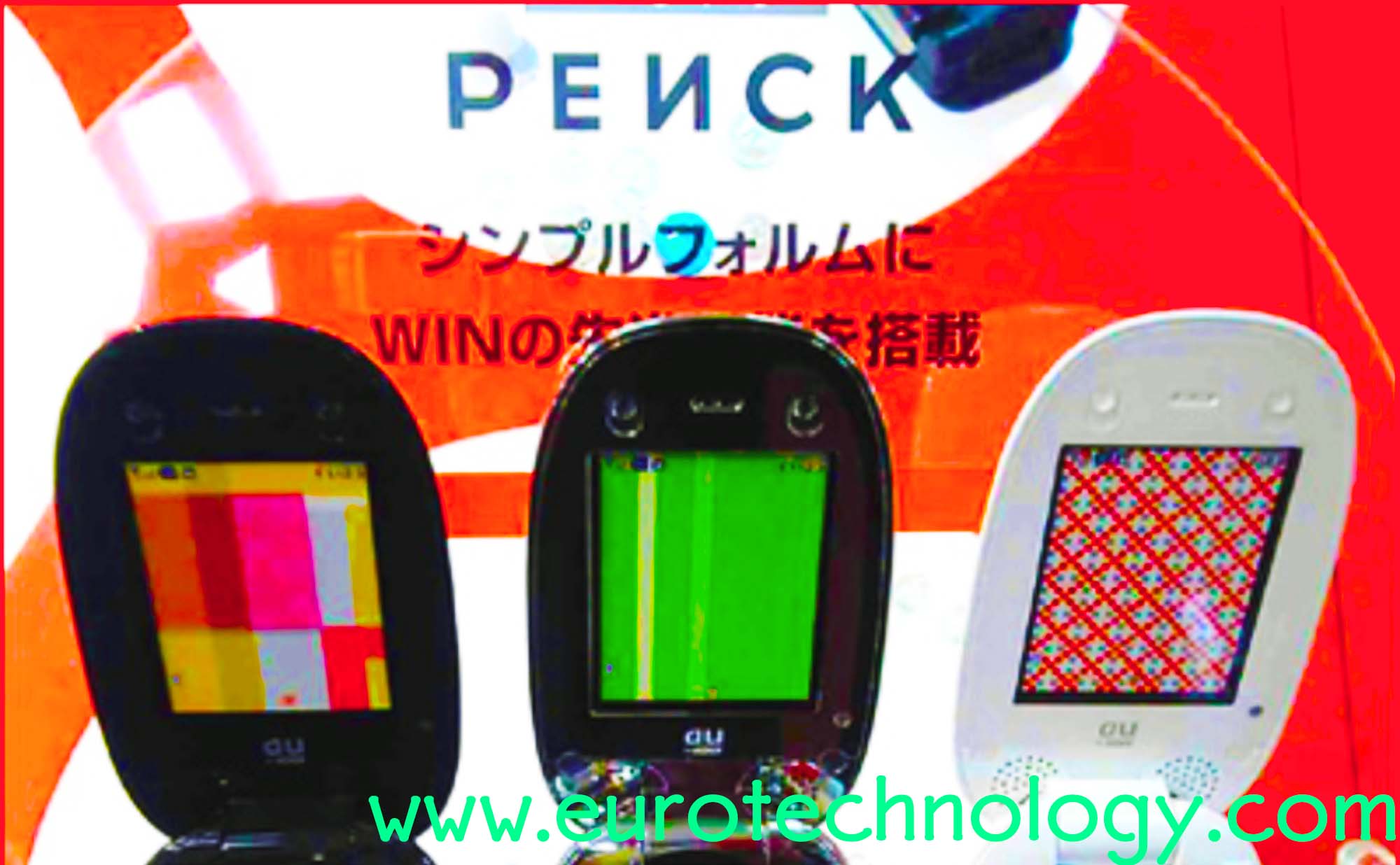
Today, February 18, KDDI-AU introduced PENCK – the latest model in the Designer Series, designed by Makoto Saito Design Office Inc.:
Designer: Makoto Saito Design Office Inc.
Data rate = 2.4 Mbps
Music = Chaku-Uta-Full, stereo speakers
Camera = 1.24 Megapixel, incl QR barcode reader
GPS = incl. Naviwalk navigation
and more…
When I was asked to brief the President of Germany, Horst Koehler, on Japan’s technology sector, KDDI kindly loaned me PENCK-phones, which I used in one of the demonstrations for President Koehler of Japan’s mobile phone industry.


Copyright (c) 1997-2013 Eurotechnology Japan KK All Rights Reserved
“Creating a Mission Statement for a Top Ranking Japanese Engineering University and Suggestions for its Realization”
Presentation by Gerhard Fasol at the “International Symposium on Building Global Excellence in Engineering Education”
“International Symposium on Building Global Excellence in Engineering Education”
Japanese program
Tokyo Institute of Technology, Tokyo, Japan, Wednesday, September 3rd, 2003: 11:50-12:35
Copyright·©1997-2013 ·Eurotechnology Japan KK·All Rights Reserved·
Briefing about Japan’s high-technology business sector for Mme Nicole Fontaine, Vice-Minister for Industry of France
Tokyo, Friday, September 20, 2002, at the French Chamber of Commerce and Industry in Japan.
Copyright·©1997-2013 ·Eurotechnology Japan KK·All Rights Reserved·
After Masaru Ibuka (井深大) died on December 19, 1997, NATURE asked me to write an obituary about Masaru Ibuka, which was published in Nature on February 26, 1998, and you can download the article as a pdf-file here. The reference is: Gerhard Fasol, “Obituary: Masaru Ibuka (1908-97)”, Nature 391, p. 848 (26 February 1998).
I used several weeks of my spare time to research and write this obituary. For example, I worked to reach and talk with several people who had met Ibuka in person, since I had never personally met Ibuka. As another example: General McArthur’s Government of Japan wanted to communicate with the population of Japan via radio, however, radio receiver production in Japan was very inefficient at that time due to quality problems, leading to very low yield. So General McArthur’s Government brought Quality experts Homer Sarasohn and Charles Protzmann to Japan to teach classes in quality management. I found out that Ibuka was a keen student of these quality classes. To understand this better, I phoned with a retired officer of General McArthur’s Government, and I also found relatives of Homer Sarasohn, who very kindly gave me a lot of information about Homer Sarasohn’s work in teaching quality management in Japan.
Interestingly, there is a lot of misunderstandings and myths around SONY, some of which I clarified in the Nature obituary for Masaru Ibuka.
Reality: SONY was founded as Tokyo Tsushin Kenkyusho (the Tokyo Communications Laboratory) by Masaru Ibuka and by Akio Morita, who are the two co-founders of Tokyo Tsushin Kenkyusho, the company name was later changed to SONY.
Reality: SONY is a Japanese company with headquarters in Tokyo-Shinagawa. The reason why many people think that SONY is an American company, is that SONY’s company name and brand name in Japan is written in Katakana, while traditional Japanese companies always write their company in Chinese characters (Kanji). (Note however, that Nissan President Carlos Ghosn, says that companies have no nationality).
Reality: Leo Esaki discovered the tunnel diode as a researcher at Tokyo Tsushin Kenkyusho, which later changed the company name to SONY. Leo Esaki then moved to IBM Yorktown Heights R&D labs, and was awarded the Nobel Prize while working at IBM for his discovery of the tunnel diode, which he discovered while working at Tokyo Tsushin Kenkyusho.
Copyright (c) 1996-2014 Eurotechnology Japan KK All Rights Reserved