Disneychannel places advertisements with huge QR-code on Tokyo’s roofs. People passing by point their mobile phones at Mickey’s QR-code, and the mobile phone takes them to Disneychannel’s mobile site.
QR codes were developed in the 1990s by Toyota affiliate Denso-Wave to manage car parts – today they are by far the best way to link mobile phones to almost anything. In many applications QR codes are cheaper, easier, more flexible and more secure than RFID and NFC.
QR codes were developed in the 1990s to manage car parts – today they are by far the best way to link mobile phones to almost anything. In many applications QR codes are cheaper, easier, more flexible and more secure than RFID and NFC.
The European Central Bank (based in Frankfurt) manages the EURO, is one of the world’s most important central banks, and uses QR-codes to link traditional PC-webpages to mobile pages.
Mobile Payment workshop and Global 3G Evolution Forum in Tokyo – Makuhari
3GPP, UMTS-Forum, Verizon and Docomo and others
22-25 January 2007 MarcusEvans organized the “Global 3G Evolution Forum” in Makuhari near Tokyo.
Speakers included:
Takanori Utano, Executive Vice-President and CTO of DoCoMo,
Takehiro Nakamura of NTT and Vice-Chairman of 3GPP
Jean-Pierre Bienaime, Chairman of the UMTS-Forum,
Gaston Ormazabal of Verizon Labs
and many other leading mobile communications managers from all over the world.
Jointly with Jan Larsson, General Strategy Manager of TeliaSonera International Carrier division, I chaired all sessions all day on Wednesday January 24, 2007.
Workshop on mobile payments
On Monday, January 22, 2007, I held a three hour workshop about “Mobile Payment”.
Mobile payment Japan, e-money and mobile credit report:
Japan’s mobile subscriber numbers grew by about 5 million in 2006. Because of the much higher ARPU, Japan’s mobile market again grew by a couple of Finlands during 2006. A growing number of people have more than one mobile phone, to take advantage of the best rates, eg for mail, voice and data. We expect growth to continue. Our analysis below shows that KDDI’s and AU’s gains are a lot larger than a superficial view of the statistics reveals – see our Figure below. Find a detailed review in the latest edition of our JCOMM-Report.
During 2006 Japan’s mobile subscription base grew by about 5 million – KDDI gained about 4.2 million new subscriptions and is the clear winner, despite shutting down its TuKa 2G service during this period
KDDI‘s subscriber gains during 2006 are much bigger than a superficial analysis reveals (see figure above):
KDDI’s AU mobile service gained about 4.2 million new subscribers during 2006 – more than twice as many than DoCoMo’s cellular service, which gained about 1.8 million new subscriptions.
Currently, KDDI is shutting down it’s TuKa 2G service, and DoCoMo is shutting down it’s PHS service. Both services together lost more than 2 million subscribers during 2006 – this is a much larger movement than due to number portability introduced on Oct 24, 2006.
KDDI offers both number portability and mobile email portability, and reports surprise that many former low-end TuKa users moved to top-end high-speed WIN (2.4 Mbps) data services.
For KDDI, enticing TuKa subscribers to move to high-end/high-speed AU services was an excellent preparation for number portability, and helped KDDI win in the first stage.
Annual Nikkei Marketing Journal (NMJ) ranking list of most successful products
NFC prepaid fare cards ranked near the top of most popular products for 2006
Every year Nikkei Marketing Journal publishes a ranking list of the most successful products of the past year in the form Sumo wrestling results are traditionally displayed: there is a Western side and an Eastern side, winners at the top are displayed in much larger print than also rans at the bottom as in Sumo rankings.
IC tickets are the “Ooseki” (second place) winners on the Eastern side of the Sumo ranking of hit products for 2006.
On March 18, 2007, more than 100 transportation companies of the Tokyo region including 25 train operators which serve a population of around 30 million will introduce PASMO IC-Tickets. Introduction of PASMO will increase market share for IC-tickets and ecash in Japan – and globally.
Shibuya Hachiko square (in Japan usually called “scramble”) is certainly among one of the world’s most busy street crossing, and therefore also one of the places in the world with the highest density of advertising and marketing efforts, certainly on a par or exceeding Times Square in New York. It is not trivial to catch attention for particular promotions within this environment of information overload.
Shibuya Hachiko and surrounding areas challenge the creativity of creative agencies, and many new concepts have been tested out first here, e.g. many different types of using QR-codes for advertising and marketing.
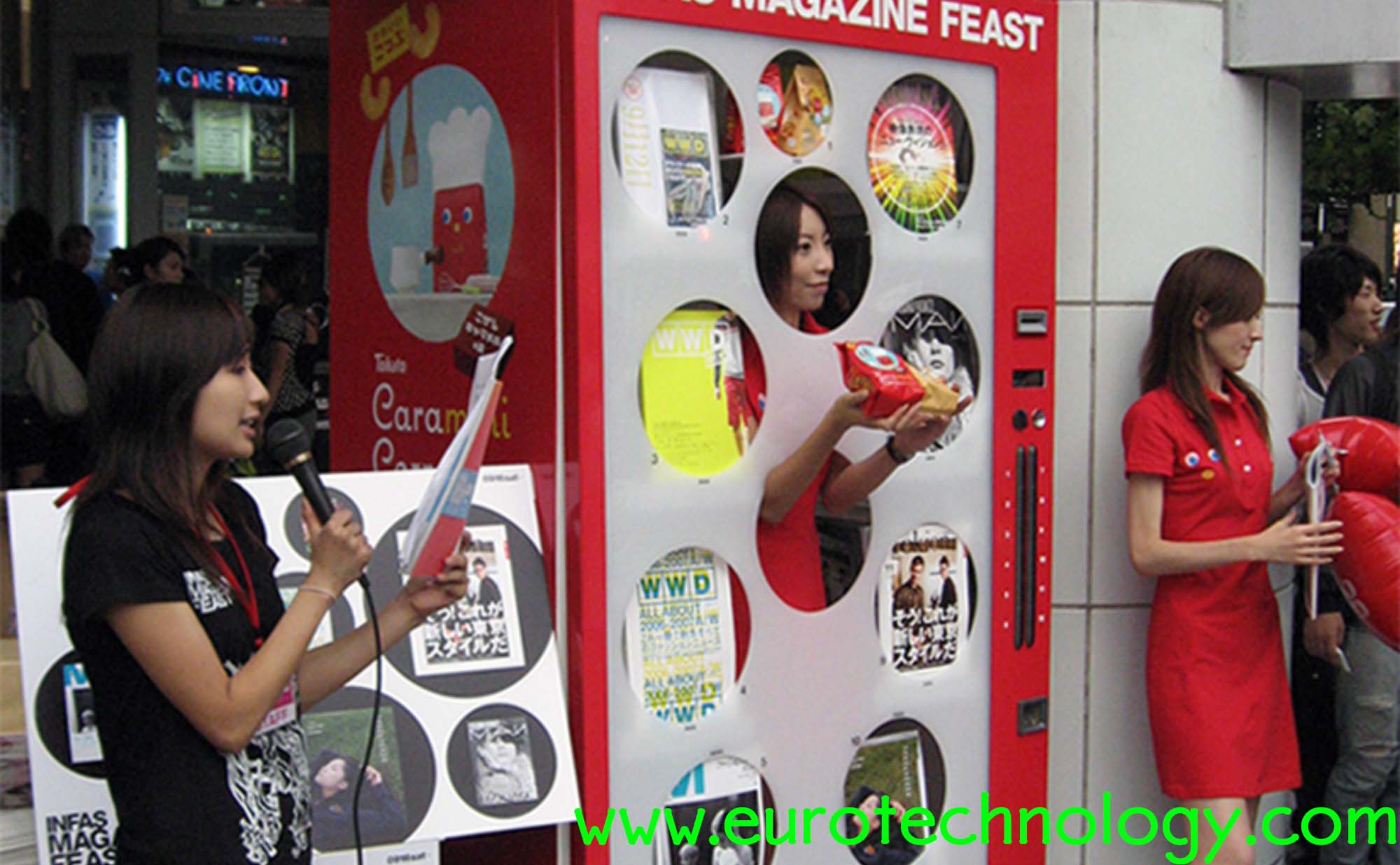
While Coca-Cola promotes Cmode vending machines with mixed success for wallet-phones and mobile payments, a promoter used the opposite extreme at the most visible spot on Shibuya’s Hachiko square recently: a human vending machine with a built-in charming human operator for the human touch (there is an upper window to serve adults and a special lower window to serve children):
QR codes for mobile phones started in Japan in August 2002
QR codes have been developed around 1994 by Toyota subsidiary Denso Wave – about 20 years ago- for car parts management at Toyota’s factories, and the first applications of QR codes for mobile phones came to market back in August 2002 – about 11 years ago here in Japan.
Thus there have been over 10 years of development and testing of many different types of applications of QR codes here in Japan, ranging from immigration control and visa, to mobile payments, ticketing and of course marketing and advertising. We have collected about 105 applications of QR codes, mainly in Japan in our QR code report.
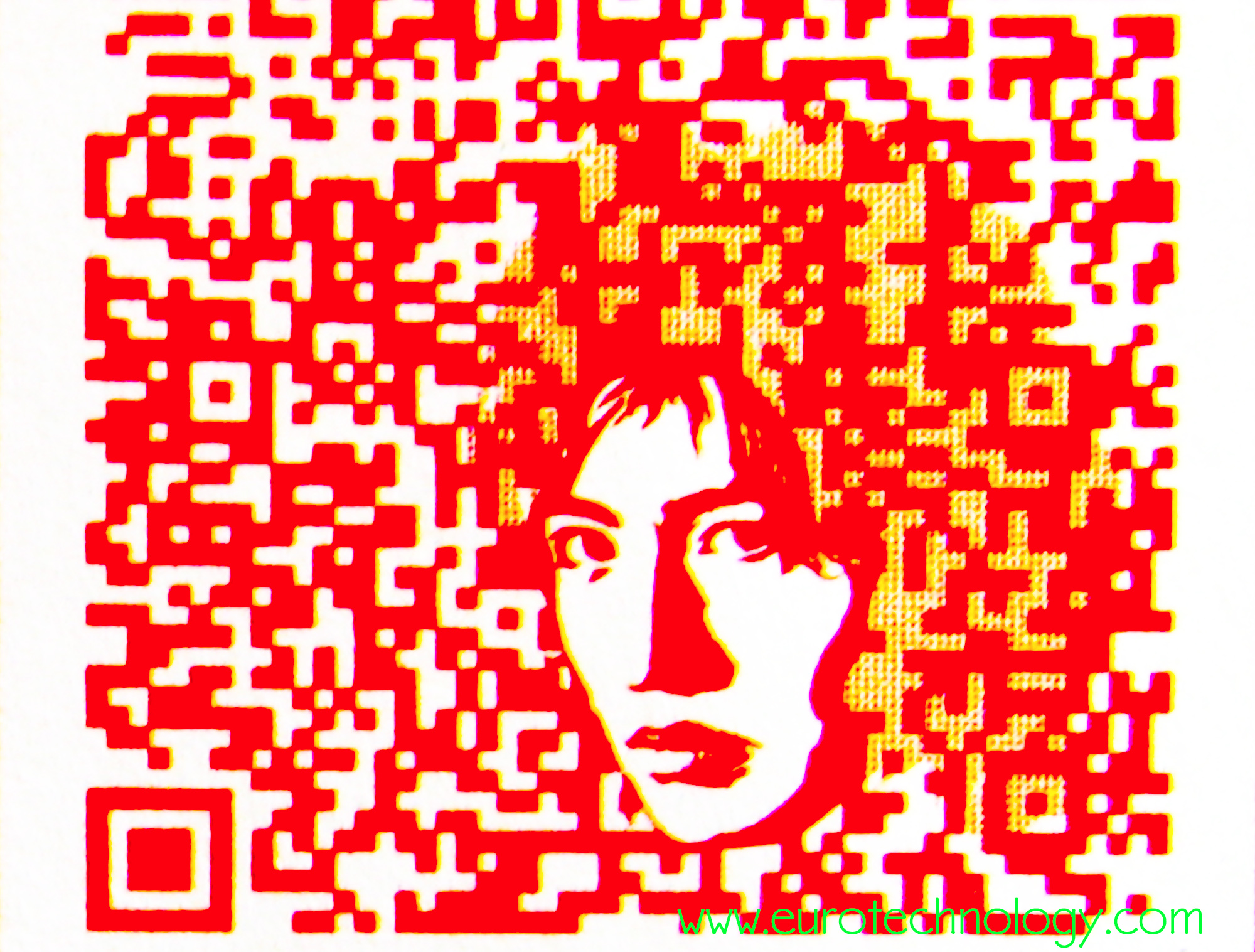
Customized QR code: QR code error correction and redundancy can be used to include images and colors
QR-codes turn out to be the killer-app for camera phones – not MMS.
QR-codes have become ubiquitous in Japan since their first introduction to mobile phones in Japan in August 2002, and link mobile phones to life in many ways. QR-codes are usually the quickest, most efficient and cheapest way to link mobile phones to information in daily life, and to provide feedback in both directions, and even for user-to-user interactions.
QR-codes do not have to be in boring black-and-white:
On March 18, 2007, more than 100 transportation companies (26 railway companies and 75 bus companies) – moving 30 million people of the Tokyo region – will switch to the IC card ticketing and e-cash system named “PASMO”. PASMO will interoperate and partially compete with SUICA.
Preparations go back more than 20 years, when Japan’s national railways started research on IC cards for ticketing. SUICA IC-card tickets were introduced commercially in November 2001 at 424 JR-EAST rail stations in the Tokyo region.
Tokyo’s PASMO combined with SUICA is likely to develop into one of the world’s biggest electronic payment and e-cash systems.
PASMO – near field smart card for fare payment in Tokyo region – started Sunday, March 18, 2007 and exceeded all expectations
Today we released the 23rd edition of our JCOMM-Report – about 250 pages of overview and analysis of Japan’s telecom sector.
KDDI gains 524,000 subscribers in Oct & Nov 2006. DoCoMo for the first time ever since it was founded experienced a net loss of subscriptions.
Net gain/loss of Japan’s mobile operators at introduction of mobile number portability (MNP)
KDDI gains 600,000 new EZweb subscribers, Japanese operators earn much from mobile internet – subscription data show even better results for KDDI‘s EZweb.
gain/loss of subscriptions by Japanese mobile internet services during introduction of mobile number portability (MNP)
Both docomo’s i-Mode and KDDI’s EZweb top menu pages display Season Greetings and reflect Japan’s seasonal mood: autumn sports days in schools, skiing in winter, Halloween and New Year.
Here are this year’s New Year greetings for the Year of the boar on i-mode and EZweb which were displayed from January 1, 2007 for a few days during Japan’s New Year vacation:
New Year 2007 on docomo’s i-Mode and KDDI’s EZweb mobile internet home pages