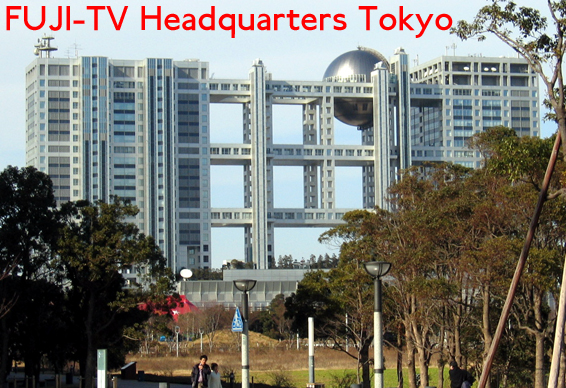
New economy player Livedoor attempts takeover of “old economy” media conglomerate Fuji Television Group
Livedoor and Fuji TV: Takafumi Horie “Horiemon” attempts to exploit an overlooked loophole in Fuji Televisions shareholder structure to gain control of the very much larger Fuji media group
Below is an outline of the take-over battle raging right now. The complex cross-shareholding is puzzling, and the reason for it is surprising to the uninitiated: a long time ago there was no radio and no TV, only newspapers. Radio in Japan was born as babies of newspaper companies, and TV stations were born as babies of the Radio stations. So at the beginning Fuji-TV was a tiny in-company venture subsidiary of Japan-Radio (Nihon Hosou). The cross-share holding structure dates from these pioneering days of TV in Japan and has not been touched since – until Livedoor’s Takafumi Horie came along.
Takafumi Horie’s battle to acquire control of Japan’s media group Fuji TV via its historic holding company Japan Radio (Nihon Hosou)Result of Horie’s battle for control of Japan’s media company Fuji TV via its historic holding company Japan Radio (Nihon Hosou), court settlement (wakai) of February 2005)
Takafumi Horie’s nickname in Japan is Horiemon. Why? Because many people think that Takafumi Horie looks similar to Japan’s cartoon character Doraemon.
By the way: some media falsely report that Horie is the founder of Livedoor. This is not the case. Horie-san founded a website design company called “Livin’ On the EDGE Inc” in 1996, later renamed EDGE, and many other companies. In 2002 he acquired the free email/ISP company Livedoor.
This battle stimulated us to release our “Japan Media” report.
Vodafone recruits Shiro Tsuda, 津田志郎, the No. 1 founding employee of NTT’s mobile division
It appeared that Vodafone KK – with the help of a major headhunting firm – had staged a major success, when Vodafone KK headhunted Mr Shiro Tsuda as their Japan-CEO as of December 1, 2004. Mr Shiro Tsuda was the founding employee No. 1 of NTT’s mobile phone division, which later became NTT-docomo.
Shiro Tsuda quits a few months later
This temporary success turned into an embarrassment for Vodafone KK when a few months later, Mr Shiro Tsuda, resigned from his Vodafone KK-CEO position, became non-executive Chairman of Vodafone KK, and soon after left Vodafone altogether.
About one year after Vodafone-CEO Arun Sarun declared in February 2005 that Vodafone had the intention to remain in Japan for 10, 20, 30 years, on Friday March 17, 2006, Vodafone and Softbank announced that Vodafone sells Vodafone KK (the totality of all Vodafone operations in Japan) to Softbank, and terminated all operations in Japan.
Understand Softbank: our report: “SoftBank today and 300 year vision”
Vodafone’s challenges in Japan’s advanced telecommunications markets catch attention
Will Vodafone stay in Japan or give up and pull out?
Vodafone’s challenges in Japan: BusinessWeek and The Economist both analyze and comment on Vodafone’s business situation in Japan, where the mobile internet was first implemented successfully starting in February 1999, far earlier than anywhere else in the world.
The following figure compares Sales (Financial year ending March 31, 2004), Net profits after taxes(Financial year ending March 31, 2004), and market capitalization (as of February 17, 2005) for DoCoMo, KDDI and Vodafone (in each case consolidated for the global company):
Sales, net income and market cap for docomo, KDDI and Vodafone for the financial year 2004