Month: April 2013

  • Intellectual Japan – BBC: “Japan has to become a brain country” – from mono zukuri to brain country

    Intellectual Japan – BBC: “Japan has to become a brain country” – from mono zukuri to brain country

    Intellectual Japan: Japan’s electronics companies need new business models – interview for the BBC

    The BBC recently examined why Japan’s electronics sector has to create new business models, and quotes “Japan has to become a brain country”.

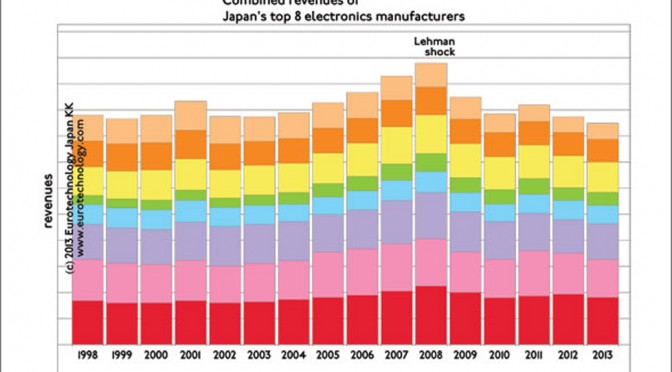
    Japan’s top 8 electronics companies combined are as large as the Netherlands economically, but have shown zero growth and zero income over the last 14 years – thus represent “sleeping giants” – or dinosaurs, depending on the point of view, and depending on whether these companies succeed to reinvent themselves.

    We have updated our report on “Japan’s electronic manufacturers: mono zukuri” to analyze Japan’s electronics manufacturing sector, and to explain who the winners and who the losers are. Read a short summary in this newsletter below.

    apan's electronics companies combined are as large as Holland economically
    apan’s electronics companies combined are as large as Holland economically

    Japan’s top electronics companies combined are as large as the Netherlands economically, but have not shown any revenue growth over the last 14 years

    Japan’s electronics sector still today is largely guided by national industrial policy, and by the management principles created long ago by charismatic founders such as Matsushita and Ibuka.

    Intellectual Japan: smart transformation at Hitachi led by the CEO and by the Chief Transformation Officer CTrO

    Hitachi’s “Chief Transformation Officer” (“CTrO”) at a recent presentation, explained that until 2 years ago Hitachi benchmarked its financial data purely domestically – until 2 years ago, Hitachi only compared performance with competitors such as Panasonic and Toshiba.

    Only 2 years ago, Hitachi started to benchmark performance with global competitors such as GE and Siemens.

    Read a summary of Hitachi’s “Smart Transformation project” in our electronics industry report.

    Japan's top 8 electronics companies combined lose YEN 50 billion/year since 1998
    Japan’s top 8 electronics companies combined lose YEN 50 billion/year since 1998

    Japan’s top 8 electronics companies lost an average of YEN 50 billion/year over the last 14 years

    Intellectual Japan: electronic component makers

    Japan’s electronics component makers, such as Kyocera or Murata, which is on the official supplier list of Apple, report positive income – although margins are declining and the component industry sector is much smaller than the top 8 electronics manufacturers.

    Drastic transformation is necessary to revive Japan’s electronics industry sector. Drastic change will happen one way or another and represents important opportunities. More details in our electronics industry report

    Japan electronics industries – mono zukuri.

    Copyright 2013 Eurotechnology Japan KK All Rights Reserved

  • Japan ought to be heaven for renewable energy (The Economist)

    Japan ought to be heaven for renewable energy (The Economist)

    Industry Ministry METI announces renewable energy sources admitted to the feed-in-tariff program

    Reversing the decline of renewable energy in Japan


    A few days ago Japan’s industry ministry METI announced the most recent data on renewable energy sources in Japan admitted under the feed-in-tariff (FIT) regulations introduced on July 1, 2012. We have updated our report on “Renewable energy in Japan” to take account of these most recent data – read a short summary in this newsletter below.

    Japan added 23% to renewable electricity generation since introduction of FIT
    Japan added 23% to renewable electricity generation since introduction of FIT

    Feed-In-Tariffs for renewables reverse Japan’s trend of decreasing contributions from renewable energy sources


    As our previous newsletter of March 26, 2013 has shown (and as shown in more detail in our renewable energy report), the contribution of renewable energy sources to Japan’s energy mix has dropped from around 25% in the 1970s to around 10% recently.

    Since the introduction of the feed-in-tariffs of July 2012, the installed capacity for renewable electricity generation in Japan has increased by about 23% if hydropower is included, and by about 70% if hydropower is excluded.

    Since solar plants are quickest to install, and the permission process is by far the easiest, about 91% of renewable electricity installations permitted under the FIT program by METI are for solar electricity, while only 9% are for other sources such as wind or bio-mass.

    Wind, hydro and geo-thermal installations require a lengthy planning, permission, environmental impact process, and far longer construction phase, so that the impact of the FIT program will be seen only in a few years time.

    126% were added to Japan's solar electrical generation capacity since July 2012
    126% were added to Japan’s solar electrical generation capacity since July 2012

    Solar electricity generation capacity more than doubled due to FIT


    Solar electricity generation capacity increased by 126% since July 2012 due to the introduction of new feed-in-tariffs and other regulations promoting solar energy. Note that previous to July 2012, about 83% of Japan’s solar electricity generation capacity was residential, while only 17% were industrial solar installations.

    .