Pokemon Go is great – but will it bring another Nintendo boom as in 2009? or even exceed 2009?
Google spin-out Niantic Labs’ augmented reality smartphone game booms to the top of charts
Niantic Labs is specialized on augmented reality games. In a previous game, Ingress, players selected about 15 million memorable locations globally. Niantic picked about 5 million of these crowd source generated locations, placed characters out of 740 Pokémon characters at such Pokéstops. Using smartphones, GPS, cameras and their avatars, players hunt Pokémon characters placed at Pokéstops, bring them to arenas/gyms and let their Pokémon characters fight for arenas/gyms. Thats just the beginning, and we can imagine many ways to expand this basic game structure, for example Pokéstops and Gyms sponsored by stores or corporations.
Overcoming Galapagos
Pokémon Go’s success is also significant, because the fundamentally Japanese Nintendo and The Pokémon Company are overcoming the Japan-Only Galapagos Syndrome by cooperating with Google and San Francisco based Google spin-out Niantic.
At the same time, Pokémon Go is also an indication of the power Nintendo can achieve in the smart phone sector. Will Nintendo dethrone current smart phone game kings Mixi and Gung-Ho in Japan?
Everybody loves Pikachu… No. 25 of currently 740 Pokémon characters
For the open day at my older son’s high school, kids made posters introducing their country: the highest mountain, the most characteristic flower, and the most famous person.
One Japanese student writes: “The Prime Minister is the most famous person in Japan, because he decides everything”.
Another Japanese student writes: “Pikachu is Japan’s most famous person, because everybody loves Pikachu”. Which of the two Japanese students knows more about his own country?
Pikachu is No. 25 of currently 740 Pokémon characters, and represents electricity with his zig-zag lightening bolt tail, and bright yellow color.
Pokémon character developer The Pokémon Company estimates the global market for Pokémon characters to be US$ 48 billion.
Nintendo market cap increases from US$ 20.3 billion to US$ 31.5 billion from 6 to 13 July, 2016
Nintendo shares rise from ¥14,055 in the morning of July 6, 2016 to ¥21,830 at close on July 13, 2016
Nintendo market cap rises from ¥ 2.56 trillion (US$ 20.3 billion) in the morning of July 6, 2016 to ¥ 3.09 trillion (US$ 31.5 billion) at close on July 13, 2016
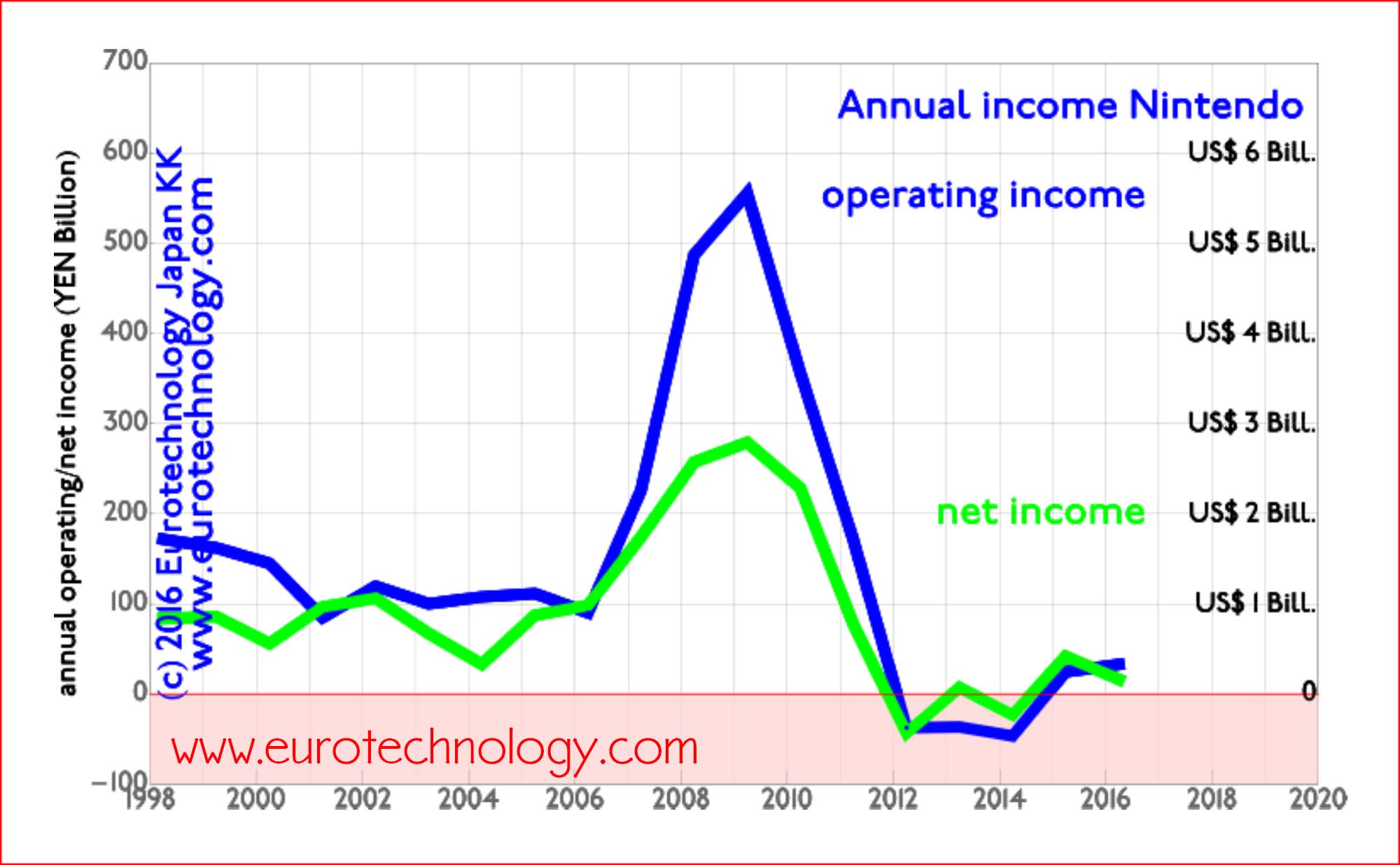
Nintendo boomed around 2009 by disrupting the game world with motion sensing Wii and two-screen handheld DS game consoles. Smartphone disruption reduced Nintendo to pre-2006 size in sales, and profits did not yet recover to pre-boom levels.
Nintendo revenues peaked in 2009, and are now back to where they were before 2006Nintendo income peaked in 2009, and just recently recovered from losses – has not yet reached pre-2006 levels
Unexpected consequences- The Bank of Kyoto booms, and Bank of Kyoto’s 4.5% holding in Nintendo is worth more than 1/2 of Bank of Kyotos market cap
The Bank of Kyoto owns 4.5% of Nintendo, at close on July 13, 2016, this holding is worth YEN 139 billion (US$ 1.4 billion).
The Bank of Kyoto (TSE Code 8369) at the close on July 13, 2016 has a market cap of YEN 274 billion (US$ 2.64 biliion)
Thus Bank of Kyoto’s holding in Nintendo corresponds to more than one half of its value. This also means that Nintendo is worth about 10 times as much as the Bank of Kyoto.
The Pokémon Company – global market size estimate for Pokémon characters estimate: US$ 48 billion
The Pokémon Company manages and develops the currently 740 Pokémon characters.
The Pokémon Company is a private company owned in equal 1/3 parts by Nintendo KK, KK Game Freek and KK Creatures. KK Game Freek and KK Creatures are both privately held game development companies
Niantic Labs, focused on augmented reality games, is a Google spin-out founded in 2010, headed by John Hanke, one of the founders of Keyhole, which is at the basis of Google Earth.
Niantic Labs had staged initial funding of US$ 90 million equally from Google (1/3), Nintendo (1/3) and The Pokémon Company (1/3), and since then an additional Series A round in February 2016, plus we assume that Founder John Hanke, maybe Google at spin-out, other founders likely also own equity. So its not clear to us how much exactly Nintendo owns of Niantec, either directly or via its holding in the Pokémon Company.
There was a augmented reality company in Japan, Tonchi-Dot 頓智ドット株式会社(トンチドット) which created a augmented reality app called Sekai-Camera during i-Mode and Galake-Phones, but it ended all services on January 22nd, 2014.
(Summary of Professor Kiyoko Kato’s keynote written by Gerhard Fasol)
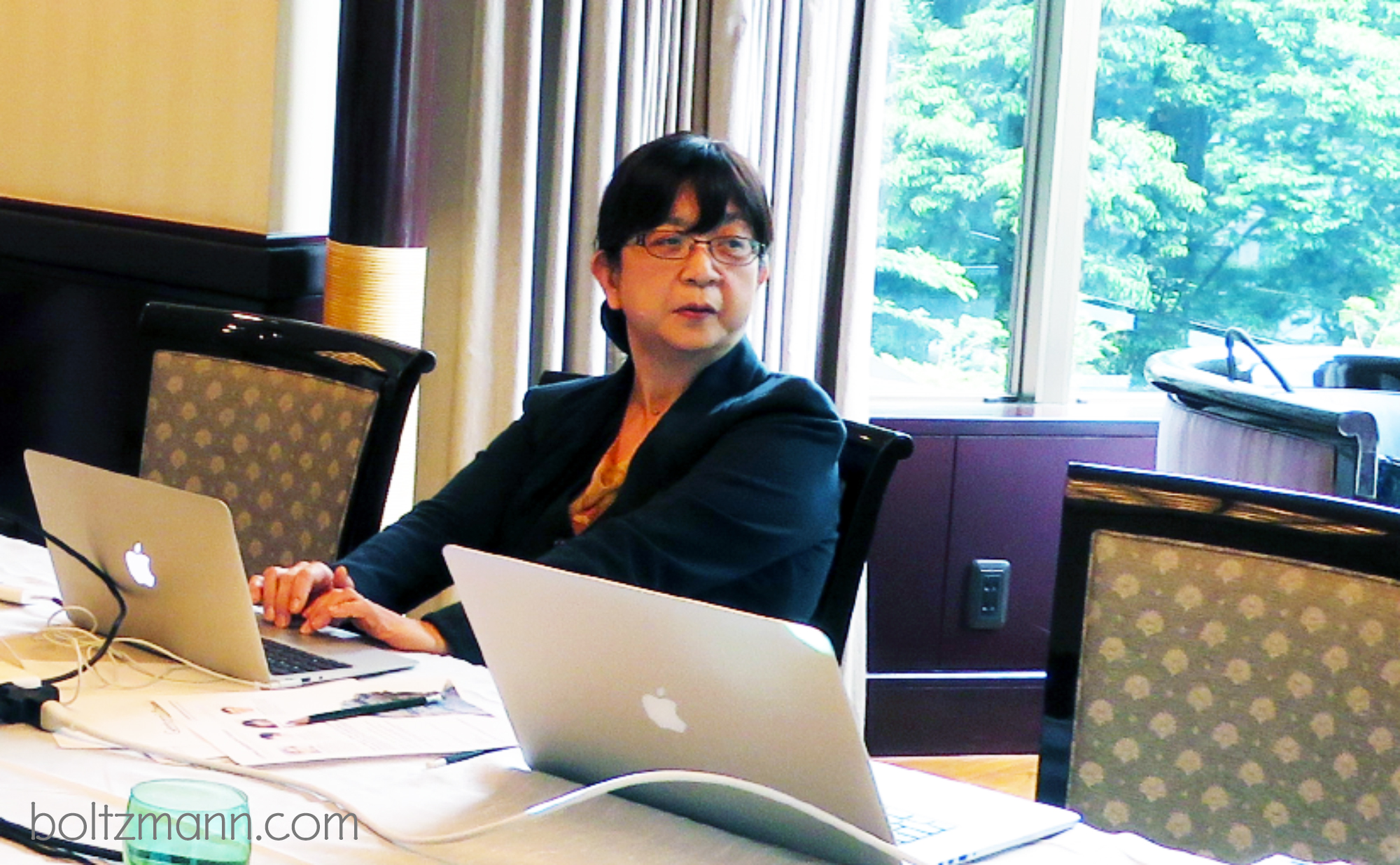
Kiyoko Kato, Professor
Department of Gynecology and Obstetrics
Graduate School of Medical Sciences
Kyushu University
Japanese Obstetrics and Gynecology: improving medical care requires gender equality – higher numbers and higher retention of women medical doctors
18% of medical doctors in Japan in 2008 are female, 82% are male. Back in 1976 only about 10% of medical doctors were female
Medical school: in 1976 about 13% of medical students were women, this ratio increased up to about 35% peaking around the year 2000, and subsequently decreases slowly to around 32% in 2008.
Thus the ratio of women medical doctors are slowly increasing in Japan.
The M-curve
About 90% medical doctors enter employment after graduation, remain employed at that level until about 35 years after graduation, when employment ratios slowly decrease due to retirement.
For women medical doctors, the employment ratio curve is M-shaped, with a minimum at about 76% employment approximately 11 years after graduation, at an age around 36 years, after this minimum many women medical doctors enter employment again, reaching similar employment ratio’s as men about 35 years after graduation.
62% of women medical doctors leaving their employment do this because of pregnancy, child birth or child care (80% in case of women younger than 45 years age).
Obstetrics and gynecology medical doctors older than 40 years are predominantly men, while doctors younger than 40 years are predominantly women
For medical doctors aged 40 years and over, obstetrics and gynecology specialists are predominantly men: women obstetricians and gynecology make up less than 10% of doctors at higher ages.
This ratio is reversed for obstetricians and gynecologists younger than 40 years of age: women outnumber male doctors, below 30 years age, women doctors outnumber men nearly by a factor of 2.
There is a clear trend: older medical doctors in the obstetrics and gynecology field are predominantly male, while below the age of 40 years, women dominate by an increasing ratio.
Kyushu University Hospital: Professor Kiyoko Kato is the one and only woman Full Professor of Medicine
Kyushu University has 135 female doctors, and 81.5% are on part-time contracts, only 18.5% have full time employment.
Ratio of women at different levels of the career pyramid:
Part-time intern doctors: 36.3% are women
Part-time doctors: 30.1% are women
Full-time doctors: 8.6% are women
Assistant Professors: 22 women vs 187 men (11.8% are women)
Lecturers: 1 single woman vs 48 men (2%)
Associate Professors: 1 single woman vs 31 men (3%)
Full Professors: 1 single woman vs 24 men = Professor Kiyoko Kato (4%)
Only one single woman has achieved promotion into each of the higher ranks of Lecturer, Associate Professor and Full Professor, indicating that any women at all in these higher academic medical Professor ranks are rare exceptions rather than the rule (no mention here of still higher ranks, such as Hospital Directors, Deans, Heads of Department, or University President).
Professor Kiyoko Kato then explained her own career, where she spent time studying in the USA, gave birth to her first child in the USA, and then to her second child after returning to Japan. She had to cope with several challenges, e.g where one of the hospitals she worked was shut down. Finally Professor Kiyoko Kato was appointed Full Professor at Kyushu University Medical School.
Professor Kiyoko Kato proposes that three issues need to be solved:
improve the work environment during pregnancy and child bearing
re-integration assistance: re-education and support after leave of absence
remove obstacles to career improvements
Improve the work environment during pregnancy and child bearing: the “Kyushu University Perinatal period cradle net project” 「周産期ゆりかごネットプロジェクト」
With support from the Ministry of Education, Culture, Sports, Science and Technology (MEXT), Kyushu University created the “Kyushu University Perinatal period cradle net project” (2013 – 2017). In Japanese 「周産期ゆりかごネットプロジェクト」, the website is here: http://www.med.kyushu-u.ac.jp/yurikago/
and an overview of the project can be found here: http://www.med.kyushu-u.ac.jp/yurikago/data.html
As the websites show, the “Kyushu University Perinatal period cradle net project” is carefully designed, structured and provides a depth of support for women medical doctors to give birth and pursue their career. Women doctors are given part-time positions in the out patient department after returning from leaves of absence.
So far seven women doctors have taken advantage of this program, and several have been assisted to return to full or part-time employment, two are still absent because of a second pregnancy. Part-time work in the outpatient department assisted them to return back to full time employment. Experiencing the hospital as a patient during birth also provided valuable experience.
Re-integration assistance: re-education and support after leave of absence. The Kyushu University Kirameki Project.
To support re-integration after absence, Kyushu University created the “Kirameki Project” (Kirameki = glitter, shine). The Kirameki Projekt is described on the website here: https://www.kyudai-kirameki.com/
2007-2009 the Kirameki Project helped female medical workers, female doctors, dentists and nurses to re-integrate after leave of absence.
From 2010 the program (“Kyushu University Hospital Kirameki Project”) was expanded to support continuation of the career for doctors, dental doctors, nurses for both men and women, because of delivery, child care, or disease / medical leave.
The aims of the project are to promote women doctors, dentists, and nurses who would have to resign their positions due to family reasons including marriage, children, husband’s job transfer etc, and to help them pursue their career after marriage.
Activities of the Kirameki Project are:
survey the problems of women doctors, dentists and nurses after marriage
recruit qualified but “hibernating” female medical personnel
learning programs
promote “high spirits”, encourage
on the job training in the out-patient department
Structured programs of the Kirameki Project:
Administrative: refresher program
Reestablishment: getting back to work program
Suspension/leave: web based education
Medical specialist: continuing specialist medical education
Marriage, child-care: continuing education
Residents, newcomer nurses: basic training
Students: gender equality education
Remove obstacles to career improvements
Assist women researchers after child birth and during child rearing: support attending international conferences, support system for hiring research assistants and technicians for research support.
Construct a support system:
Return support after child-care leave: day nursery, team medical care including emergency mutual help system, flexible working time, e.g. 9-5 work day
Improvement of career: system of supporting female researchers during child bearing and child rearing, grants for female researchers to support technicians
Professor Kiyoko Kato’s wishes and expectations for female doctors
responsibility and awareness
gratitude to all who helped
contribution to medical progress
Ludwig Boltzmann Forum on Women’s development and leadershipLudwig Boltzmann Forum on Women’s development and leadershipLudwig Boltzmann Forum on Women’s development and leadershipLudwig Boltzmann Forum on Women’s development and leadershipLudwig Boltzmann Forum on Women’s development and leadership
Dame Carol Black DBE FRCP FMedSci, Principal of Newnham College, Cambridge University, and Expert Adviser on Health and Work, Department of Health and Public Health England
(Summary of Dame Carol Black’s keynote written by Gerhard Fasol)
Dame Carol Black DBE FRCP FMedSci
Principal of Newnham College, Cambridge University.
Dame Carol Black has held top positions in medicine and now holds high-level policy advisory positions on health and work in the United Kingdom.
Women in healthcare – Women in the British National Health Service
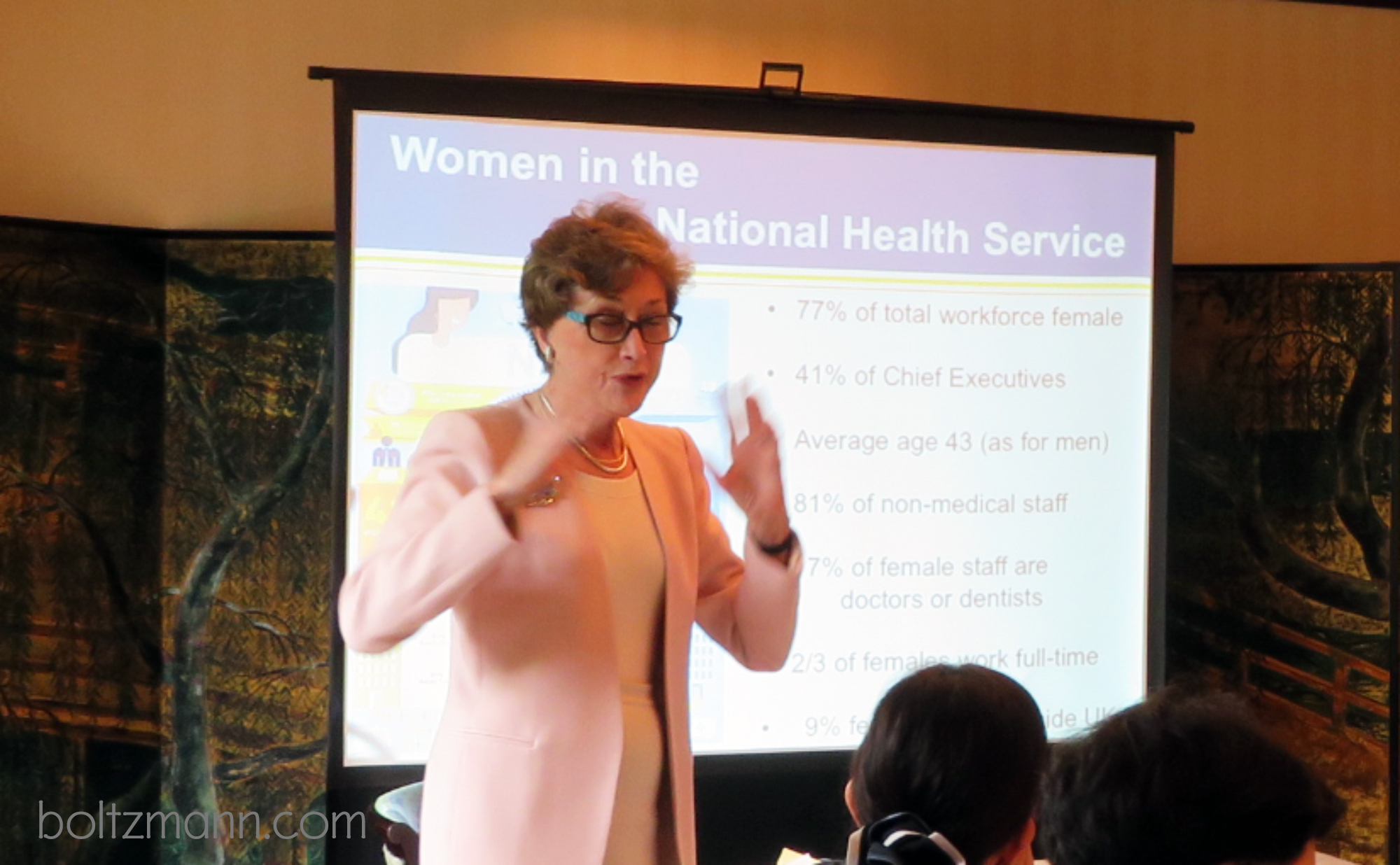
The gender imbalance in the National Health Service is reflected by the facts that 77% of the total workforce is female, while only 7% of female staff are doctors or dentists, ie only 5.4% of total workforce are female doctors or dentists.
41% of Chief Executives are women.
81% of non-medical staff are women.
Alison Wolf and the XX Factor
Alison Margaret Wolf, Baroness Wolf of Dulwich CBE, is a British economist, and the Sir Roy Griffiths Professor of Public Sector Management at King’s College London, see:
In her book “The XX Factor: How Working Women Are Creating A New Society” (Profile Books 2013), Alison Wolf writes that women are split into two groups: one group sacrificing family for rapid professional advancements, while the other group of women opts for having children at a young age, and remain in low level positions. As a result, inequality is growing faster among women than among men, and low status and low paid jobs are predominantly done by women:
97% of secretaries are female
92% of registered nurses are female
89% of nursing, psychiatric and home health aides are female
90% of maids and housekeeping cleaners are female
The fundamentals: what are the essential characteristics of “good employment”?
Good work: is stable and safe, allows individual control, is flexible, gives opportunities, promotes wellbeing, reintegrates sick or disabled people if possible.
Good workplaces: have visible senior leadership and well trained managers, enable staff engagement, empower employees to care for their own health
Good news for medicine, less good news for academic medicine
Generally we have achieved a good situation regarding gender equality in medicine. We have achieved meritocracy, and their are no reports providing evidence for systematic barriers against women’s professional advancement. Both intake and retention for women in medicine is high, and the pay scales are the same.
A study (Royal College of Physicians (RCP) Working Party 2009), investigated the female share of Consultants (= established Senior Medical Professionals in the UK), and showed the ratio of women is highest (38% – 49%) in “more plan-able” and “more people oriented” specializations such as general practice or paediatrics, while women’s share is lowest (8% – 23%) in “more technology oriented” and “more unpredictable” specializations such as anaesthetics or surgical specializations.
There is far less progress in academic medicine, and cultural stereotypes and bias remain, see:
Women’s advance into top leadership positions suffers from “cultural” prejudices, e.g. prejudices that women too kind, too caring, not logical or strong enough, or otherwise unsuited to lead.
Prominent leadership roles for women, Prominent medical leadership
Prominent leadership roles need investment in the “extras”, leads leadership dimension in each speciality, and requires career single-mindedness.
Prominent medical leadership requires investment of time “over and above” the ordinary duties, requires professional “stewardship contributions”.
The top 200 leadership positions will naturally go to those who pursue their career goals with a high degree of single-mindedness.
Women choosing the route towards prominent leadership roles need encouragement and support, they need:
role models
mentors, and
sponsors
Role models: Prominent women leaders in UK medicine
Una O’Brien, Permanent Secretary, Department of Health
Professor Dame Sally Davies, Chief Medical Officer
Dame Julie Moore, CEO, University Hospitals Birmingham, NHS FT
Claire Murdoch, CEO, Central and NW London NHS Foundation Trust
Professor Jane Dacre, PRC Physicans
Clare Marx CBE, PRC Surgeons
Dr Suzy Lishman, PRC Pathologists
Dr Maureen Baker, Chair, RC General Practitioners
Need to debunk leadership myths
Its important not to fall into the traps of common leadership myths, e.g. that leadership is inborn, that leadership is that of a lone genius, that they must inspire others to follow their vision, the leadership requires formal authority, or that all leaders have common personality features.
We need to avoid similar leadership myths in medicine, e.g. that men naturally make better leaders.
Dame Carol Black: From a shoe-making village in decline to Government Advisor
Dame Carol Black is born in the shoe-making village of Barwell, Leicestershire, went to Grammar School in Market Bosworth, were she became Head Girl, despite her working class background.
Dame Carol Black studied first History, then Medical Social Work and finally Medicine at the University of Bristol, specialized in Rheumatology research, focusing on Scleroderma. Later advanced to Medical Director, Royal Free Hospital, President of the Royal College of Physicians, Chairman of the Academy of Medical Royal Colleges, Chair of the Nuffield Trust on Health Policy, then advising Government as National Director for Health and Work, and now Principal of Newnham College, Cambridge.
A major step was Dame Carol Black’s advancement to Medical Director of the Royal Free Hospital, since this meant not just responsibility for an institution or a group or a department, but also responsibility for the health of a population.
Leading the Royal College of Physicians
The Royal College of Physicians was founded by Royal Charter by Henry VIII on 23 September 1518 with the aim to promote the highest standards in medicine.
The skills required were: understanding a wide landscape, consensual leadership, standing ground when necessary, negotiating with Whitehall (= British Government) and building trust.
Chairing all the Medical Royal Colleges – The Academy, 2006-2009
Dame Carol Black from 2006-2009 chaired this group of 21 independent organizations. As Chair, Dame Carol Black had no executive powers, needed to lead by persuasion and with consensus.
Advising Government
Dame Carol Black shared several of her experiences advising Government and highest ranking Government officials and Ministers.
Key was to become valuable in the eyes of Government officials by giving independent advice based on scientific evidence, in combination with remaining totally unpolitical.
Dame Carol Black became a champion for the “cause” of health and work, and kept totally out of politics, never revealing any political views or opinion, and wrote three major reports.
The Confidence Code – forget perfection…Striving for perfection can waste women’s time, and hold back the best from reaching the top
Women tend to be held back by striving for perfection, while men tend to take more risks. Striving for perfection can waste women’s time, and hold back the best from reaching the top.
Women in healthcare, Women and careers, women in scientific careers
This UK House of Commons report finds some common traits which hold women back from reaching top leadership positions, including that women may perceive promotions as undesirable, wait until they meet all perceived criteria for promotion while men often take higher risks and may behave more speculatively, and women may think that “political” skills are required to reach the top.
Finally, to reach top leadership positions, we need:
self confidence
aspiration
risk taking
resilience
speaking out
staying motivated after failure
mentors, sponsors, role models
networks
personal values aligned to organisational values
Dame Carol Black DBE FRCP FMedSci: Advancing women in healthcareDame Carol Black DBE FRCP FMedSci: Advancing women in healthcareDame Carol Black DBE FRCP FMedSci, Principal of Newnham College Cambridge, and Professor Kyoko Nomura, Associate professor, Department of Hygiene and Public Health, Teikyo University, School of Medicine
View the full workshop program here, Gerhard Fasol’s keynote lays out the objectives of the workshop in the present article.
Gerhard Fasol CEO, Eurotechnology Japan KK, Board Director, GMO Cloud KK. former faculty Cambridge University, and Trinity College, and Tokyo University
Gerhard Fasol
CEO, Eurotechnology Japan KK,
Board Director, GMO Cloud KK.
former faculty Cambridge University, and Trinity College, and Tokyo University
Ludwig Boltzmann Forum on Women’s development and leadership: objectives
There are two immediate objectives for the Ludwig Boltzmann Forum on Women’s Development and Leadership:
empower women leaders with global leverage
lets change mind sets
I am building the Ludwig Boltzmann Forum as global leadership platform honoring my great-grandfather, and the Ludwig Boltzmann Forum on Women’s Development and Leadership is part if this initiative:
drive innovation based on science and technology
“there is no other forum for open discussions among leaders in Japan other than the Ludwig Boltzmann Forum” (said one of Japan’s top technology leaders, former Board Director of Japan’s largest Telecommunications Operator, former President of a large University, and former President of one of Japan’s most important technology organizations)
and as an additional bonus we will create new cooperations and new initiatives.
Ludwig Boltzmann Forum on Women’s development and leadership – my actions so far
Several confidential preparations with Japanese Ministry officials and foreign Embassies in Japan.
One key conclusion from preparations: top priority and most difficult is to change mindsets in Japan regarding empowering women and gender issues
Next step is today’s (16 May 2016) “Ludwig Boltzmann Forum on Women’s development and leadership”.
How to change mindsets? Expand the solution space and add new dimensions!
The basic issues, empowering women and men to combine child care and professional development, work towards greater equality and improving decision making by implementing diversity of decision makers are similar all over the world, especially in Europe and Japan.
Learning solutions from each other, expands the dimensionality of the solution space.
When we are looking for solutions to solve difficult problems, our search for solutions is limited by our experience, knowledge and imagination. Our search for solutions is in space of limited dimensionality. In many cases solutions exist outside the space we are considering.
Therefore to reach better solutions, its necessary to expand this solution space. Looking how other countries solve similar problems is one straight forward way to expand the dimensionality of the solution space, and that is where the Ludwig Boltzmann Forum aims to contribute.
As an example, many people in Japan do not know that most European countries have a Family Ministry (家族省), which represents Families at the Cabinet level. In fact, most Japanese people I have been discussing this issue with are perplexed by the possibility of a Family Ministry (家族省), and usually in response ask, what the tasks of a Family Ministry would be.
If your country does not have a Family Ministry, if you have never heard about a Family Ministry, its difficult to come up with the proposal to create a Family Ministry, and its difficult to imagine what a Family Ministry should do.
At the same time, in today’s internet age, its in theory only a click away to have a look at a Family Ministry: here is the webpage of Austria’s Family Ministry: Das Österreichische “Bundesministerium für Familien und Jugend” (The Austrian Federal Ministry for families and youth, オーストリア連邦家族・青年省)
And here is the current Austrian Minister for Family and Youth, Dr. Sophie Karmasin. 49 years old, with two children, Dr Sophie Karmasin has achieved a Doctorate in Psychology on “consumer behavior in the health market”, from 1993 to 2013, for 13 years she has pursued a very successful career in industry, most recently as Managing Director/CEO of a major market research company, before becoming party independent Minister of Family and Youth. She is not affiliated with any political party, but independent politician since 2013.
Expanding the solution space: wouldn’t it be better to have at least one woman on a committee promoting women’s empowerment?
Compare Family and Youth Minister Dr Sophie Karmasin with the all-male “woman act.” committee promoting women’s equality in Japan’s Kanagawa Prefecture, wouldn’t it be better to have at least one woman on a committee promoting women? But unless you are familiar on how this is done in other countries, your solution space is limited to what you know.
Why did today’s Ludwig Boltzmann Forum on Women’s development and leadership happen? Because of Trinity College Cambridge
At a recent event of Trinity College Cambridge in Hong Kong, I met with Dame Carol Black, and our meeting led to today’s Forum.
Trinity College was founded By King Henry VIII in 1546 by combining the two older colleges King’s Hall and Michael House and seven Hostels. Sir Isaac Newton worked at Trinity College and about 32 Nobel Prize winners are or were members of Trinity College. Trinity College is part of the University of Cambridge
More about Trinity College Cambridge, for example on the website of our Trinity in Japan Society.
Why Ludwig Boltzmann Forum? Who is Ludwig Boltzmann?
Ludwig Boltzmann is one of the world’s most important physicists and we use his results and tools every day. Here are some examples of his work:
S = k log W, linking macroscopic entropy to the microscopic statistics of molecules, and linking statistical mechanics with measuring information, and the arrow of time
the Stefan-Boltzmann radiation law
Boltzmann transport equations are used to design jet engines and aircraft and in semiconductor physics and many other areas
philosophy of nature
and much much more….
I am developing the Ludwig Boltzmann Forum a global leadership platform in honor of my great-grandfather.
Ludwig Boltzmann and women’s development and leadership
1872 Ludwig Boltzmann met Henriette von Aigentler (my great-grandmother), who was refused permission to unofficially audit lectures at Graz University, where Ludwig Boltzmann later became University President. Ludwig Boltzmann advised her to appeal, in 1874 Henriette passed the exam as high-school teacher, and on 17 July 1876, Ludwig Boltzmann and Henriette von Aigentler married.
One of Ludwig Boltzmann’s students is Lise Meitner (November 1878 – 27 October 1968). She was only the second woman to be awarded a PhD in Physics from the University of Vienna. Later she was part of the team that discovered nuclear fission, Otto Hahn was awarded the Nobel Prize for this work. Element No. 109, Meitnerium, is named after Lise Meitner.
Ludwig Boltzmann Forum on Women’s development and leadership – outlook and next steps
Lets build the Ludwig Boltzmann Forum on women’s development and leadership together
Lets empower women leaders
Lets change mind sets
Lets build the Ludwig Boltzmann Forum into a global leadership platform based on science and logic
lets expand the solution space for important problems, and work towards implementing these solutions
Ludwig Boltzmann Forum on Women’s development and leadershipLudwig Boltzmann Forum on Women’s development and leadershipLudwig Boltzmann Forum on Women’s development and leadershipLudwig Boltzmann Forum on Women’s development and leadership
Ludwig Boltzmann Forum on Women’s development and leadership: Notes