Shuji Nakamura’s invention to save energy corresponding to about 60 nuclear power stations by 2020
2nd and 3rd Generation Solid State Lighting
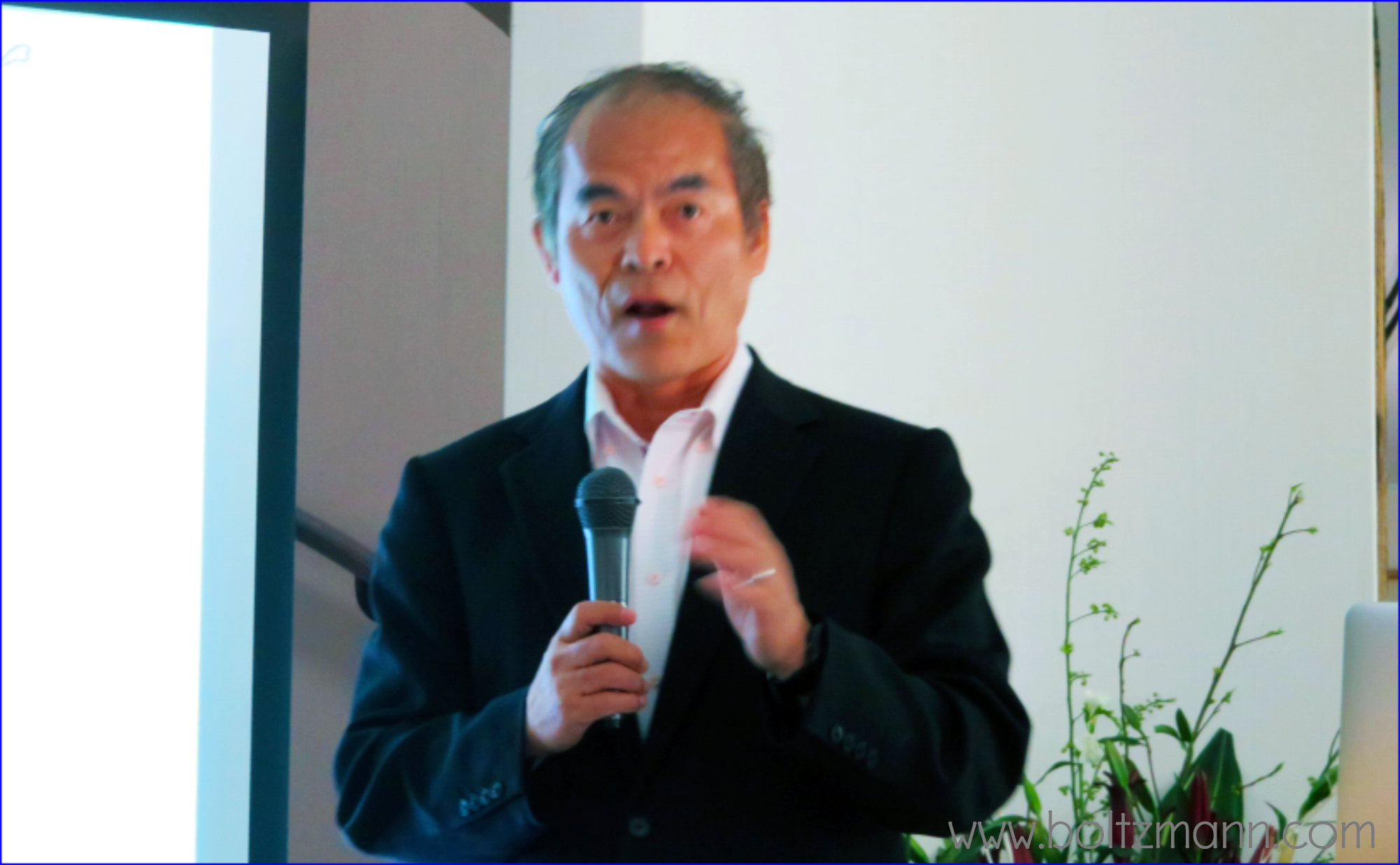
For Shuji Nakamura’s invention of high-efficiency GaN double-heterostructure LEDs he was awarded the Nobel Prize in Physics 2014, while his employer sued him in the USA for leaking intellectual property – Shuji Nakamura won this court case, and his employer lost the case. To defend himself and his family, Shuji Nakamura countersued in Japan, and the Japanese court awarded Shuji a substantial award in a settlement. Shuji shared some insights into the comparison of IP lawsuits in US vs Japan with us at the 8th Ludwig Boltzmann Forum.
Shuji moved to the University of California Santa Barbara, and is now building the company Soraa in Silicon Valley with investments from major US VC funds. Soraa may already be or is likely to be soon much bigger in value than Shuji’s previous Japanese employer. Soraa develops 2nd and 3rd Generation Solid State Lighting products.
Energy savings corresponding to 60 nuclear power stations by 2020
The global lighting revolution triggered by Shuji Nakamura’s inventions leads to energy savings corresponding to 60 nuclear power stations by 2020 – 60 nuclear power stations less will need to be built than without Shuji Nakamura’s inventions.
2nd Generation and 3rd Generation Solid State Lighting
With his venture company Soraa, Shuji is now working on 2nd Generation Solid State Lighting (GaN on GaN substrates) and 3rd Generation Solid State Lighting (laser lighting, which allows much higher light density), and which is already in use for car headlights.
Why squeeze Nobel Prize winner Shuji Nakamura into a top-down narrative?
Shuji Nakamura showed with a long list of newspaper clippings, TV show extracts, and Japanese Government agency announcements that he is being squeezed into a top-down innovation narrative, which is at odds with the findings of the Nobel Prize Committee of the Swedish Academy of Science.
Shuji Nakamura asks why he is being squeezed retrospectively into a top-down innovation narrative.
The truth is that most real innovation is bottom-up and disruptive, not government planned and top-down.
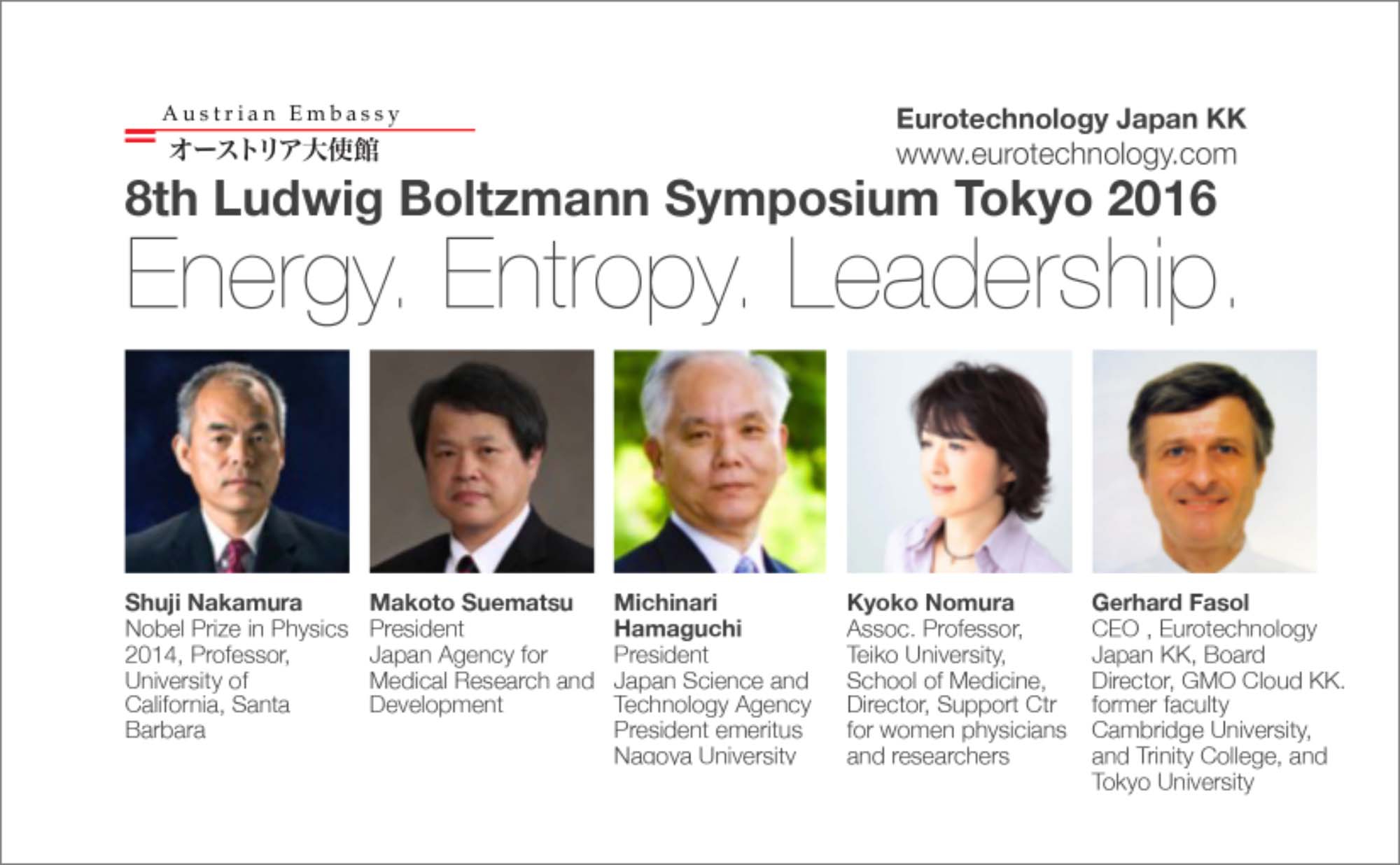
At the 8th Ludwig Boltzmann Forum we had intense discussions between Her Imperial Highness, Princess Takamado, Professor Makoto Suematsu, Nobel Prize Winner Shuji Nakamura, Professor Nomura, JST-President Michinari Hamaguchi, and several other Japanese technology and R&D leaders.
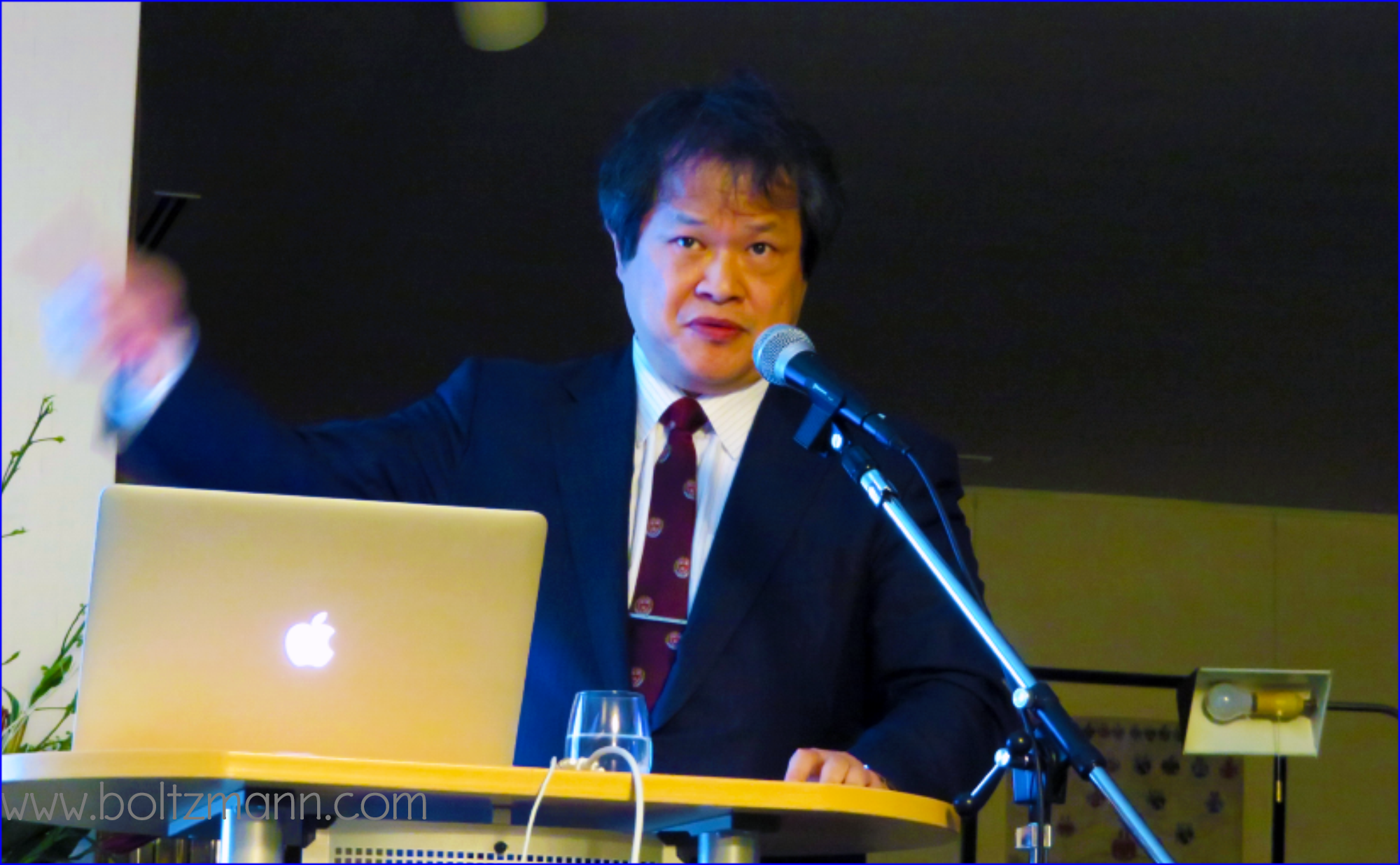
Makoto Suematsu, Founding President of Japan’s new Agency for Medical Research and Development AMED: The situation in Japan is so crazy, but now I will stay in Japan because I have a mission
summary of Professor Makoto Suematsu’s talk by Gerhard Fasol
Medical research in Japan: Fast-tracking medical research and development in Japan
In April 2015 Japan created the new “Japan Agency for Medical Research and Development, AMED” inspired by the US NIH (National Institutes of Health), “to promote integrated research and development in the field of medicine”.
Professor Makoto Suematsu was selected as the founding President of AMED, to build up this new Japanese national medical research agency.
Professor Makoto Suematsu is not only an outstanding medical professional and researcher, but he is also extremely outspoken about the many changes necessary to “fast-track” medical research in Japan, and particularly to overcome the fragmentation, “the Balkanization” of medical research in Japan, due to several different competing and overlapping supervising Government ministries and agencies in the past.
Professor Makoto Suematsu also explained the priorities he is setting to set out with relatively modest resources.
At the 8th Ludwig Boltzmann Forum we had intense discussions between Her Imperial Highness, Princess Takamado, Professor Makoto Suematsu, Nobel Prize Winner Shuji Nakamura, Professor Nomura, JST-President Michinari Hamaguchi, and several other Japanese technology and R&D leaders.
Shuji Nakamura’s invention of high efficiency LEDs enable us to reduce global energy consumption by an amount corresponding to 60 nuclear power stations by 2020, for which he was awarded the 2014 Nobel Prize in Physics.
Still, a poster child for bottom-up innovation, Shuji Nakamura was sued by his employer, left for the USA, and is now building a company in Silicon Valley which might soon become bigger than his former Japanese employer.
Why does Shuji Nakamura’s bottom-up innovation not fit into top-down innovation narratives?
Why does Shuji Nakamura’s bottom-up innovation not fit into top-down innovation narratives? Would Japan be a better and faster growing place with a better balance between bottom-up and top-down innovation? Does top-down innovation work at all?
Shuji Nakamura came specially from the USA to address many of Japan’s science and technology R&D leaders at the 8th Ludwig Boltzmann Forum, and explain why it makes no sense to try squeezing his bottom-up inventions into a top-down narrative and why its better to overcome established top-down narratives.
The 8th Ludwig Boltzmann Forum brought together Nobel Prize Winner Shuji Nakamura, the leaders of Japan’s two major research and technology R&D funding organizations, Professor Nomura, who is working to overcome gender inequality for Japan’s (too few) medical doctors, and several of Japan’s technology leaders to discuss how to accelerate innovation in Japan.
Her Imperial Highness, Princess Takamado honored us by taking a very active part, and asking thoughtful questions to Nobel Winner Shuji Nakamura and other speakers.
5 years and many lessons learnt since the Tohoku and Fukushima disasters
Tohoku disaster and Fukushima nuclear disaster lead to Japan’s energy market liberalization
Tohoku disaster: On Friday March 11, 2011 at 14:46:24, the magnitude 9.0 “Great East Japan earthquake” caused a tsunami, reaching up to 40.4 meters high inland in Tohoku.
Japan’s National Police Agency registers 15,894 deaths and 2,562 missing people.
TEPCO’s Fukushima Dai-1 nuclear power plant vs Tohoku Electric Power Corporation’s Onagawa Nuclear Power Plant
One of the world’s worst nuclear disasters started at Tokyo Electric Power (TEPCO) Fukushima Dai-1 Nuclear Power Plant.
The Onagawa Nuclear Power Plant, owned and operated by Tohoku Electric Power Company, and built under Yanosuke Hirai, was closest to the 2011/3/11 earthquake’s epicenter, and survived the quake without major damage and was successfully shut down, and served as a refuge for 300 people from the neighborhood who had lost their homes. There were radiation alarm signals at Onagawa Power Station, but these alarms were caused by radioactive fallout blown from Fukushima-Dai-Ichi by winds, and did not originate from Onagawa.
The Onagawa Nuclear Power Plant was the only nuclear power plant in the region of the Tohoku Earthquake that survived the earthquake without any major damage.
On Yanosuke Hirai’s insistence, Tohoku Electric Power Company built Onagawa Nuclear Power Plant at 13.8 meters above sea level, while during the construction of TEPCO’s Fukushima Dai-1 plant the natural ground elevation was reduced from 35 meters to 10 meters. The Tsunami reached 13 meters height in both locations.
In 1990 Tohoku Electric Power Company (Onagawa Nuclear Power Station Construction Office) published a detailed analysis of the Great Jogan Tsunami of AD 869
Yanosuke Hirai had researched the Great Jogan Tsunami of July 13, 869, which was caused by the 869 Sanriku Earthquake (貞観地震). The results were taken into account in planning the Onagawa Nuclear Power Station, and published in 1990:
Fukushima nuclear disaster mitigation. US sends 150 nuclear experts headed by Chuck Casto to work with the Japanese Prime Minister and top leaders for 11 months to help deal with the Fukushima disaster
The USA sent a team of about 150 nuclear experts for 11 months to Japan to assist TEPCO and the Japanese Government in mastering the nuclear crisis. This team was headed by Chuck Casto – read some of his conclusions here:
Japan’s Parliament for the first time ever created an Independent Parliamentary Commission to analyze the nuclear disaster, headed by Kiyoshi Kurokawa, read the summary of his talk “Groupthink can kill” here (including videos describing the Commissions results in simple easy to understand terms).
Three former TEPCO executives have now been indicted by a citizen’s prosecution committee.
Nuclear disaster leads to energy market liberalization in Japan
Japan’s faith in nuclear power was shaken, leading to development of renewable energy, liberalization and long overdue reforms of Japan’s energy sector.
Quakes and after-quakes
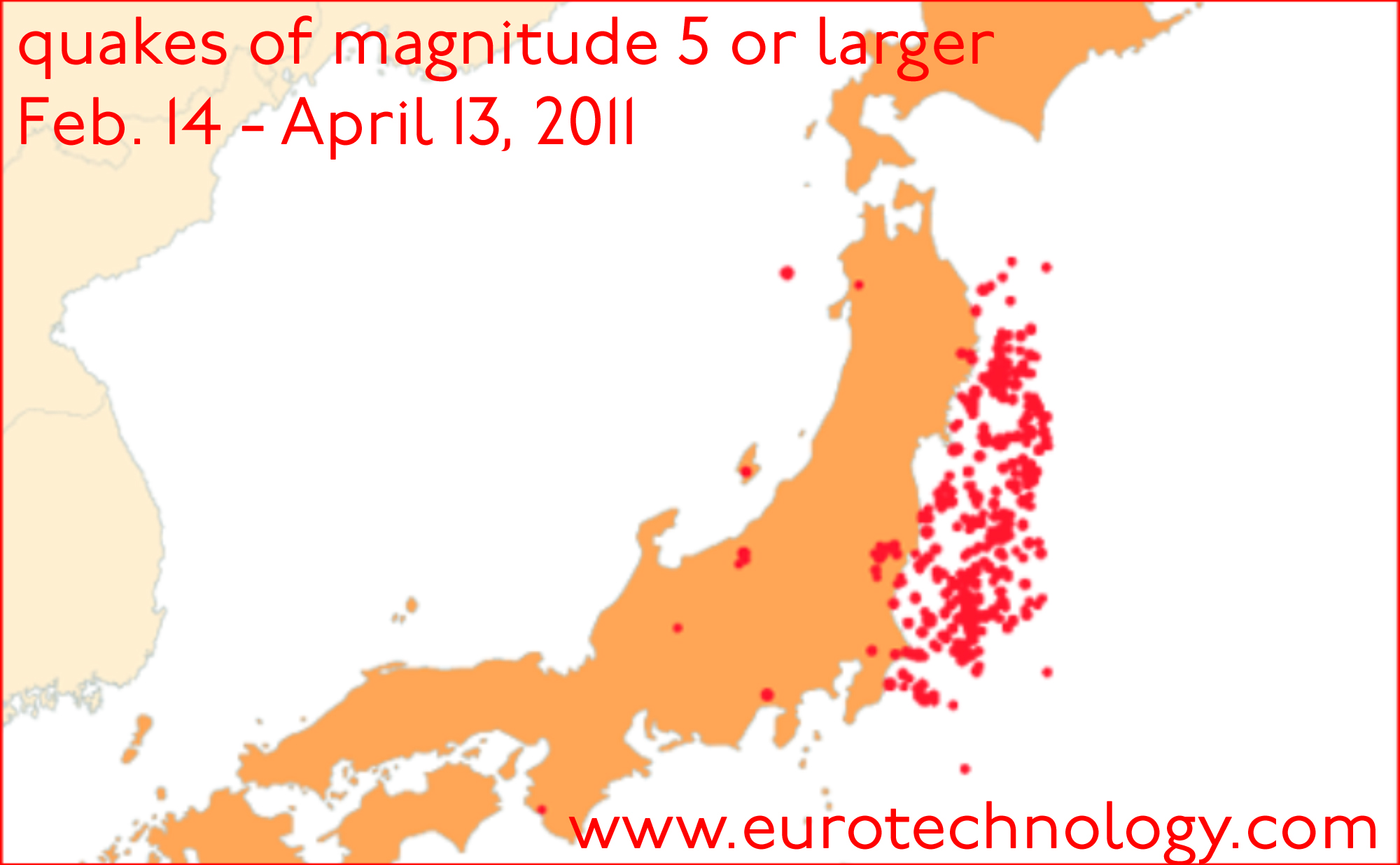
The figures show that more than 300 earthquakes of magnitude 5 or larger occurred since the major quake on March 11, 2011 at 14:46. The epicenters of quakes lie mostly where the Pacific Plate moves under the North American Plate on which Tohoku lies.
According to our knowledge earth quakes are mathematically speaking a “chaotic” phenomenon, and scientific arguments are, that it is difficult if not impossible to predict earth quakes with precision. (Figure: Wolfram Alpha LLC)
Earth quakes of magnitude 5 and greater in Japan (March-April 2011) (Figure: Wolfram Alpha LLC)Earth quakes of magnitude 5 and greater in Japan (March-April 2011) on logarithmic magnitude scale (Figure: Wolfram Alpha LLC)
Nuclear fallout on Tokyo: radiation levels in Tokyo/Shinjuku
Starting with Tuesday 15 March 2011, radioactive fallout came down on Tokyo as shown in the figures below.
Radiation in Tokyo/Shinjuku (until April 13, 2011) compared to Austria
Radiation levels in Tokyo (Shinjuku and Shibuya) and Tsukuba:
Radiation in Tsukuba (until April 13, 2011) compared to Austria
The blue curve above shows the radiation levels in Tokyo/Shinjuku as measured and published by the Tokyo Metropolitan Institute for Public Health here:
each hour for the last 24 hours
daily starting March 1
The red curves show maximum and minimum data as measured by TEPCO in Tokyo-Shibuya, and published here: TEPCO radiation data
The green curves show radiation data measured by Japan’s highly respected AIST Laboratory in Tsukuba (Ibaraki-ken, about 60 km north of Tokyo in direction of Fukushima) and published here: AIST radiation data.
Radiation levels in Tsukuba
The green curves show radiation data measured by AIST Laboratory in Tsukuba (Ibaraki-ken, about 60 km north of Tokyo in direction of Fukushima) and published here: AIST radiation data.
The radiation measurement results in Tsukuba are considerably higher than found in Tokyo, but have decreased close to the top levels found naturally in Austria and in many other countries.
The differences in the data between Tokyo and Tsukuba could be because Tsukuba is 60km closer to Fukushima, could be caused by weather conditions, but they could also be caused by differences in the measurement equipment or a combination of these factors.
Eurotechnology-Japan newsletters in March/April 2011
In a series of newsletters, our company informed our customers, and friends about the nuclear disaster impact on Tokyo. Our newsletters were reposted by our readers to 100s of friends, and in some cases influenced the decisions by foreign subsidiaries here in Tokyo. In the days following the nuclear disaster, it was difficult for non-phycists to understand the true situation, and what the radioactive fallout really meant.